第37章内分泌系
37.1 Types of Hormones37.1 ホルモンの種類
Learning Objectives学習目標
By the end of this section, you will be able to do the following:
この節を学び終えると、次のことができるようになる。
- List the different types of hormonesホルモンの種類を挙げる。
- Explain their role in maintaining homeostasis恒常性の維持におけるホルモンの役割を説明する。
Maintaining homeostasis within the body requires the coordination of many different systems and organs. Communication between neighboring cells, and between cells and tissues in distant parts of the body, occurs through the release of chemicals called hormones. Hormones are released into body fluids (usually blood) that carry these chemicals to their target cells. At the target cells, which are cells that have a receptor for a signal or ligand from a signal cell, the hormones elicit a response. The cells, tissues, and organs that secrete hormones make up the endocrine system. Examples of glands of the endocrine system include the adrenal glands, which produce hormones such as epinephrine and norepinephrine that regulate responses to stress, and the thyroid gland, which produces thyroid hormones that regulate metabolic rates.
英語のヒント
体内の恒常性を保つには、さまざまな系と器官の協調が必要である。隣り合う細胞同士も、体の離れた部分にある細胞や組織同士も、ホルモンという化学物質の放出によって情報をやり取りする。ホルモンは体液、通常は血液に放出され、標的細胞へ運ばれる。標的細胞は、信号を送る細胞の信号物質、すなわちリガンドに対する受容体をもち、ホルモンはそこで応答を引き起こす。ホルモンを分泌する細胞、組織、器官が内分泌系をなす。内分泌腺の例には副腎と甲状腺がある。副腎はストレス応答を調節するアドレナリンやノルアドレナリンを、甲状腺は代謝率を調節する甲状腺ホルモンをつくる。
Although there are many different hormones in the human body, they can be divided into three classes based on their chemical structure: lipid-derived, amino acid-derived, and peptide (peptide and proteins) hormones. One of the key distinguishing features of lipid-derived hormones is that they can diffuse across plasma membranes whereas the amino acid-derived and peptide hormones cannot.
英語のヒント
ヒトの体には多くのホルモンがあるが、化学構造に基づいて、脂質由来、アミノ酸由来、ペプチド(ペプチドおよびタンパク質)という三つに分けられる。脂質由来ホルモンの重要な特徴は、細胞膜を拡散して通過できることである。アミノ酸由来ホルモンとペプチドホルモンは通過できない。
Lipid-Derived Hormones (or Lipid-soluble Hormones)脂質由来ホルモン(脂溶性ホルモン)
Most lipid hormones are derived from cholesterol and thus are structurally similar to it, as illustrated in Figure 37.2. The primary class of lipid hormones in humans is the steroid hormones. Chemically, these hormones are usually ketones or alcohols; their chemical names will end in “-ol” for alcohols or “-one” for ketones. Examples of steroid hormones include estrogens (such as estradiol) and androgens (such as testosterone), both of which regulate bone and tissue development in all humans.
英語のヒント
脂質ホルモンの大部分はコレステロールに由来し、そのため構造が似ている(図37.2)。ヒトの主な脂質ホルモンはステロイドホルモンである。化学的には通常、ケトンまたはアルコールであり、名称の末尾はアルコールなら「-ol」、ケトンなら「-one」となる。例には、エストラジオールなどのエストロゲンと、テストステロンなどのアンドロゲンがある。どちらも、すべてのヒトで骨や組織の発達を調節する。
Gonadal hormones, produced by the gonads, include both steroid and peptide hormones. Androgens and estrogens resemble one another in chemical structure and originate from the same molecule. Estrogens are chief drivers of sexual development in an ovarian reproductive system, while androgens drive development in a testicular reproductive system. The ovaries produce steroid hormones such as estradiol and progesterone. When androgens are produced, some of them are later converted to estrogens. Minute amounts of estrogen occur through aromatase actions in adipose, brain, skin, and bone, which convert testosterone to estrogen. The testes and the adrenal cortex both secrete testosterone.
英語のヒント
生殖腺がつくる生殖腺ホルモンには、ステロイドホルモンとペプチドホルモンの両方がある。アンドロゲンとエストロゲンは化学構造が似ており、同じ分子から生じる。エストロゲンは卵巣をもつ生殖系の性発達を主に促し、アンドロゲンは精巣をもつ生殖系の発達を促す。卵巣はエストラジオールやプロゲステロンなどのステロイドホルモンを産生する。つくられたアンドロゲンの一部は、後にエストロゲンへ変換される。脂肪組織、脳、皮膚、骨では、アロマターゼの作用によってテストステロンがエストロゲンに変わり、微量のエストロゲンが生じる。精巣と副腎皮質は、どちらもテストステロンを分泌する。
Other steroid hormones include aldosterone and cortisol, which are released by the adrenal glands along with some other types of androgens. Steroid hormones are insoluble in water, and they are transported by transport proteins in blood. As a result, they remain in circulation longer than peptide hormones. For example, cortisol has a half-life of 60 to 90 minutes, while epinephrine, an amino acid derived-hormone, has a half-life of approximately one minute.
英語のヒント
ほかのステロイドホルモンにはアルドステロンとコルチゾールがあり、副腎から、ほかの種類のアンドロゲンとともに放出される。ステロイドホルモンは水に溶けず、血中では輸送タンパク質によって運ばれる。そのためペプチドホルモンより長く循環中にとどまる。たとえばコルチゾールの半減期は60~90分だが、アミノ酸由来ホルモンであるアドレナリンの半減期は約1分である。
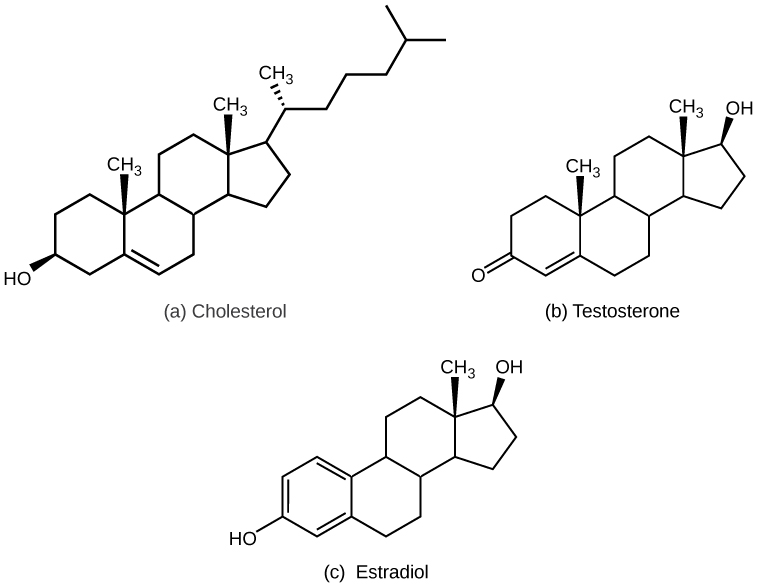
Figure 37.2図 37.2
The structures shown here represent (a) cholesterol, plus the steroid hormones (b) testosterone and (c) estradiol.
(a)コレステロールと、ステロイドホルモンである(b)テストステロン、(c)エストラジオールの構造。
Amino Acid-Derived Hormonesアミノ酸由来ホルモン
The amino acid-derived hormones are relatively small molecules that are derived from the amino acids tyrosine and tryptophan, shown in Figure 37.3. If a hormone is amino acid-derived, its chemical name will end in “-ine”. Examples of amino acid-derived hormones include epinephrine and norepinephrine, which are synthesized in the medulla of the adrenal glands, and thyroxine, which is produced by the thyroid gland. The pineal gland in the brain makes and secretes melatonin which regulates sleep cycles.
アミノ酸由来ホルモンは、図37.3のチロシンとトリプトファンから生じる比較的小さな分子である。化学名の末尾は「-ine」となる。例には、副腎髄質で合成されるアドレナリンとノルアドレナリン、甲状腺でつくられるチロキシンがある。脳の松果体は、睡眠周期を調節するメラトニンを産生・分泌する。
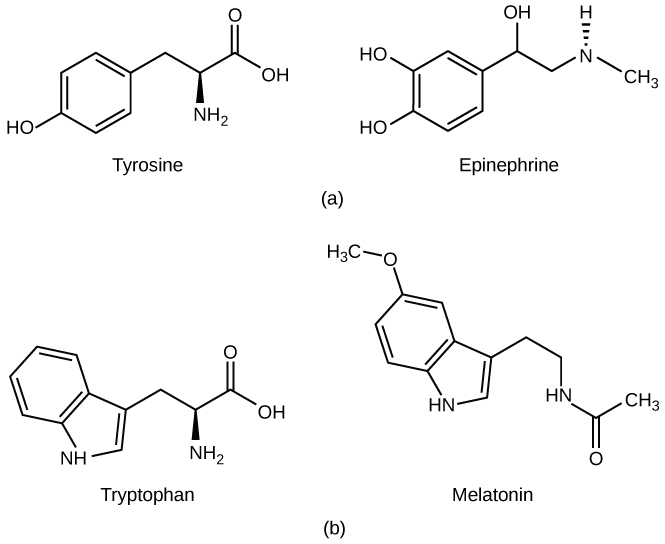
Figure 37.3図 37.3
(a) The hormone epinephrine, which triggers the fight-or-flight response, is derived from the amino acid tyrosine. (b) The hormone melatonin, which regulates circadian rhythms, is derived from the amino acid tryptophan.
(a)闘争・逃走反応を引き起こすアドレナリンは、アミノ酸のチロシンに由来する。(b)概日リズムを調節するメラトニンは、アミノ酸のトリプトファンに由来する。
Peptide Hormonesペプチドホルモン
The structure of peptide hormones is that of a polypeptide chain (chain of amino acids). The peptide hormones include molecules that are short polypeptide chains, such as antidiuretic hormone and oxytocin produced in the brain and released into the blood in the posterior pituitary gland. This class also includes small proteins, like growth hormones produced by the pituitary, and large glycoproteins such as follicle-stimulating hormone produced by the pituitary. Figure 37.4 illustrates these peptide hormones.
ペプチドホルモンは、アミノ酸の鎖であるポリペプチド鎖の構造をもつ。短い鎖のものには、脳でつくられ、下垂体後葉から血中に放出される抗利尿ホルモンとオキシトシンがある。この分類には、下垂体がつくる成長ホルモンのような小さなタンパク質や、同じく下垂体がつくる卵胞刺激ホルモンのような大きな糖タンパク質も含まれる。図37.4にこれらを示す。
Secreted peptides like insulin are stored within vesicles in the cells that synthesize them. They are then released in response to stimuli such as high blood glucose levels in the case of insulin. Amino acid-derived and polypeptide hormones are water-soluble and insoluble in lipids. These hormones cannot pass through plasma membranes of cells; therefore, their receptors are found on the surface of the target cells.
インスリンなどの分泌ペプチドは、合成する細胞の小胞内に貯蔵される。その後、インスリンなら血糖値の上昇といった刺激に応じて放出される。アミノ酸由来ホルモンとポリペプチドホルモンは水に溶け、脂質には溶けない。細胞膜を通過できないため、その受容体は標的細胞の表面にある。
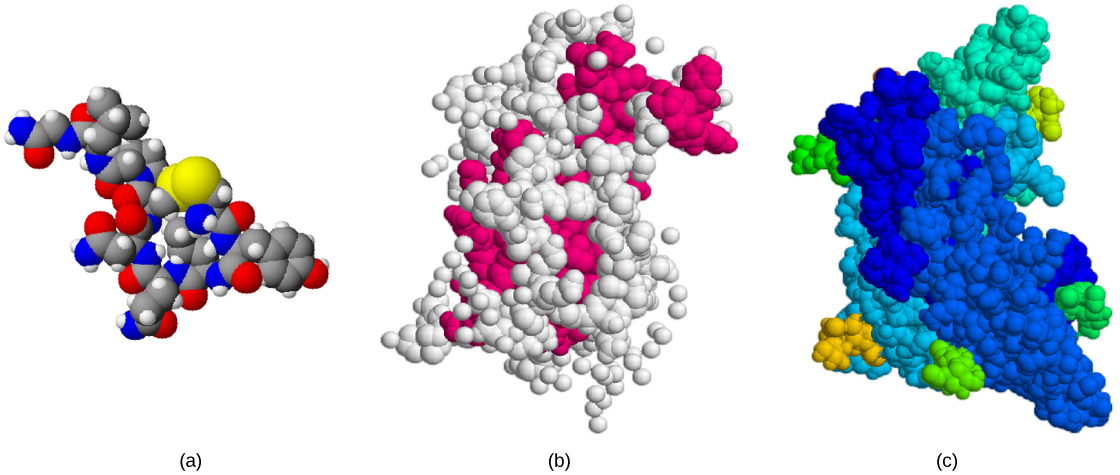


Figure 37.4図 37.4
The structures of peptide hormones (a) oxytocin, (b) growth hormone, and (c) follicle-stimulating hormone are shown. These peptide hormones are much larger than those derived from cholesterol or amino acids.
ペプチドホルモンである(a)オキシトシン、(b)成長ホルモン、(c)卵胞刺激ホルモンの構造。これらは、コレステロールやアミノ酸に由来するホルモンよりはるかに大きい。