第37章内分泌系
Plasma Membrane Hormone Receptors細胞膜のホルモン受容体
Amino acid-derived hormones (with the exception of thyroxine) and polypeptide hormones are not lipid-derived (lipid-soluble) and therefore cannot diffuse through the plasma membrane of cells. Lipid insoluble hormones bind to receptors on the outer surface of the plasma membrane, via plasma membrane hormone receptors. Unlike steroid hormones, lipid insoluble hormones do not directly affect the target cell because they cannot enter the cell and act directly on DNA. Binding of these hormones to a cell surface receptor results in activation of a signaling pathway; this triggers intracellular activity and carries out the specific effects associated with the hormone. In this way, nothing passes through the cell membrane; the hormone that binds at the surface remains at the surface of the cell while the intracellular product remains inside the cell. The hormone that initiates the signaling pathway is called a first messenger, which activates a second messenger in the cytoplasm, as illustrated in Figure 37.6.
チロキシンを除くアミノ酸由来ホルモンと、ポリペプチドホルモンは、脂質由来の脂溶性物質ではない。そのため細胞膜を拡散して通過できず、細胞膜の外表面にあるホルモン受容体に結合する。脂質に溶けないホルモンは、ステロイドホルモンと違って細胞内へ入りDNAに直接作用できないので、標的細胞へ直接は作用しない。細胞表面の受容体への結合が信号伝達経路を活性化し、細胞内の活動を引き起こして、そのホルモン特有の作用を実現する。この仕組みでは、何も細胞膜を通過しない。表面に結合するホルモンは表面にとどまり、細胞内でできる産物は内部にとどまる。図37.6のように、経路を開始するホルモンを第一メッセンジャーといい、細胞質の第二メッセンジャーを活性化する。
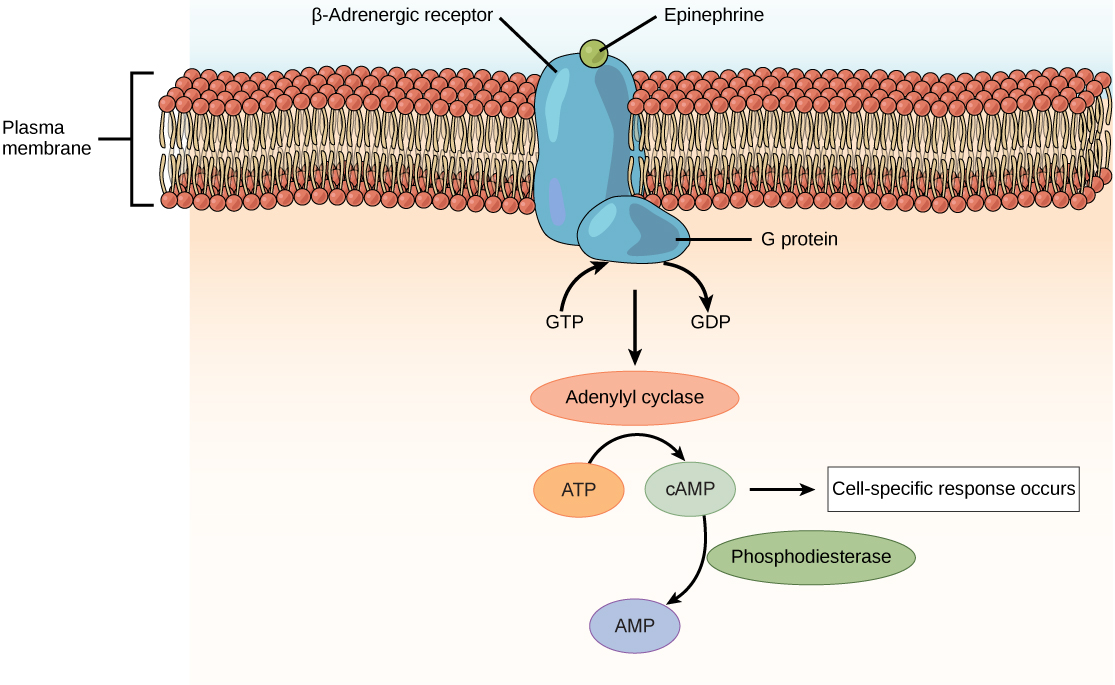

Figure 37.6図 37.6
The amino acid-derived hormones epinephrine and norepinephrine bind to beta-adrenergic receptors on the plasma membrane of cells. Hormone binding to receptor activates a G-protein, which in turn activates adenylyl cyclase, converting ATP to cAMP. cAMP is a second messenger that mediates a cell-specific response. An enzyme called phosphodiesterase breaks down cAMP, terminating the signal.
アミノ酸由来ホルモンのアドレナリンとノルアドレナリンは、細胞膜上のβアドレナリン受容体に結合する。ホルモンの結合がGタンパク質を活性化し、続いてアデニル酸シクラーゼを活性化して、ATPをcAMPへ変換する。cAMPは細胞特有の応答を仲介する第二メッセンジャーである。ホスホジエステラーゼという酵素がcAMPを分解し、信号を終わらせる。
One very important second messenger is cyclic AMP (cAMP). When a hormone binds to its membrane receptor, a G-protein that is associated with the receptor is activated; G-proteins are proteins separate from receptors that are found in the cell membrane. When a hormone is not bound to the receptor, the G-protein is inactive and is bound to guanosine diphosphate, or GDP. When a hormone binds to the receptor, the G-protein is activated by binding guanosine triphosphate, or GTP, in place of GDP. After binding, GTP is hydrolysed by the G-protein into GDP and becomes inactive.
英語のヒント
特に重要な第二メッセンジャーの一つが、環状AMP(cAMP)である。ホルモンが膜受容体に結合すると、受容体につながるGタンパク質が活性化する。Gタンパク質は、細胞膜にある受容体とは別個のタンパク質である。ホルモンが受容体に結合していないとき、Gタンパク質は不活性で、グアノシン二リン酸(GDP)に結合している。ホルモンが結合すると、GDPに代わってグアノシン三リン酸(GTP)が結合し、活性化する。結合後、GTPはGタンパク質によってGDPへ加水分解され、不活性になる。
The activated G-protein in turn activates a membrane-bound enzyme called adenylyl cyclase. Adenylyl cyclase catalyzes the conversion of ATP to cAMP. cAMP, in turn, activates a group of proteins called protein kinases, which transfer a phosphate group from ATP to a substrate molecule in a process called phosphorylation. The phosphorylation of a substrate molecule changes its structural orientation, thereby activating it. These activated molecules can then mediate changes in cellular processes.
英語のヒント
活性化したGタンパク質は、膜結合酵素のアデニル酸シクラーゼを活性化する。この酵素はATPからcAMPへの変換を触媒する。cAMPはさらに、プロテインキナーゼというタンパク質群を活性化する。プロテインキナーゼは、リン酸化という過程で、ATPのリン酸基を基質分子へ移す。基質分子のリン酸化は、その構造的な向きを変え、活性化する。活性化された分子が、細胞内の過程の変化を仲介する。
The effect of a hormone is amplified as the signaling pathway progresses. The binding of a hormone at a single receptor causes the activation of many G-proteins, which activates adenylyl cyclase. Each molecule of adenylyl cyclase then triggers the formation of many molecules of cAMP. Further amplification occurs as protein kinases, once activated by cAMP, can catalyze many reactions. In this way, a small amount of hormone can trigger the formation of a large amount of cellular product. To stop hormone activity, cAMP is deactivated by the cytoplasmic enzyme phosphodiesterase, or PDE. PDE is always present in the cell and breaks down cAMP to control hormone activity, preventing overproduction of cellular products.
英語のヒント
信号伝達経路が進むにつれ、ホルモンの作用は増幅される。一つの受容体へのホルモンの結合が、多数のGタンパク質を活性化し、アデニル酸シクラーゼの活性化を引き起こす。この酵素の各分子は、多数のcAMP分子を生じさせる。cAMPで活性化されたプロテインキナーゼも多くの反応を触媒できるため、さらに増幅される。このように、少量のホルモンが大量の細胞産物の形成を引き起こす。ホルモンの作用を止めるときは、細胞質のホスホジエステラーゼ(PDE)がcAMPを不活性化する。PDEは常に細胞内にあり、cAMPを分解してホルモンの作用を制御し、細胞産物のつくりすぎを防ぐ。
The specific response of a cell to a lipid insoluble hormone depends on the type of receptors that are present on the cell membrane and the substrate molecules present in the cell cytoplasm. Cellular responses to hormone binding of a receptor include altering membrane permeability and metabolic pathways, stimulating synthesis of proteins and enzymes, and activating hormone release.
英語のヒント
脂質に溶けないホルモンへの細胞の特有の応答は、細胞膜の受容体の種類と、細胞質に存在する基質分子によって決まる。受容体へのホルモン結合に対する応答には、膜透過性や代謝経路の変化、タンパク質や酵素の合成促進、ホルモン放出の活性化などがある。
Section Summary節のまとめ
Hormones cause cellular changes by binding to receptors on target cells. The number of receptors on a target cell can increase or decrease in response to hormone activity. Hormones can affect cells directly through intracellular hormone receptors or indirectly through plasma membrane hormone receptors.
ホルモンは、標的細胞の受容体に結合して細胞の変化を起こす。受容体の数は、ホルモンの活動に応じて増減する。細胞内ホルモン受容体を介して直接作用する場合と、細胞膜受容体を介して間接的に作用する場合がある。
Lipid-derived (soluble) hormones can enter the cell by diffusing across the plasma membrane and binding to DNA to regulate gene transcription and to change the cell’s activities by inducing production of proteins that affect, in general, the long-term structure and function of the cell. Lipid insoluble hormones bind to receptors on the plasma membrane surface and trigger a signaling pathway to change the cell’s activities by inducing production of various cell products that affect the cell in the short-term. The hormone is called a first messenger and the cellular component is called a second messenger. G-proteins activate the second messenger (cyclic AMP), triggering the cellular response. Response to hormone binding is amplified as the signaling pathway progresses. Cellular responses to hormones include the production of proteins and enzymes and altered membrane permeability.
脂質由来の脂溶性ホルモンは細胞膜を拡散して通過し、DNAに結合して遺伝子転写を調節する。一般に細胞の長期的な構造と機能に作用するタンパク質の産生を誘導し、活動を変える。脂質に溶けないホルモンは細胞膜表面の受容体に結合し、信号伝達経路を始める。短期的に作用するさまざまな細胞産物の産生を誘導し、活動を変える。ホルモンを第一メッセンジャー、細胞側の成分を第二メッセンジャーという。Gタンパク質が第二メッセンジャーの環状AMPを活性化し、細胞応答を引き起こす。ホルモン結合への応答は、経路が進むにつれて増幅される。応答には、タンパク質や酵素の産生、膜透過性の変化などがある。