第4章細胞の構造
4.6 Connections between Cells and Cellular Activities4.6 細胞間のつながりと細胞の活動
Learning Objectives学習目標
By the end of this section, you will be able to do the following:
この節を学ぶと、次のことができるようになる。
- Describe the extracellular matrix細胞外マトリックスを説明する。
- List examples of the ways that plant cells and animal cells communicate with adjacent cells植物細胞と動物細胞が隣の細胞と情報をやり取りする方法の例を挙げる。
- Summarize the roles of tight junctions, desmosomes, gap junctions, and plasmodesmata密着結合、デスモソーム、ギャップ結合、原形質連絡の役割を要約する。
You already know that tissue is a group of similar cells working together. As you might expect, if cells are to work together, they must communicate with each other, just as you need to communicate with others if you work on a group project. Let’s take a look at how cells communicate with each other.
英語のヒント
組織とは、似た細胞が協力して働く集まりであることは、すでに学んだ。予想できるように、細胞が協力して働くには互いに情報をやり取りする必要がある。グループで課題に取り組むときに、ほかの人と意思疎通する必要があるのと同じである。細胞がどのように情報をやり取りするのか見ていこう。
Extracellular Matrix of Animal Cells動物細胞の細胞外マトリックス
While cells in most multicellular organisms release materials into the extracellular space, animal cells will be discussed as an example. The primary components of these materials are proteins, and the most abundant protein is collagen. Collagen fibers are interwoven with proteoglycans, which are carbohydrate-containing protein molecules. Collectively, we call these materials the extracellular matrix (Figure 4.27). Not only does the extracellular matrix hold the cells together to form a tissue, but it also allows the cells within the tissue to communicate with each other. How can this happen?
英語のヒント
ほとんどの多細胞生物の細胞は細胞外空間に物質を放出するが、ここでは動物細胞を例に取り上げる。これらの物質の主成分はタンパク質で、最も豊富なのはコラーゲンである。コラーゲン繊維は、糖質を含むタンパク質分子であるプロテオグリカンと織り合わされている。これらの物質をまとめて細胞外マトリックスという(図4.27)。細胞外マトリックスは、細胞どうしをつなぎ留めて組織を作るだけでなく、組織内の細胞が互いに情報をやり取りできるようにもする。これは、どのように起こるのだろうか。
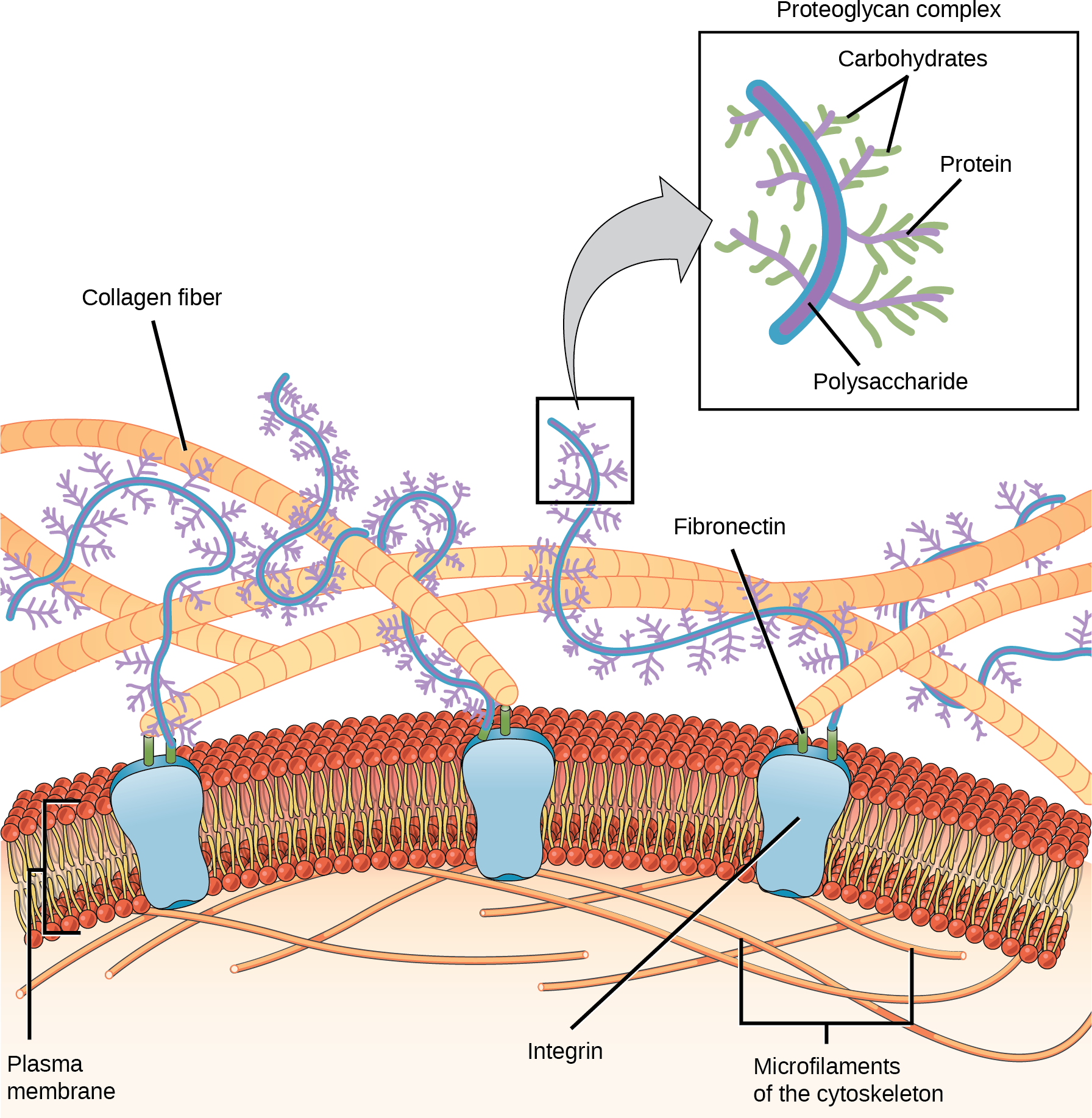
Figure 4.27図 4.27
The extracellular matrix consists of a network of proteins and carbohydrates.
細胞外マトリックスは、タンパク質と糖質の網目からなる。
Cells have protein receptors on their plasma membranes' extracellular surfaces. When a molecule within the matrix binds to the receptor, it changes the receptor's molecular structure. The receptor, in turn, changes the microfilaments' conformation positioned just inside the plasma membrane. These conformational changes induce chemical signals inside the cell that reach the nucleus and turn “on” or “off” the transcription of specific DNA sections, which affects the associated protein production, thus changing the activities within the cell.
英語のヒント
細胞膜の細胞外側の表面には、タンパク質受容体がある。マトリックス中の分子が受容体に結合すると、受容体の分子構造が変わる。次に受容体は、細胞膜のすぐ内側にあるマイクロフィラメントの立体構造を変える。この立体構造の変化が細胞内に化学的なシグナルを生じさせ、それが核に達し、特定のDNA領域の転写を「オン」または「オフ」にする。すると、関連するタンパク質の産生に影響が及び、細胞内の活動が変わる。
Blood clotting provides an example of the extracellular matrix's role in cell communication. When the cells lining a blood vessel are damaged, they display a protein receptor, which we call tissue factor. When tissue factor binds with another factor in the extracellular matrix, it causes platelets to adhere to the damaged blood vessel's wall, stimulates the adjacent smooth muscle cells in the blood vessel to contract (thus constricting the blood vessel), and initiates a series of steps that stimulate the platelets to produce clotting factors.
英語のヒント
血液凝固は、細胞間の情報伝達における細胞外マトリックスの役割を示す例である。血管の内面を覆う細胞が傷つくと、組織因子と呼ばれるタンパク質受容体を提示する。組織因子が細胞外マトリックス中の別の因子に結合すると、血小板が傷ついた血管壁に付着する。また、血管内の隣接する平滑筋細胞を刺激して収縮させ、血管を狭めるとともに、血小板に凝固因子の産生を促す一連の過程を開始する。
Intercellular Junctions細胞間結合
Cells can also communicate with each other via direct contact, or intercellular junctions. There are differences in the ways that plant and animal and fungal cells communicate. Plasmodesmata are junctions between plant cells; whereas, animal cell contacts include tight junctions, gap junctions, and desmosomes.
英語のヒント
細胞は、直接接触すること、すなわち細胞間結合を介しても情報をやり取りできる。植物、動物、菌類の細胞では、その方法に違いがある。原形質連絡は植物細胞どうしの結合である。一方、動物細胞の接触には、密着結合、ギャップ結合、デスモソームがある。
Plasmodesmata原形質連絡
In general, long stretches of the plasma membranes of neighboring plant cells cannot touch one another because the cell wall that surrounds each cell separates them (Figure 4.8). How then, can a plant transfer water and other soil nutrients from its roots, through its stems, and to its leaves? Such transport uses the vascular tissues (xylem and phloem) primarily. There also exist structural modifications, which we call plasmodesmata (singular = plasmodesma). Numerous channels that pass between adjacent plant cells' cell walls connect their cytoplasm, and enable transport of materials from cell to cell, and thus throughout the plant (Figure 4.28).
英語のヒント
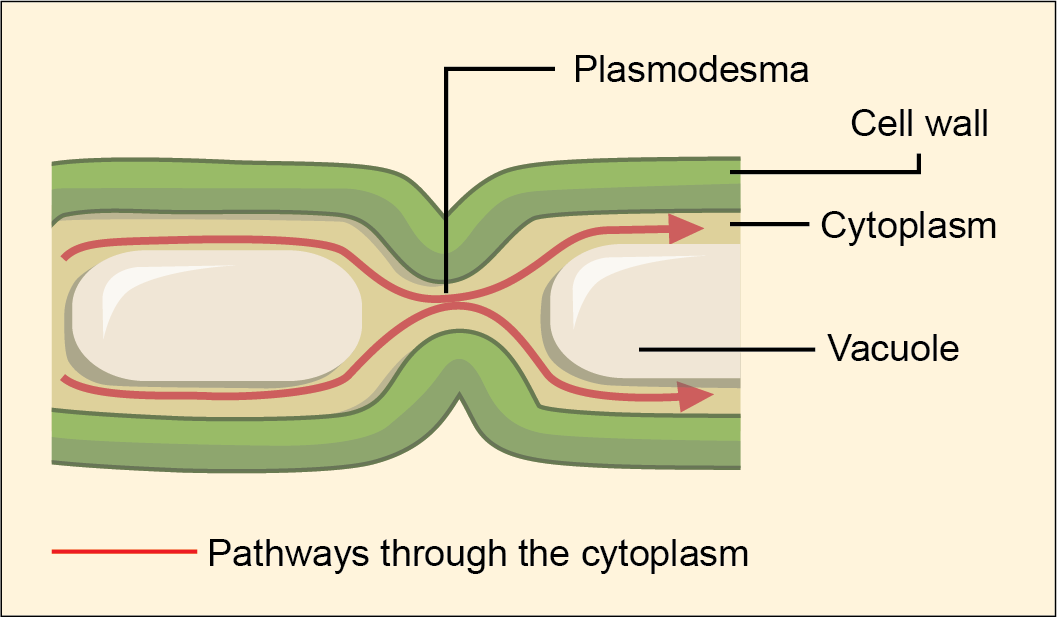


Figure 4.28図 4.28
A plasmodesma is a channel between two adjacent plant cells' cell walls. Plasmodesmata allow materials to pass from one plant cell's cytoplasm to an adjacent cell's cytoplasm.
原形質連絡は、隣り合う二つの植物細胞の細胞壁を通る通路である。一方の植物細胞の細胞質から、隣の細胞の細胞質へ物質を通す。
Tight Junctions密着結合
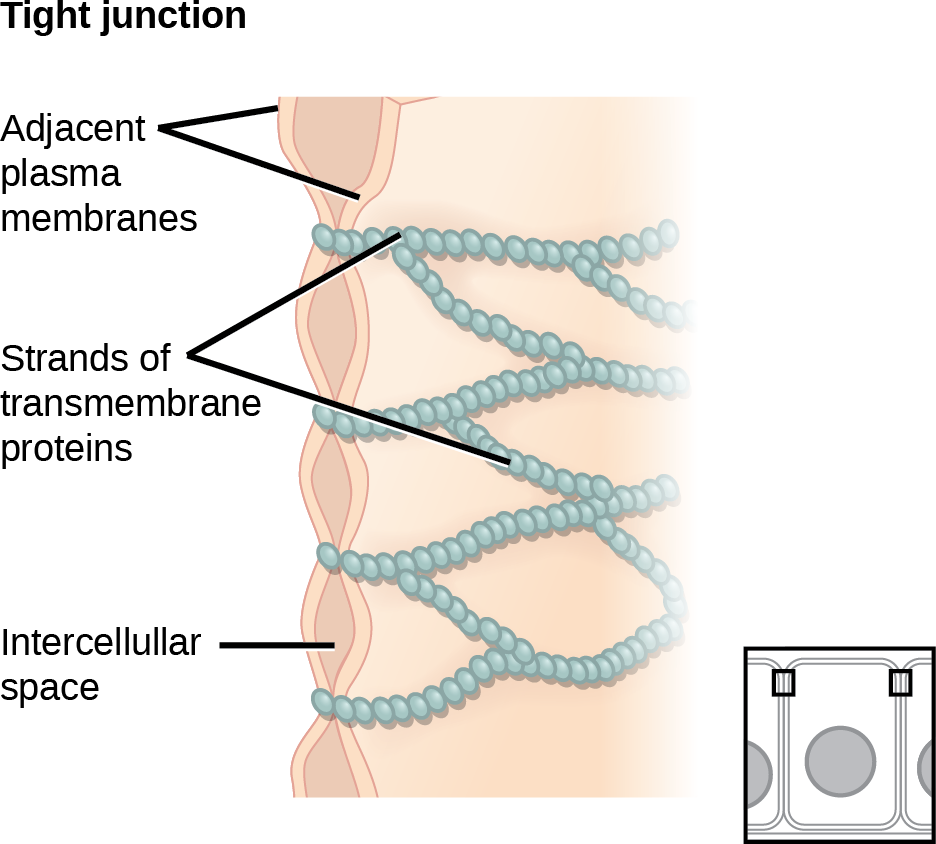
A tight junction is a watertight seal between two adjacent animal cells (Figure 4.29). Proteins (predominantly two proteins called claudins and occludins) tightly hold the cells against each other.
英語のヒント
密着結合は、隣り合う二つの動物細胞の間を水が漏れないように封じる構造である(図4.29)。主にクローディンとオクルディンという二つのタンパク質が、細胞どうしをぴったり保持する。
OpenStax, Rice University; Biology 2e. (credit: modification of work by Mariana Ruiz Villareal) · CC BY 4.0 · Source出典

Figure 4.29図 4.29
Tight junctions form watertight connections between adjacent animal cells. Proteins create tight junction adherence. (credit: modification of work by Mariana Ruiz Villareal)
密着結合は、隣り合う動物細胞の間に水を通さないつながりを作る。密着結合の接着は、タンパク質によって作られる。(クレジット:Mariana Ruiz Villarealの作品を改変)
This tight adherence prevents materials from leaking between the cells; tight junctions are typically found in epithelial tissues that line internal organs and cavities, and comprise most of the skin. For example, the tight junctions of the epithelial cells lining your urinary bladder prevent urine from leaking out into the extracellular space.
英語のヒント
この強い接着により、細胞間から物質が漏れるのを防ぐ。密着結合は通常、内臓や体内の空洞の内面を覆い、皮膚の大部分を構成する上皮組織に見られる。例えば、膀胱の内面を覆う上皮細胞の密着結合は、尿が細胞外空間へ漏れ出すのを防いでいる。