第4章細胞の構造
Flagella and Cilia鞭毛と繊毛
The flagella (singular = flagellum) are long, hair-like structures that extend from the plasma membrane and enable an entire cell to move (for example, sperm, Euglena, and some prokaryotes). When present, the cell has just one flagellum or a few flagella. However, when cilia (singular = cilium) are present, many of them extend along the plasma membrane's entire surface. They are short, hair-like structures that move entire cells (such as paramecia) or substances along the cell's outer surface (for example, the cilia of cells lining the Fallopian tubes that move the ovum toward the uterus, or cilia lining the cells of the respiratory tract that trap particulate matter and move it toward your nostrils.)
英語のヒント
鞭毛(複数形flagella、単数形flagellum)は、細胞膜から伸びる長い毛状の構造で、細胞全体の移動を可能にする。例えば、精子、ミドリムシ、一部の原核生物に見られる。鞭毛がある場合、細胞がもつのは1本または少数である。一方、繊毛(複数形cilia、単数形cilium)がある場合は、細胞膜の表面全体に多数が伸びている。繊毛は短い毛状の構造で、ゾウリムシのように細胞全体を動かしたり、細胞の外表面に沿って物質を動かしたりする。例えば、卵管内面の細胞の繊毛は卵子を子宮へ運び、気道内面の細胞の繊毛は粒子状物質を捕らえて鼻孔へ動かす。
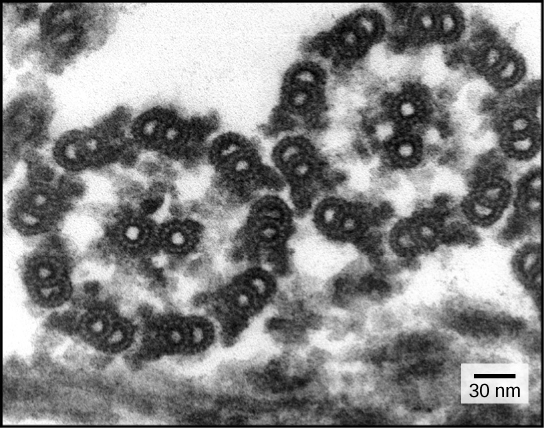
Despite their differences in length and number, flagella and cilia share a common structural arrangement of microtubules called a “9 + 2 array.” This is an appropriate name because a single flagellum or cilium is made of a ring of nine microtubule doublets, surrounding a single microtubule doublet in the center (Figure 4.26).
英語のヒント
長さや数には違いがあるものの、鞭毛と繊毛は「9+2配列」という共通の微小管配置をもつ。この名は適切である。1本の鞭毛や繊毛は、中央の1組の微小管二連構造を囲んで、9組の微小管二連構造が輪状に並んでいるからである(図4.26)。
OpenStax, Rice University; Biology 2e. (credit: modification of work by Dartmouth Electron Microscope Facility, Dartmouth College; scale-bar data from Matt Russell) · CC BY 4.0 · Source出典

Figure 4.26図 4.26
This transmission electron micrograph of two flagella shows the microtubules' 9 + 2 array: nine microtubule doublets surround a single microtubule doublet. (credit: modification of work by Dartmouth Electron Microscope Facility, Dartmouth College; scale-bar data from Matt Russell)
2本の鞭毛の透過電子顕微鏡写真に、微小管の9+2配列が見える。9組の微小管二連構造が、1組の微小管二連構造を囲んでいる。(クレジット:ダートマス大学電子顕微鏡施設の作品を改変。スケールバーのデータ:Matt Russell)
You have now completed a broad survey of prokaryotic and eukaryotic cell components. For a summary of cellular components in prokaryotic and eukaryotic cells, see Table 4.1.
原核細胞と真核細胞の構成要素を、ひととおり見てきた。両者の細胞構成要素のまとめは、表4.1を参照しよう。
Components of Prokaryotic and Eukaryotic Cells 原核細胞と真核細胞の構成要素 |
||||
|---|---|---|---|---|
Cell Component 細胞の構成要素 |
Function 機能 |
Present in Prokaryotes? 原核生物にあるか |
Present in Animal Cells? 動物細胞にあるか |
Present in Plant Cells? 植物細胞にあるか |
Plasma membrane 細胞膜 |
Separates cell from external environment; controls passage of organic molecules, ions, water, oxygen, and wastes into and out of cell 細胞を外部環境から隔てる。有機分子、イオン、水、酸素、老廃物の細胞内外への通過を調節する |
Yes ある |
Yes ある |
Yes ある |
Cytoplasm 細胞質 |
Provides turgor pressure to plant cells as fluid inside the central vacuole; site of many metabolic reactions; medium in which organelles are found 中央液胞内の液体として植物細胞に膨圧を与える。多くの代謝反応の場であり、細胞小器官が存在する媒体である |
Yes ある |
Yes ある |
Yes ある |
Nucleolus 核小体 |
Darkened area within the nucleus where ribosomal subunits are synthesized. リボソームのサブユニットが合成される、核内の濃く見える領域 |
No ない |
Yes ある |
Yes ある |
Nucleus 核 |
Cell organelle that houses DNA and directs synthesis of ribosomes and proteins DNAを収め、リボソームとタンパク質の合成を指揮する細胞小器官 |
No ない |
Yes ある |
Yes ある |
Ribosomes リボソーム |
Protein synthesis タンパク質合成 |
Yes ある |
Yes ある |
Yes ある |
Mitochondria ミトコンドリア |
ATP production/cellular respiration ATPの産生/細胞呼吸 |
No ない |
Yes ある |
Yes ある |
Peroxisomes ペルオキシソーム |
Oxidize and thus break down fatty acids and amino acids, and detoxify poisons 脂肪酸とアミノ酸を酸化して分解し、毒物を解毒する |
No ない |
Yes ある |
Yes ある |
Vesicles and vacuoles 小胞と液胞 |
Storage and transport; digestive function in plant cells 貯蔵と輸送。植物細胞では消化機能も担う |
No ない |
Yes ある |
Yes ある |
Centrosome 中心体 |
Unspecified role in cell division in animal cells; microtubule source in animal cells 動物細胞の細胞分裂における未特定の役割。動物細胞の微小管の供給源 |
No ない |
Yes ある |
No ない |
Lysosomes リソソーム |
Digestion of macromolecules; recycling of worn-out organelles 高分子の消化。使い古された細胞小器官の再利用 |
No ない |
Yes ある |
Some 一部にある |
Cell wall 細胞壁 |
Protection, structural support, and maintenance of cell shape 保護、構造の支持、細胞の形の維持 |
Yes, primarily peptidoglycan ある。主にペプチドグリカン |
No ない |
Yes, primarily cellulose ある。主にセルロース |
Chloroplasts 葉緑体 |
Photosynthesis 光合成 |
No ない |
No ない |
Yes ある |
Endoplasmic reticulum 小胞体 |
Modifies proteins and synthesizes lipids タンパク質を修飾し、脂質を合成する |
No ない |
Yes ある |
Yes ある |
Golgi apparatus ゴルジ体 |
Modifies, sorts, tags, packages, and distributes lipids and proteins 脂質とタンパク質の修飾、仕分け、目印づけ、包装、配送 |
No ない |
Yes ある |
Yes ある |
Cytoskeleton 細胞骨格 |
Maintains cell’s shape, secures organelles in specific positions, allows cytoplasm and vesicles to move within cell, and enables unicellular organisms to move independently 細胞の形を保ち、細胞小器官を特定の位置に固定し、細胞質と小胞の細胞内移動を可能にし、単細胞生物が独立して動けるようにする |
Yes ある |
Yes ある |
Yes ある |
Flagella 鞭毛 |
Cellular locomotion 細胞の移動 |
Some 一部にある |
Some 一部にある |
No, except for some plant sperm cells 一部の植物の精細胞を除いて、ない |
Cilia 繊毛 |
Cellular locomotion, movement of particles along plasma membrane's extracellular surface, and filtration 細胞の移動。細胞膜の細胞外表面に沿った粒子の移動と、ろ過 |
Some 一部にある |
Some 一部にある |
No ない |
Section Summaryこの節のまとめ
The cytoskeleton has three different protein element types. From narrowest to widest, they are the microfilaments (actin filaments), intermediate filaments, and microtubules. Biologists often associate microfilaments with myosin. They provide rigidity and shape to the cell and facilitate cellular movements. Intermediate filaments bear tension and anchor the nucleus and other organelles in place. Microtubules help the cell resist compression, serve as tracks for motor proteins that move vesicles through the cell, and pull replicated chromosomes to opposite ends of a dividing cell. They are also the structural element of centrioles, flagella, and cilia.
細胞骨格には3種類のタンパク質要素がある。細い順に、マイクロフィラメント(アクチンフィラメント)、中間径フィラメント、微小管である。マイクロフィラメントはしばしばミオシンと関連づけられる。細胞に剛性と形を与え、細胞の動きを助ける。中間径フィラメントは張力を受け止め、核やほかの細胞小器官を所定の位置につなぎ留める。微小管は、細胞が圧縮に抵抗するのを助け、モータータンパク質が小胞を細胞内で運ぶための軌道となり、複製された染色体を分裂中の細胞の両端へ引っ張る。中心小体、鞭毛、繊毛の構造要素でもある。
Review Questions確認問題
Exercises 31–33練習問題 31–33
Exercise 31問題 31
Which of the following have the ability to disassemble and reform quickly?
次のうち、すばやく分解・再形成できるのはどれか。
- microfilaments and intermediate filamentsマイクロフィラメントと中間径フィラメント
- microfilaments and microtubulesマイクロフィラメントと微小管
- intermediate filaments and microtubules中間径フィラメントと微小管
- only intermediate filaments中間径フィラメントだけ
Solution解き方
B
B
Exercise 32問題 32
Which of the following do not play a role in intracellular movement?
次のうち、細胞内の移動に関与しないのはどれか。
- microfilaments and intermediate filamentsマイクロフィラメントと中間径フィラメント
- microfilaments and microtubulesマイクロフィラメントと微小管
- intermediate filaments and microtubules中間径フィラメントと微小管
- only intermediate filaments中間径フィラメントだけ
Solution解き方
D
D
Exercise 33問題 33
In humans, _____ are used to move a cell within its environment while _____ are used to move the environment relative to the cell.
ヒトでは、_____は周囲の環境の中で細胞を動かすために使われ、_____は細胞に対して周囲の環境を動かすために使われる。
- cilia, pseudopodia繊毛、仮足
- flagella; cilia鞭毛、繊毛
- microtubules; flagella微小管、鞭毛
- microfilaments; microtubulesマイクロフィラメント、微小管
Solution解き方
B
B