第4章細胞の構造
Chloroplasts葉緑体
Like the mitochondria, chloroplasts have their own DNA and ribosomes, but chloroplasts have an entirely different function. Chloroplasts are plant cell organelles that carry out photosynthesis. Photosynthesis is the series of reactions that use carbon dioxide, water, and light energy to make glucose and oxygen. This is a major difference between plants and animals. Plants (autotrophs) are able to make their own food, like sugars used in cellular respiration to provide ATP energy generated in the plant mitochondria. Animals (heterotrophs) must ingest their food.
英語のヒント
葉緑体は、ミトコンドリアと同様に独自のDNAとリボソームをもつが、機能はまったく異なる。葉緑体は、光合成を行う植物細胞の細胞小器官である。光合成は、二酸化炭素、水、光エネルギーを使い、グルコースと酸素を作る一連の反応である。この点は、植物と動物の大きな違いである。植物(独立栄養生物)は、自分で栄養を作れる。例えば、糖は細胞呼吸に使われ、植物のミトコンドリアで作られるATPのエネルギーを供給する。動物(従属栄養生物)は、食物を摂取しなければならない。
Like mitochondria, chloroplasts have outer and inner membranes, but within the space enclosed by a chloroplast’s inner membrane is a set of interconnected and stacked fluid-filled membrane sacs we call thylakoids (Figure 4.17). Each thylakoid stack is a granum (plural = grana). We call the fluid enclosed by the inner membrane that surrounds the grana the stroma.
英語のヒント
葉緑体はミトコンドリアと同様に外膜と内膜をもつが、内膜に囲まれた空間の中には、チラコイドと呼ばれる、液体の入った膜の袋が互いにつながって積み重なっている(図4.17)。チラコイドの積み重なり一つをグラナム(単数形granum、複数形grana)という。内膜に囲まれ、グラナを取り巻く液体をストロマという。
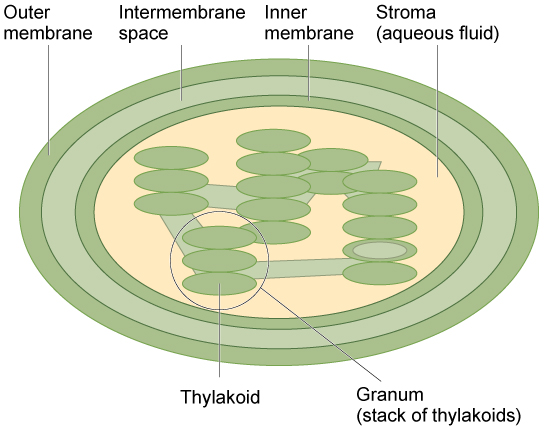

Figure 4.17図 4.17
The chloroplast has an outer membrane, an inner membrane, and membrane structures - thylakoids that are stacked into grana. We call the space inside the thylakoid membranes the thylakoid space. The light harvesting reactions take place in the thylakoid membranes, and sugar synthesis takes place in the fluid inside the inner membrane, which we call the stroma. Chloroplasts also have their own genome, which is contained on a single circular chromosome.
葉緑体には、外膜、内膜、そしてグラナとして積み重なったチラコイドという膜構造がある。チラコイド膜の内側の空間をチラコイド腔という。光を取り込む反応はチラコイド膜で行われ、糖の合成は、内膜の内側にあるストロマという液体で行われる。葉緑体は独自のゲノムももち、1本の環状染色体に収められている。
The chloroplasts contain a green pigment, chlorophyll, which captures the light energy that drives the reactions of photosynthesis. Like plant cells, photosynthetic protists also have chloroplasts. Some bacteria perform photosynthesis, but their chlorophyll is not relegated to an organelle.
英語のヒント
葉緑体は、光合成反応を駆動する光エネルギーを取り込む、クロロフィルという緑色の色素を含む。植物細胞と同様に、光合成を行う原生生物も葉緑体をもつ。一部の細菌も光合成を行うが、そのクロロフィルは細胞小器官に収められているわけではない。
The Central Vacuole中央液胞
Previously, we mentioned vacuoles as essential components of plant cells. If you look at Figure 4.8b, you will see that plant cells each have a large central vacuole that occupies most of the cell's volume. The central vacuole plays a key role in regulating the cell’s concentration of water in changing environmental conditions. Have you ever noticed that if you forget to water a plant for a few days, it wilts? That’s because as the water concentration in the soil becomes lower than the water concentration in the plant, water moves out of the central vacuoles and cytoplasm. As the central vacuole shrinks, it leaves the cell wall unsupported. This loss of support to the plant's cell walls results in the wilted appearance.
英語のヒント
すでに、液胞は植物細胞に欠かせない構成要素であると述べた。図4.8bを見ると、それぞれの植物細胞に、細胞の体積の大部分を占める大きな中央液胞があることが分かる。中央液胞は、環境条件が変化する中で、細胞内の水の濃度を調節する重要な役割を果たす。数日間水やりを忘れると、植物がしおれることに気づいただろうか。土壌中の水の濃度が植物内より低くなり、水が中央液胞と細胞質から出ていくためである。中央液胞が縮むと、細胞壁を支えられなくなる。植物の細胞壁が支えを失うことで、しおれた外観になる。
The central vacuole also supports the cell's expansion. When the central vacuole holds more water, the cell becomes larger without having to invest considerable energy in synthesizing new cytoplasm.
英語のヒント
中央液胞は、細胞が大きくなるのも助ける。中央液胞がより多くの水を含むと、新しい細胞質の合成に多大なエネルギーを注ぐ必要がなくても、細胞を大きくできる。
Section Summaryこの節のまとめ
Like a prokaryotic cell, a eukaryotic cell has a plasma membrane, cytoplasm, and ribosomes, but a eukaryotic cell is typically larger than a prokaryotic cell, has a true nucleus (meaning a membrane surrounds its DNA), and has other membrane-bound organelles that allow for compartmentalizing functions. The plasma membrane is a phospholipid bilayer embedded with proteins. The nucleus’s nucleolus is the site of ribosome assembly. We find ribosomes either in the cytoplasm or attached to the cytoplasmic side of the plasma membrane or endoplasmic reticulum. They perform protein synthesis. Mitochondria participate in cellular respiration. They are responsible for the majority of ATP produced in the cell. Peroxisomes hydrolyze fatty acids, amino acids, and some toxins. Vesicles and vacuoles are storage and transport compartments. In plant cells, vacuoles also help break down macromolecules.
真核細胞には、原核細胞と同様に細胞膜、細胞質、リボソームがある。しかし、一般に原核細胞より大きく、真の核(DNAが膜で囲まれていることを意味する)と、機能を区画化できるそのほかの膜に囲まれた細胞小器官をもつ。細胞膜は、タンパク質が埋め込まれたリン脂質二重層である。核内の核小体は、リボソームを組み立てる場所である。リボソームは細胞質中にあるか、細胞膜や小胞体の細胞質側に付着し、タンパク質合成を行う。ミトコンドリアは細胞呼吸に関わり、細胞内で作られるATPの大部分を担う。ペルオキシソームは、脂肪酸、アミノ酸、一部の毒素を加水分解する。小胞と液胞は、貯蔵と輸送のための区画である。植物細胞では、液胞は高分子の分解も助ける。
Animal cells also have a centrosome and lysosomes. The centrosome has two bodies perpendicular to each other, the centrioles, and has an unknown purpose in cell division. Lysosomes are the digestive organelles of animal cells.
動物細胞には、中心体とリソソームもある。中心体には、互いに垂直な二つの構造である中心小体があり、細胞分裂での役割は分かっていない。リソソームは、動物細胞の消化を担う細胞小器官である。
Plant cells and plant-like cells each have a cell wall, chloroplasts, and a central vacuole. The plant cell wall, whose primary component is cellulose, protects the cell, provides structural support, and gives the cell shape. Photosynthesis takes place in chloroplasts. The central vacuole can expand without having to produce more cytoplasm.
植物細胞と植物に似た細胞は、それぞれ細胞壁、葉緑体、中央液胞をもつ。植物の細胞壁は、セルロースを主成分とし、細胞を保護し、構造を支え、形を与える。光合成は葉緑体で行われる。中央液胞は、細胞質をさらに作らなくても拡大できる。