第4章細胞の構造
Desmosomesデスモソーム
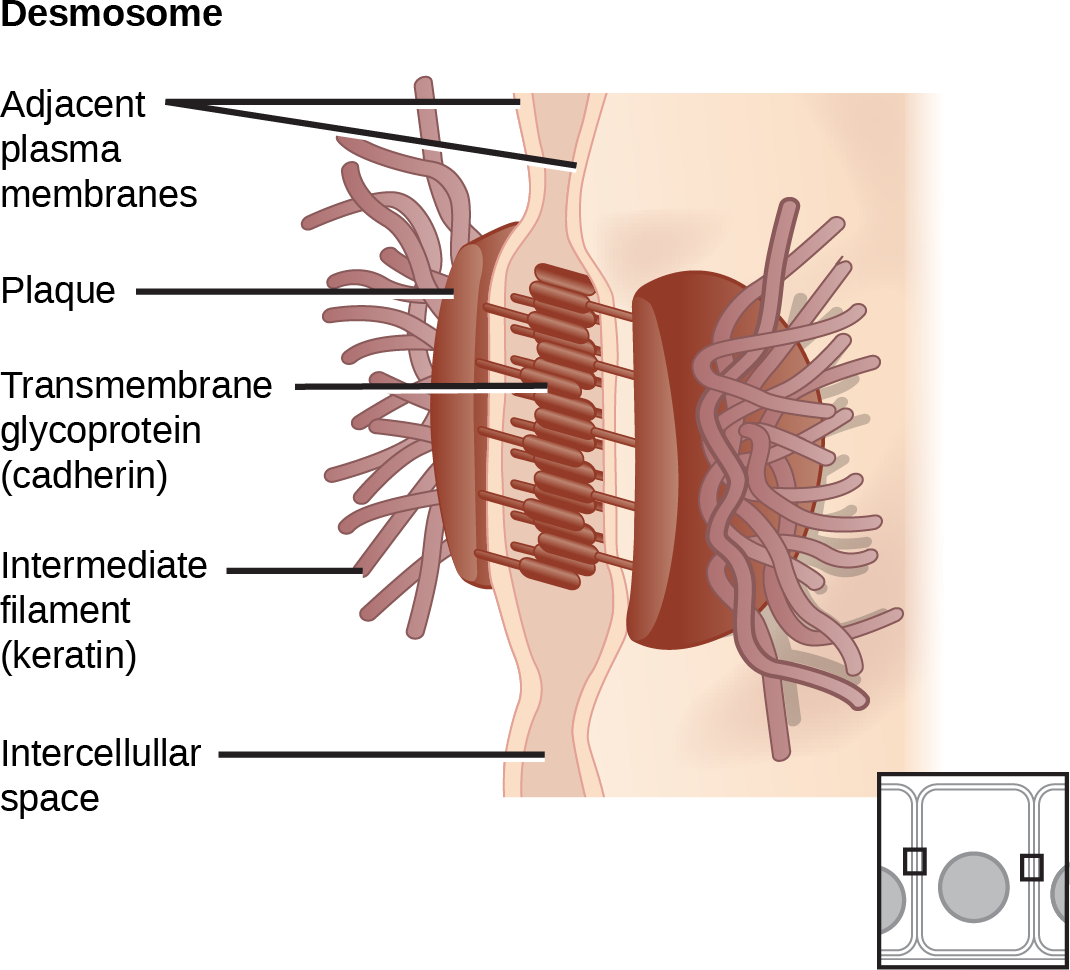
Also only in animal cells are desmosomes, which act like spot welds between adjacent epithelial cells (Figure 4.30). Cadherins, short proteins in the plasma membrane connect to intermediate filaments to create desmosomes. The cadherins connect two adjacent cells and maintain the cells in a sheet-like formation in organs and tissues that stretch, like the skin, heart, and muscles.
英語のヒント
デスモソームも動物細胞だけにあり、隣り合う上皮細胞間のスポット溶接のように働く(図4.30)。細胞膜内の短いタンパク質であるカドヘリンが中間径フィラメントにつながり、デスモソームを作る。カドヘリンは隣り合う二つの細胞を結び、皮膚、心臓、筋肉のような伸びる器官や組織で、細胞をシート状に保つ。
OpenStax, Rice University; Biology 2e. (credit: modification of work by Mariana Ruiz Villareal) · CC BY 4.0 · Source出典

Figure 4.30図 4.30
A desmosome forms a very strong spot weld between cells. Linking cadherins and intermediate filaments create it. (credit: modification of work by Mariana Ruiz Villareal)
デスモソームは、細胞どうしの間に非常に強いスポット溶接のような接着を作る。カドヘリンと中間径フィラメントをつなぐことで形成される。(クレジット:Mariana Ruiz Villarealの作品を改変)
Gap Junctionsギャップ結合
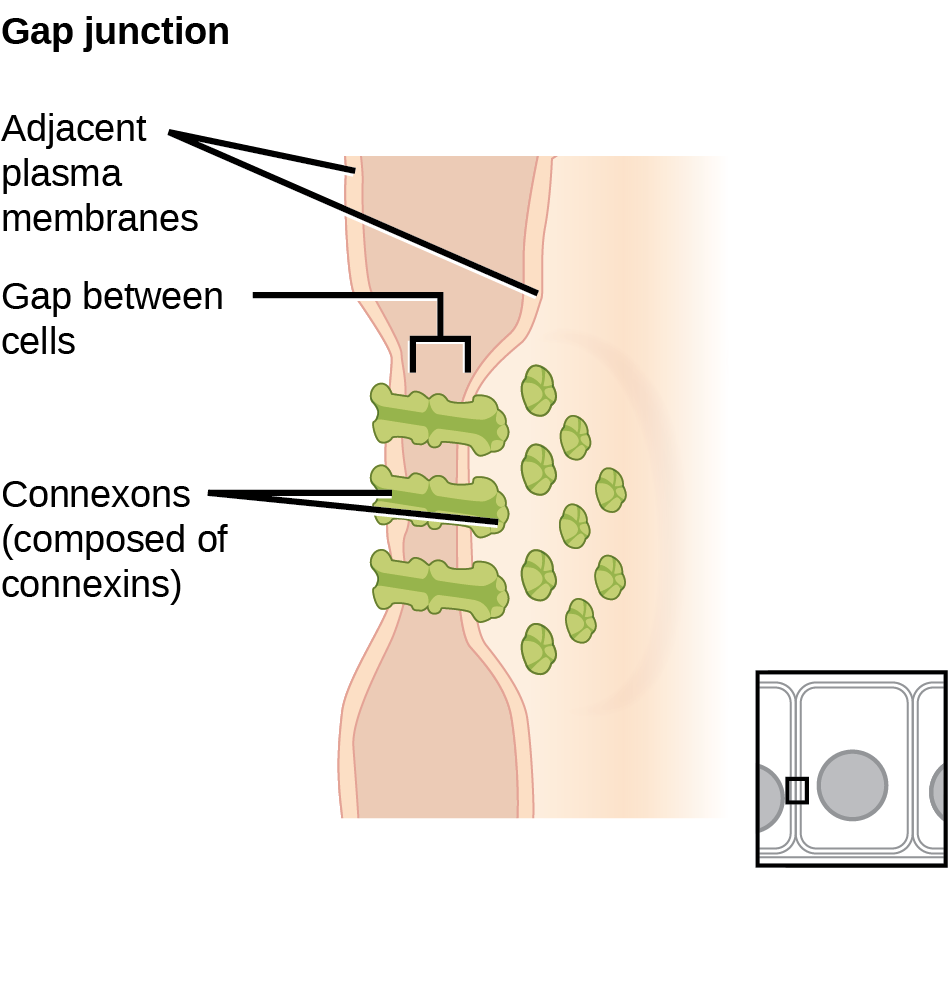
Gap junctions in animal cells are like plasmodesmata in plant cells in that they are channels between adjacent cells that allow for transporting ions, nutrients, and other substances that enable cells to communicate (Figure 4.31). Structurally, however, gap junctions and plasmodesmata differ.
英語のヒント
動物細胞のギャップ結合は、隣接する細胞間の通路であり、イオン、栄養素などの物質を運んで細胞間の情報伝達を可能にする点で、植物細胞の原形質連絡に似ている(図4.31)。ただし、ギャップ結合と原形質連絡は構造が異なる。
OpenStax, Rice University; Biology 2e. (credit: modification of work by Mariana Ruiz Villareal) · CC BY 4.0 · Source出典

Figure 4.31図 4.31
A gap junction is a protein-lined pore that allows water and small molecules to pass between adjacent animal cells. (credit: modification of work by Mariana Ruiz Villareal)
ギャップ結合は、隣り合う動物細胞の間で水や小分子を通す、タンパク質で縁取られた孔である。(クレジット:Mariana Ruiz Villarealの作品を改変)
Gap junctions develop when a set of six proteins (connexins) in the plasma membrane arrange themselves in an elongated donut-like configuration - a connexon. When the connexon's pores (“doughnut holes”) in adjacent animal cells align, a channel between the two cells forms. Gap junctions are particularly important in cardiac muscle. The electrical signal for the muscle to contract passes efficiently through gap junctions, allowing the heart muscle cells to contract in tandem.
英語のヒント
細胞膜の6個のタンパク質(コネキシン)が、細長いドーナツ状の配置であるコネクソンを作ると、ギャップ結合が形成される。隣り合う動物細胞のコネクソンの孔、つまり「ドーナツの穴」がそろうと、二つの細胞をつなぐ通路ができる。ギャップ結合は、特に心筋で重要である。筋肉を収縮させる電気信号がギャップ結合を効率よく通るため、心筋細胞は足並みをそろえて収縮できる。
Section Summaryこの節のまとめ
Animal cells communicate via their extracellular matrices and are connected to each other via tight junctions, desmosomes, and gap junctions. Plant cells are connected and communicate with each other via plasmodesmata.
動物細胞は細胞外マトリックスを介して情報をやり取りし、密着結合、デスモソーム、ギャップ結合によって互いにつながる。植物細胞は、原形質連絡を介してつながり、情報をやり取りする。
When protein receptors on the plasma membrane's surface of an animal cell bind to a substance in the extracellular matrix, a chain of reactions begins that changes activities taking place within the cell. Plasmodesmata are channels between adjacent plant cells, while gap junctions are channels between adjacent animal cells. However, their structures are quite different. A tight junction is a watertight seal between two adjacent cells, while a desmosome acts like a spot weld.
動物細胞の細胞膜表面にあるタンパク質受容体が細胞外マトリックスの物質に結合すると、一連の反応が始まり、細胞内の活動を変える。原形質連絡は隣り合う植物細胞の間の通路であり、ギャップ結合は隣り合う動物細胞の間の通路である。ただし、その構造は大きく異なる。密着結合は隣り合う二つの細胞の間を水が漏れないように封じ、デスモソームはスポット溶接のように働く。
Review Questions確認問題
Exercises 38–40練習問題 38–40
Exercise 38問題 38
Which of the following are only in plant cells?
次のうち、植物細胞だけにあるのはどれか。
- gap junctionsギャップ結合
- desmosomesデスモソーム
- plasmodesmata原形質連絡
- tight junctions密着結合
Solution解き方
C
C
Exercise 39問題 39
The key components of desmosomes are cadherins and __________.
デスモソームの主要な構成要素は、カドヘリンと__________である。
- actinアクチン
- microfilamentsマイクロフィラメント
- intermediate filaments中間径フィラメント
- microtubules微小管
Solution解き方
C
C
Exercise 40問題 40
Diseased animal cells may produce molecules that activate death cascades to kill the cells in a controlled manner. Why would neighboring healthy cells also die?
病気になった動物細胞は、制御された仕方で自身を死なせるため、細胞死の連鎖反応を活性化する分子を作ることがある。なぜ隣の健康な細胞も死ぬのだろうか。
- The death molecule is passed through desmosomes.細胞死を起こす分子が、デスモソームを通って渡されるから。
- The death molecule is passed through plasmodesmata.細胞死を起こす分子が、原形質連絡を通って渡されるから。
- The death molecule disrupts the extracellular matrix.細胞死を起こす分子が、細胞外マトリックスを壊すから。
- The death molecule passes through gap junctions.細胞死を起こす分子が、ギャップ結合を通り抜けるから。
Solution解き方
D
D
Critical Thinking Questions考察問題
Exercises 41–43練習問題 41–43
Exercise 41問題 41
How does the structure of a plasmodesma differ from that of a gap junction?
原形質連絡とギャップ結合の構造は、どのように異なるか。
Solution解き方
They differ because plant cell walls are rigid. Plasmodesmata, which a plant cell needs for transportation and communication, are able to allow movement of really large molecules. Gap junctions are necessary in animal cells for transportation and communication.
植物の細胞壁は硬いため、構造が異なる。植物細胞の輸送と情報伝達に必要な原形質連絡は、非常に大きな分子の移動も可能にする。ギャップ結合は、動物細胞の輸送と情報伝達に必要である。
Exercise 42問題 42
Explain how the extracellular matrix functions.
細胞外マトリックスがどのように働くか説明しなさい。
Solution解き方
The extracellular matrix functions in support and attachment for animal tissues. It also functions in the healing and growth of the tissue.
細胞外マトリックスは、動物の組織を支え、接着させる役割を果たす。また、組織の治癒と成長にも働く。
Exercise 43問題 43
Pathogenic E. coli have recently been shown to degrade tight junction proteins during infection. How would this provide an advantage to the bacteria?
病原性大腸菌は、感染中に密着結合のタンパク質を分解することが最近示された。これは細菌にどのような利点を与えるだろうか。
Solution解き方
E. coli infections generally cause food poisoning, meaning that the invading bacteria cross from the lumen of the gut into the rest of the body. Tight junctions hold the epithelial layer that lines the digestive tract together so that the material that crosses into the body is tightly regulated. One way E. coli can avoid this regulation is to destroy the tight junctions so that it can enter the body between the epithelial cells, rather than having to go through the cells.
大腸菌感染は一般に食中毒を引き起こし、侵入した細菌が腸の内腔から体のほかの部分へ移る。密着結合は消化管を覆う上皮層をつなぎ、体内に入る物質を厳しく調節している。大腸菌は、密着結合を破壊することでこの調節を回避できる。そうすれば細胞内を通過する必要がなく、上皮細胞の間から体内へ侵入できる。
desmosome
デスモソーム
linkages between adjacent epithelial cells that form when cadherins in the plasma membrane attach to intermediate filaments
細胞膜のカドヘリンが中間径フィラメントに付着することで形成される、隣り合う上皮細胞どうしのつながり
extracellular matrix
細胞外マトリックス
material secreted from animal or fungal cells that provides mechanical protection and anchoring for the cells in the tissue
動物や菌類の細胞から分泌され、組織内の細胞を機械的に保護し、固定する物質
gap junction
ギャップ結合
channel between two adjacent animal cells that allows ions, nutrients, and low molecular weight substances to pass between cells, enabling the cells to communicate
隣り合う二つの動物細胞の間の通路。イオン、栄養素、低分子量の物質を細胞間で通し、情報伝達を可能にする
plasmodesma
原形質連絡
(plural = plasmodesmata) channel that passes between adjacent plant cells' cell walls, connects their cytoplasm, and allows transporting of materials from cell to cell
複数形はplasmodesmata。隣り合う植物細胞の細胞壁を通り、細胞質どうしをつないで、細胞間の物質輸送を可能にする通路
tight junction
密着結合
protein adherence that creates a firm seal between two adjacent animal cells
隣り合う二つの動物細胞の間をしっかり封じる、タンパク質による接着