第4章細胞の構造
4.3 Eukaryotic Cells4.3 真核細胞
Learning Objectives学習目標
By the end of this section, you will be able to do the following:
この節を学ぶと、次のことができるようになる。
- Describe the structure of eukaryotic cells真核細胞の構造を説明する。
- Compare animal cells with plant cells動物細胞と植物細胞を比較する。
- State the role of the plasma membrane細胞膜の役割を述べる。
- Summarize the functions of the major cell organelles主な細胞小器官の機能を要約する。
Have you ever heard the phrase “form follows function?” It’s a philosophy that many industries follow. In architecture, this means that buildings should be constructed to support the activities that will be carried out inside them. For example, a skyscraper should include several elevator banks. A hospital should have its emergency room easily accessible.
英語のヒント
「形態は機能に従う」という言葉を聞いたことがあるだろうか。多くの産業が従っている考え方である。建築では、建物の中で行われる活動を支えられるように建てるべきだ、という意味になる。例えば、超高層ビルには複数のエレベーター群が必要だ。病院では、救急処置室に容易に行けるようにすべきである。
Our natural world also utilizes the principle of form following function, especially in cell biology, and this will become clear as we explore eukaryotic cells (Figure 4.8). Unlike prokaryotic cells, eukaryotic cells have: 1) a membrane-bound nucleus; 2) numerous membrane-bound organelles such as the endoplasmic reticulum, Golgi apparatus, chloroplasts, mitochondria, and others; and 3) several, rod-shaped chromosomes. Because a membrane surrounds eukaryotic cell’s nucleus, it has a “true nucleus.” The word “organelle” means “little organ,” and, as we already mentioned, organelles have specialized cellular functions, just as your body's organs have specialized functions.
英語のヒント
自然界でも「形態は機能に従う」という原理が働いており、特に細胞生物学でそれが見られる。このことは、真核細胞を調べると明らかになる(図4.8)。原核細胞と異なり、真核細胞には、1)膜で囲まれた核、2)小胞体、ゴルジ体、葉緑体、ミトコンドリアなど、膜で囲まれた多数の細胞小器官、3)複数の棒状の染色体がある。真核細胞の核は膜で囲まれているため、「真の核」をもつという。「細胞小器官」という言葉は「小さな器官」を意味する。すでに述べたように、体の器官にそれぞれ特有の機能があるのと同じく、細胞小器官にも細胞内での専門的な機能がある。
At this point, it should be clear to you that eukaryotic cells have a more complex structure than prokaryotic cells. Organelles allow different functions to be compartmentalized in different areas of the cell. Before turning to organelles, let’s first examine two important components of the cell: the plasma membrane and the cytoplasm.
英語のヒント
ここまでで、真核細胞が原核細胞より複雑な構造をもつことが明らかになっただろう。細胞小器官があると、異なる機能を細胞内の異なる領域に分けて行える。細胞小器官に話を移す前に、まず細胞の重要な二つの構成要素である細胞膜と細胞質を調べよう。
The Plasma Membrane細胞膜
Like prokaryotes, eukaryotic cells have a plasma membrane (Figure 4.9), a phospholipid bilayer with embedded proteins that separates the internal contents of the cell from its surrounding environment. A phospholipid is a lipid molecule with two fatty acid chains and a phosphate-containing group. The plasma membrane controls the passage of organic molecules, ions, water, and oxygen into and out of the cell. Wastes (such as carbon dioxide and ammonia) also leave the cell by passing through the plasma membrane.
英語のヒント
原核生物と同様に、真核細胞にも細胞膜がある(図4.9)。細胞膜はタンパク質が埋め込まれたリン脂質二重層であり、細胞の内容物を周囲の環境から隔てている。リン脂質は、2本の脂肪酸鎖とリン酸を含む基をもつ脂質分子である。細胞膜は、有機分子、イオン、水、酸素の細胞内外への通過を調節する。二酸化炭素やアンモニアなどの老廃物も、細胞膜を通って細胞から出ていく。
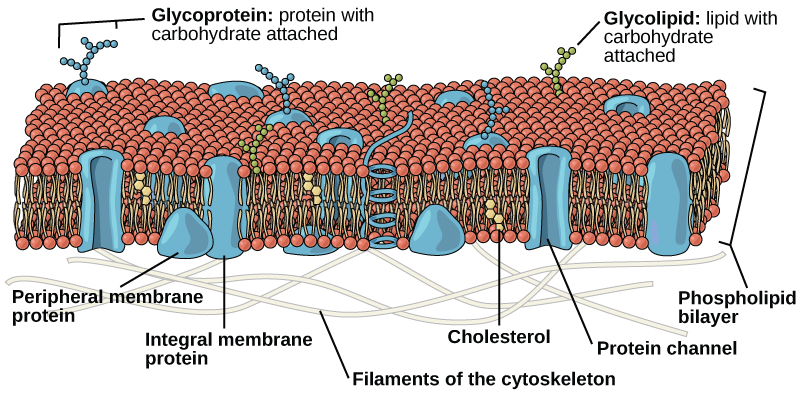

Figure 4.9図 4.9
The eukaryotic plasma membrane is a phospholipid bilayer with proteins and cholesterol embedded in it.
真核細胞の細胞膜は、タンパク質とコレステロールが埋め込まれたリン脂質二重層である。
The plasma membranes of cells that specialize in absorption fold into fingerlike projections that we call microvilli (singular = microvillus); (Figure 4.10). Such cells typically line the small intestine, the organ that absorbs nutrients from digested food. This is an excellent example of form following function. People with celiac disease have an immune response to gluten, which is a protein in wheat, barley, and rye. The immune response damages microvilli, and thus, afflicted individuals cannot absorb nutrients. This leads to malnutrition, cramping, and diarrhea. Patients suffering from celiac disease must follow a gluten-free diet.
英語のヒント
吸収に特化した細胞の細胞膜は、微絨毛と呼ばれる指状の突起を作るように折り畳まれている(複数形microvilli、単数形microvillus。図4.10)。こうした細胞は、典型的には小腸の内面を覆う。小腸は、消化した食物から栄養素を吸収する器官である。これは、形態が機能に従うことの優れた例である。セリアック病の人は、小麦、大麦、ライ麦に含まれるタンパク質のグルテンに対して免疫反応を起こす。この免疫反応は微絨毛を傷つけるため、患者は栄養素を吸収できなくなる。その結果、栄養失調、腹部のけいれん、下痢が起こる。セリアック病の患者は、グルテンを含まない食事に従わなければならない。
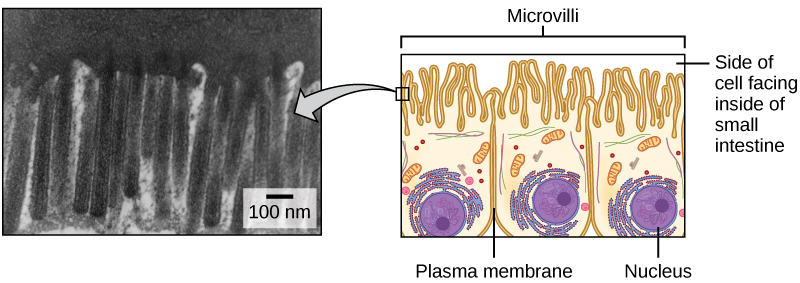
OpenStax, Rice University; Biology 2e. (credit "micrograph": modification of work by Louisa Howard) · CC BY 4.0 · Source出典

Figure 4.10図 4.10
Microvilli, as they appear on cells lining the small intestine, increase the surface area available for absorption. These microvilli are only on the area of the plasma membrane that faces the cavity from which substances will be absorbed. (credit "micrograph": modification of work by Louisa Howard)
小腸の内面を覆う細胞に見られる微絨毛は、吸収に使える表面積を増やす。微絨毛があるのは、物質を吸収する元となる空洞に面した細胞膜の部分だけである。(「顕微鏡写真」のクレジット:Louisa Howardの作品を改変)
The Cytoplasm細胞質
The cytoplasm is the cell's entire region between the plasma membrane and the nuclear envelope (a structure we will discuss shortly). It is comprised of organelles suspended in the gel-like cytosol, the cytoskeleton, and various chemicals (Figure 4.8). Even though the cytoplasm consists of 70 to 80 percent water, it has a semi-solid consistency, which comes from the proteins within it. However, proteins are not the only organic molecules in the cytoplasm. Glucose and other simple sugars, polysaccharides, amino acids, nucleic acids, fatty acids, and derivatives of glycerol are also there. Ions of sodium, potassium, calcium, and many other elements also dissolve in the cytoplasm. Many metabolic reactions, including protein synthesis, take place in the cytoplasm.
英語のヒント
細胞質は、細胞膜と核膜(まもなく説明する構造)の間にある細胞内の領域全体を指す。ゲル状の細胞質基質に浮かぶ細胞小器官、細胞骨格、さまざまな化学物質からなる(図4.8)。細胞質の70〜80パーセントは水だが、内部のタンパク質によって半固体状の性状をもつ。ただし、細胞質内の有機分子はタンパク質だけではない。グルコースなどの単糖、多糖、アミノ酸、核酸、脂肪酸、グリセロールの誘導体も存在する。ナトリウム、カリウム、カルシウムなど、多くの元素のイオンも細胞質に溶けている。タンパク質合成を含む多くの代謝反応が、細胞質で起こる。