第38章筋骨格系
38.3 Joints and Skeletal Movement38.3 関節と骨格の運動
Learning Objectives学習目標
By the end of this section, you will be able to do the following:
この節を終えると、次のことができるようになる。
- Classify the different types of joints on the basis of structureさまざまな種類の関節を構造に基づいて分類する。
- Explain the role of joints in skeletal movement骨格の運動における関節の役割を説明する。
The point at which two or more bones meet is called a joint, or articulation. Joints are responsible for movement, such as the movement of limbs, and stability, such as the stability found in the bones of the skull.
英語のヒント
2つ以上の骨が接する場所を関節という。関節は、四肢を動かすような運動と、頭蓋骨に見られるような安定性を担う。
Classification of Joints on the Basis of Structure構造に基づく関節の分類
There are two ways to classify joints: on the basis of their structure or on the basis of their function. The structural classification divides joints into bony, fibrous, cartilaginous, and synovial joints depending on the material composing the joint and the presence or absence of a cavity in the joint.
英語のヒント
関節を分類する方法には、構造に基づくものと、機能に基づくものがある。構造による分類では、連結を構成する材料と、関節内に空洞があるかどうかに基づいて、骨性、線維性、軟骨性の連結、および滑膜性関節に分ける。
Fibrous Joints線維性連結
The bones of fibrous joints are held together by fibrous connective tissue. There is no cavity, or space, present between the bones and so most fibrous joints do not move at all, or are only capable of minor movements. There are three types of fibrous joints: sutures, syndesmoses, and gomphoses. Sutures are found only in the skull and possess short fibers of connective tissue that hold the skull bones tightly in place (Figure 38.23).
英語のヒント
線維性連結では、骨どうしが線維性結合組織によってつながっている。骨の間に空洞、すなわち隙間がないため、大半の線維性連結はまったく動かないか、ごくわずかしか動かない。線維性連結には、縫合、靱帯結合、釘植の3種類がある。縫合は頭蓋にだけ見られ、短い結合組織の線維が、頭蓋の骨を所定の位置に強く固定している(図38.23)。
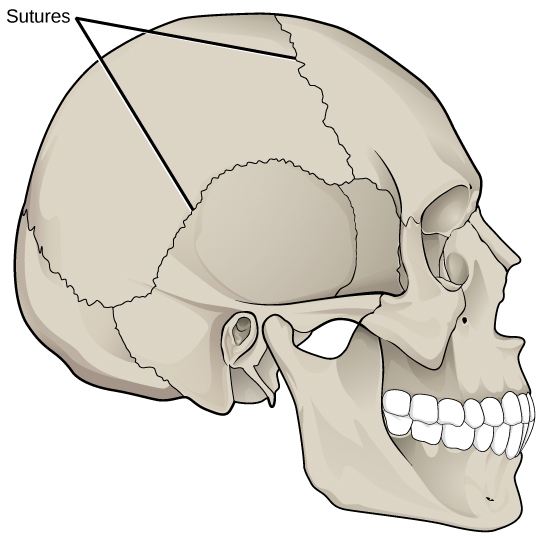
Figure 38.23図 38.23
Sutures are fibrous joints found only in the skull.
縫合は、頭蓋にだけ見られる線維性連結である。
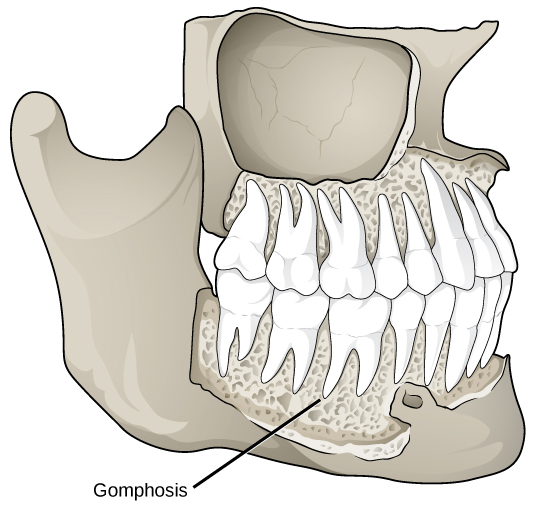
Syndesmoses are joints in which the bones are connected by a band of connective tissue, allowing for more movement than in a suture. An example of a syndesmosis is the joint of the tibia and fibula in the ankle. The amount of movement in these types of joints is determined by the length of the connective tissue fibers. Gomphoses occur between teeth and their sockets; the term refers to the way the tooth fits into the socket like a peg (Figure 38.24). The tooth is connected to the socket by a connective tissue referred to as the periodontal ligament.
英語のヒント
靱帯結合は、帯状の結合組織によって骨どうしがつながる連結であり、縫合より大きな動きが可能である。例として、足首の脛骨と腓骨の連結がある。この種類の連結の可動性は、結合組織の線維の長さによって決まる。釘植は、歯と歯槽の間に見られる。歯が釘のように歯槽へはまる形に由来する名称である(図38.24)。歯は、歯根膜という結合組織によって歯槽につながっている。
OpenStax, Rice University; Biology 2e. (credit: modification of work by Gray's Anatomy) · CC BY 4.0 · Source出典
Figure 38.24図 38.24
Gomphoses are fibrous joints between the teeth and their sockets. (credit: modification of work by Gray's Anatomy)
釘植は、歯と歯槽の間の線維性連結である。(出典:Gray’s Anatomyの作品を改変)
Cartilaginous Joints軟骨性連結
Cartilaginous joints are joints in which the bones are connected by cartilage. There are two types of cartilaginous joints: synchondroses and symphyses. In a synchondrosis, the bones are joined by hyaline cartilage. Synchondroses are found in the epiphyseal plates of growing bones in children. In symphyses, hyaline cartilage covers the end of the bone but the connection between bones occurs through fibrocartilage. Symphyses are found at the joints between vertebrae. Either type of cartilaginous joint allows for very little movement.
英語のヒント
軟骨性連結は、骨どうしが軟骨によってつながる連結である。軟骨結合と線維軟骨結合の2種類がある。軟骨結合では、骨は硝子軟骨によってつながる。子どもの成長中の骨の骨端板に見られる。線維軟骨結合では、骨の端は硝子軟骨に覆われているが、骨どうしは線維軟骨を介してつながる。線維軟骨結合は、椎骨間の連結に見られる。どちらの種類の軟骨性連結も、動きはごくわずかである。
Synovial Joints滑膜性関節
Synovial joints are the only joints that have a space between the adjoining bones (Figure 38.25). This space is referred to as the synovial (or joint) cavity and is filled with synovial fluid. Synovial fluid lubricates the joint, reducing friction between the bones and allowing for greater movement. The ends of the bones are covered with articular cartilage, a hyaline cartilage, and the entire joint is surrounded by an articular capsule composed of connective tissue that allows movement of the joint while resisting dislocation. Articular capsules may also possess ligaments that hold the bones together. Synovial joints are capable of the greatest movement of the three structural joint types; however, the more mobile a joint, the weaker the joint. Knees, elbows, and shoulders are examples of synovial joints.
英語のヒント
滑膜性関節は、隣り合う骨の間に隙間をもつ唯一の関節である(図38.25)。この隙間を関節腔といい、滑液で満たされている。滑液は関節を潤滑し、骨どうしの摩擦を減らして、大きな動きを可能にする。骨の端は、硝子軟骨である関節軟骨で覆われている。関節全体は結合組織からなる関節包に包まれ、脱臼を防ぎながら関節の動きを可能にしている。関節包には、骨どうしをつなぎとめる靱帯がある場合もある。滑膜性関節は、構造で分けた3種類の連結の中で、最も大きな動きが可能である。しかし、関節がよく動くほど、その関節は弱くなる。膝、肘、肩は滑膜性関節の例である。
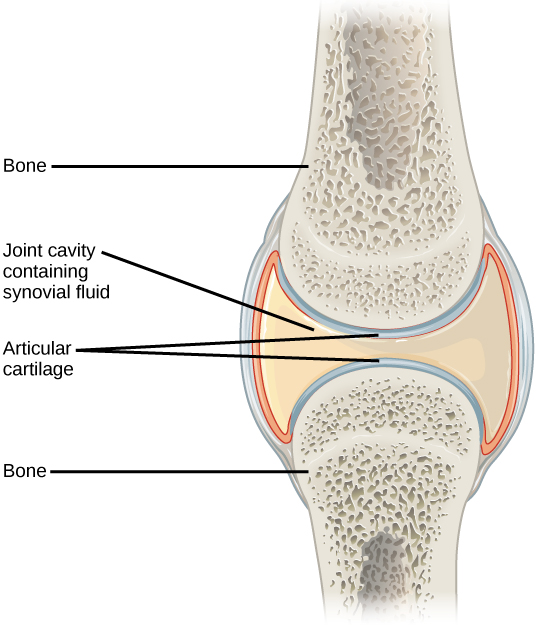


Figure 38.25図 38.25
Synovial joints are the only joints that have a space or “synovial cavity” in the joint.
滑膜性関節は、関節内に隙間、すなわち「関節腔」をもつ唯一の関節である。
Classification of Joints on the Basis of Function機能に基づく関節の分類
The functional classification divides joints into three categories: synarthroses, amphiarthroses, and diarthroses. A synarthrosis is a joint that is immovable. This includes sutures, gomphoses, and synchondroses. Amphiarthroses are joints that allow slight movement, including syndesmoses and symphyses. Diarthroses are joints that allow for free movement of the joint, as in synovial joints.
英語のヒント
機能による分類では、関節を不動関節、微動関節、可動関節の3種類に分ける。不動関節は、動かない関節であり、縫合、釘植、軟骨結合が含まれる。微動関節は、わずかに動く関節で、靱帯結合や線維軟骨結合が含まれる。可動関節は、滑膜性関節のように、自由に動くことのできる関節である。
Movement at Synovial Joints滑膜性関節での運動
The wide range of movement allowed by synovial joints produces different types of movements. The movement of synovial joints can be classified as one of four different types: gliding, angular, rotational, or special movement.
英語のヒント
滑膜性関節では広い可動域が得られ、さまざまな種類の運動が可能になる。その運動は、滑走運動、角運動、回旋運動、特殊な運動の4種類に分類できる。