第38章筋骨格系
38.2 Bone38.2 骨
Learning Objectives学習目標
By the end of this section, you will be able to do the following:
この節を終えると、次のことができるようになる。
- Classify the different types of bones in the skeleton骨格を構成するさまざまな種類の骨を分類する。
- Explain the role of the different cell types in bone骨に含まれる各種の細胞の役割を説明する。
- Explain how bone forms during development発生の過程で骨がどのように形成されるかを説明する。
Bone, or osseous tissue, is a connective tissue that constitutes the endoskeleton. It contains specialized cells and a matrix of mineral salts and collagen fibers.
英語のヒント
骨、すなわち骨組織は、内骨格を構成する結合組織である。特殊化した細胞と、無機塩類およびコラーゲン線維からなる基質を含む。
The mineral salts primarily include hydroxyapatite, a mineral formed from calcium phosphate. Calcification is the process of deposition of mineral salts on the collagen fiber matrix that crystallizes and hardens the tissue. The process of calcification only occurs in the presence of collagen fibers.
英語のヒント
無機塩類の主な成分は、リン酸カルシウムからできる鉱物であるヒドロキシアパタイトである。石灰化とは、コラーゲン線維の基質に無機塩類が沈着し、結晶化によって組織が硬くなる過程をいう。石灰化は、コラーゲン線維が存在する場合にのみ起こる。
The bones of the human skeleton are classified by their shape: long bones, short bones, flat bones, sutural bones, sesamoid bones, and irregular bones (Figure 38.16).
ヒトの骨格を構成する骨は、形によって、長骨、短骨、扁平骨、縫合骨、種子骨、不規則骨に分類される(図38.16)。
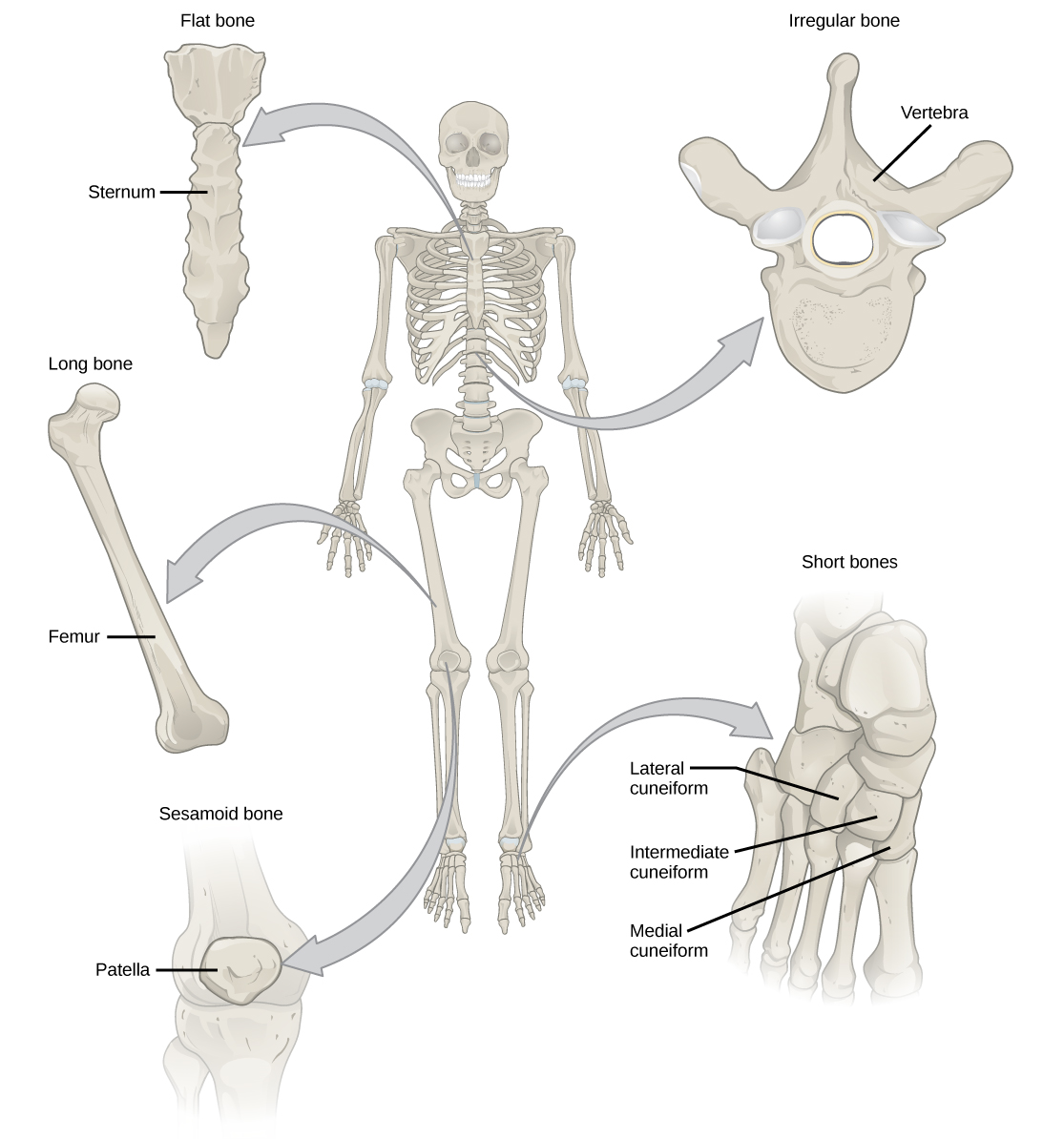
Figure 38.16図 38.16
Shown are different types of bones: flat, irregular, long, short, and sesamoid.
扁平骨、不規則骨、長骨、短骨、種子骨という、異なる種類の骨を示す。
Long bones are longer than they are wide and have a shaft and two ends. The diaphysis, or central shaft, contains bone marrow in a medullary (marrow) cavity. The rounded ends, the epiphyses, are covered with articular cartilage and are filled with red bone marrow, which produces blood cells (Figure 38.17). Most of the limb bones are long bones—for example, the femur, tibia, ulna, and radius. Exceptions to this include the patella and the bones of the wrist and ankle.
英語のヒント
長骨は幅より長さが長く、骨幹と2つの端をもつ。中央の軸にあたる骨幹には、骨髄腔があり、その中に骨髄を含む。丸みを帯びた両端は骨端と呼ばれ、関節軟骨で覆われている。その内部には、血球をつくる赤色骨髄が詰まっている(図38.17)。四肢の骨の大半は長骨であり、大腿骨、脛骨、尺骨、橈骨などがその例である。膝蓋骨や、手首・足首の骨は例外である。
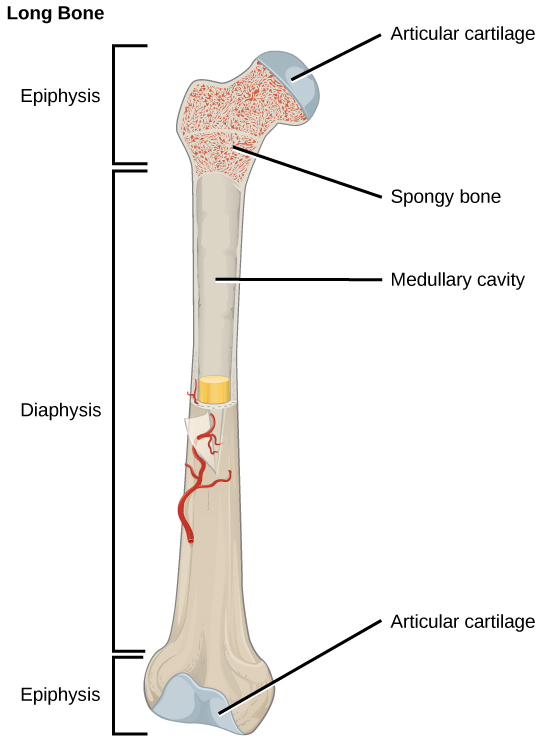
Figure 38.17図 38.17
The long bone is covered by articular cartilage at either end and contains bone marrow (shown in yellow in this illustration) in the medullary cavity.
長骨は両端を関節軟骨で覆われ、骨髄腔の中に骨髄(この図では黄色)を含む。
Short bones, or cuboidal bones, are bones that are the same width and length, giving them a cube-like shape. For example, the bones of the wrist (carpals) and ankle (tarsals) are short bones (Figure 38.16).
短骨は、幅と長さが同じで、立方体に似た形の骨である。たとえば、手首の手根骨と足首の足根骨は短骨である(図38.16)。
Flat bones are thin and relatively broad bones that are found where extensive protection of organs is required or where broad surfaces of muscle attachment are required. Examples of flat bones are the sternum (breast bone), ribs, scapulae (shoulder blades), and the roof of the skull (Figure 38.16).
英語のヒント
扁平骨は、薄く比較的幅の広い骨であり、器官を広範囲に保護する必要がある場所や、筋が付着する広い面が必要な場所に見られる。扁平骨の例には、胸骨、肋骨、肩甲骨、頭蓋の上部がある(図38.16)。
Irregular bones are bones with complex shapes. These bones may have short, flat, notched, or ridged surfaces. Examples of irregular bones are the vertebrae, hip bones, and several skull bones.
不規則骨は、複雑な形をした骨である。短い面、平たい面、切れ込みのある面、隆起のある面などをもつことがある。例として、椎骨、寛骨、一部の頭蓋骨がある。
Sesamoid bones are small, flat bones and are shaped similarly to a sesame seed. The patellae are sesamoid bones (Figure 38.18). Sesamoid bones develop inside tendons and may be found near joints at the knees, hands, and feet.
英語のヒント
種子骨は、ゴマの種子に似た形をした、小さく平たい骨である。膝蓋骨は種子骨である(図38.18)。種子骨は腱の内部で発達し、膝・手・足の関節の近くに見られることがある。
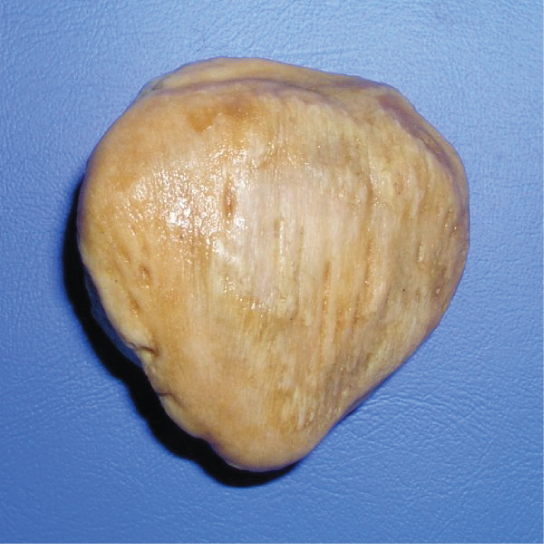


Figure 38.18図 38.18
The patella of the knee is an example of a sesamoid bone.
膝の膝蓋骨は、種子骨の一例である。
Sutural bones are small, flat, irregularly shaped bones. They may be found between the flat bones of the skull. They vary in number, shape, size, and position.
縫合骨は、小さく平たい、不規則な形の骨である。頭蓋の扁平骨の間に見られることがある。数、形、大きさ、位置はさまざまである。
Bone Tissue骨組織
Bones are considered organs because they contain various types of tissue, such as blood, connective tissue, nerves, and bone tissue. Osteocytes, the living cells of bone tissue, form the mineral matrix of bones. There are two types of bone tissue: compact and spongy.
英語のヒント
骨には血液、結合組織、神経、骨組織など、さまざまな種類の組織が含まれるため、骨は器官とみなされる。骨組織の生きた細胞である骨細胞は、骨の無機質の基質を形成する。骨組織には、緻密骨と海綿骨の2種類がある。
Compact Bone Tissue緻密骨組織
Compact bone (or cortical bone) forms the hard external layer of all bones and surrounds the medullary cavity, or bone marrow. It provides protection and strength to bones. Compact bone tissue consists of units called osteons or Haversian systems. Osteons are cylindrical structures that contain a mineral matrix and living osteocytes connected by canaliculi, which transport blood. They are aligned parallel to the long axis of the bone. Each osteon consists of lamellae, which are layers of compact matrix that surround a central canal called the Haversian canal. The Haversian canal (osteonic canal) contains the bone’s blood vessels and nerve fibers (Figure 38.19). Osteons in compact bone tissue are aligned in the same direction along lines of stress and help the bone resist bending or fracturing. Therefore, compact bone tissue is prominent in areas of bone at which stresses are applied in only a few directions.
英語のヒント
緻密骨(皮質骨)は、すべての骨の硬い外層を形成し、骨髄腔や骨髄を囲む。骨を保護し、強度を与える。緻密骨組織は、オステオン、またはハバース系と呼ばれる単位からなる。オステオンは円柱状の構造で、無機質の基質と、生きた骨細胞を含む。骨細胞は、血液を運ぶ骨細管によってつながっている。オステオンは骨の長軸と平行に配列している。各オステオンは骨層板からなる。骨層板は緻密な基質の層であり、ハバース管と呼ばれる中心の管を取り囲む。ハバース管(オステオンの管)には、骨の血管と神経線維が含まれる(図38.19)。緻密骨組織のオステオンは、応力の線に沿って同じ方向に並び、骨が曲がったり折れたりすることに抵抗するのを助ける。このため、緻密骨組織は、限られた方向からだけ応力が加わる骨の領域で発達している。