第38章筋骨格系
The Thoracic Cage胸郭
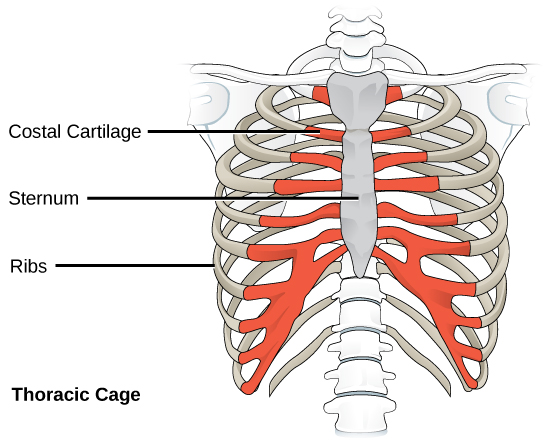
The thoracic cage, also known as the ribcage, is the skeleton of the chest, and consists of the ribs, sternum, thoracic vertebrae, and costal cartilages (Figure 38.9). The thoracic cage encloses and protects the organs of the thoracic cavity, including the heart and lungs. It also provides support for the shoulder girdles and upper limbs, and serves as the attachment point for the diaphragm, muscles of the back, chest, neck, and shoulders. Changes in the volume of the thorax enable breathing.
英語のヒント
胸郭は胸部の骨格で、肋骨、胸骨、胸椎、肋軟骨からなる(図38.9)。胸郭は、心臓や肺など胸腔内の器官を包み、保護する。また、肩帯と上肢を支え、横隔膜や、背中・胸・首・肩の筋の付着部となる。胸郭の容積の変化によって呼吸が可能になる。
The sternum, or breastbone, is a long, flat bone located at the anterior of the chest. It is formed from three bones that fuse in the adult. The ribs are 12 pairs of long, curved bones that attach to the thoracic vertebrae and curve toward the front of the body, forming the ribcage. Costal cartilages connect the anterior ends of the ribs to the sternum, with the exception of rib pairs 11 and 12, which are free-floating ribs.
胸骨は、胸の前側にある細長く平たい骨である。3個の骨が成人で融合してできる。肋骨は12対の長く弯曲した骨で、胸椎に付着し、体の前方へ曲がって胸郭を形成する。肋軟骨は肋骨の前端と胸骨をつなぐ。ただし、第11・第12肋骨は例外で、前端が自由な浮遊肋である。
OpenStax, Rice University; Biology 2e. (credit: modification of work by NCI, NIH) · CC BY 4.0 · Source出典
Figure 38.9図 38.9
The thoracic cage, or rib cage, protects the heart and the lungs. (credit: modification of work by NCI, NIH)
胸郭は、心臓と肺を保護する。(出典:NCI、NIHの作品を改変)
Human Appendicular Skeletonヒトの付属肢骨格
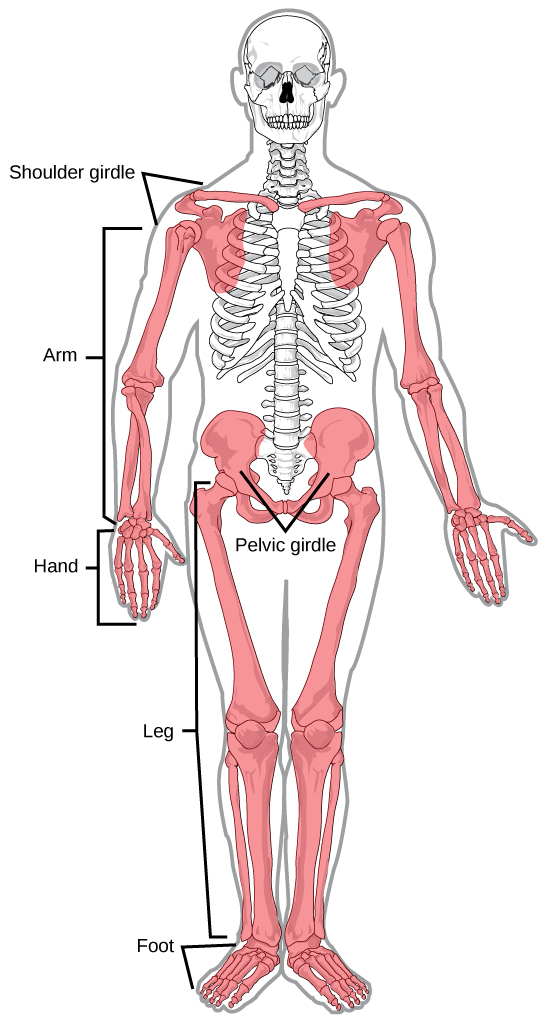
The appendicular skeleton is composed of the bones of the upper limbs (which function to grasp and manipulate objects) and the lower limbs (which permit locomotion). It also includes the pectoral girdle, or shoulder girdle, that attaches the upper limbs to the body, and the pelvic girdle that attaches the lower limbs to the body (Figure 38.10).
英語のヒント
付属肢骨格は、物をつかんだり操作したりする上肢の骨と、移動を可能にする下肢の骨からなる。さらに、上肢を体につなぐ肩帯と、下肢を体につなぐ骨盤帯も含まれる(図38.10)。
OpenStax, Rice University; Biology 2e. (credit: modification of work by Mariana Ruiz Villareal) · CC BY 4.0 · Source出典
Figure 38.10図 38.10
The appendicular skeleton is composed of the bones of the pectoral limbs (arm, forearm, hand), the pelvic limbs (thigh, leg, foot), the pectoral girdle, and the pelvic girdle. (credit: modification of work by Mariana Ruiz Villareal)
付属肢骨格は、上肢(上腕・前腕・手)、下肢(大腿・下腿・足)、肩帯、骨盤帯の骨からなる。(出典:Mariana Ruiz Villarealの作品を改変)
The Pectoral Girdle肩帯
The pectoral girdle bones provide the points of attachment of the upper limbs to the axial skeleton. The human pectoral girdle consists of the clavicle (or collarbone) in the anterior, and the scapula (or shoulder blades) in the posterior (Figure 38.11).
肩帯の骨は、上肢を中軸骨格につなぐ付着部となる。ヒトの肩帯は、前側にある鎖骨と、後ろ側にある肩甲骨からなる(図38.11)。
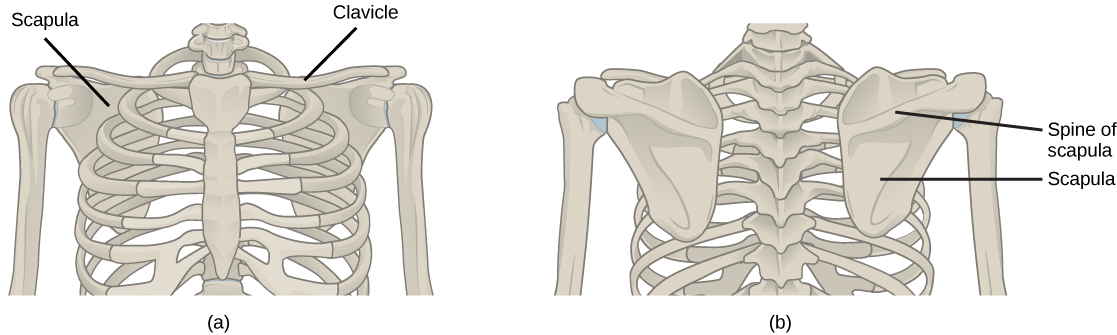
Figure 38.11図 38.11
(a) The pectoral girdle in primates consists of the clavicles and scapulae. (b) The posterior view reveals the spine of the scapula to which muscle attaches.
(a)霊長類の肩帯は鎖骨と肩甲骨からなる。(b)後ろから見ると、筋が付着する肩甲棘が見える。
The clavicles are S-shaped bones that position the arms on the body. The clavicles lie horizontally across the front of the thorax (chest) just above the first rib. These bones are fairly fragile and are susceptible to fractures. For example, a fall with the arms outstretched causes the force to be transmitted to the clavicles, which can break if the force is excessive. The clavicle articulates with the sternum and the scapula.
英語のヒント
鎖骨はS字形の骨で、腕を体に対して一定の位置に置く。鎖骨は第1肋骨のすぐ上で、胸郭の前側を水平に横切っている。鎖骨は比較的もろく、骨折しやすい。たとえば、腕を伸ばした状態で転倒すると、力が鎖骨へ伝わり、その力が大きすぎる場合には骨折することがある。鎖骨は胸骨と肩甲骨と関節を形成する。
The scapulae are flat, triangular bones that are located at the back of the pectoral girdle. They support the muscles crossing the shoulder joint. A ridge, called the spine, runs across the back of the scapula and can easily be felt through the skin (Figure 38.11). The spine of the scapula is a good example of a bony protrusion that facilitates a broad area of attachment for muscles to bone.
英語のヒント
肩甲骨は、肩帯の後ろ側にある、平たい三角形の骨である。肩関節をまたぐ筋を支えている。肩甲骨の後面には、肩甲棘という隆起が横に走っており、皮膚の上から容易に触れることができる(図38.11)。肩甲棘は、筋が骨に付着するための広い面を確保する骨性の突出部の好例である。
The Upper Limb上肢
The upper limb contains 30 bones in three regions: the arm (shoulder to elbow), the forearm (ulna and radius), and the wrist and hand (Figure 38.12).
上肢は、上腕(肩から肘)、前腕(尺骨と橈骨)、手首と手という3つの領域に、30個の骨をもつ(図38.12)。
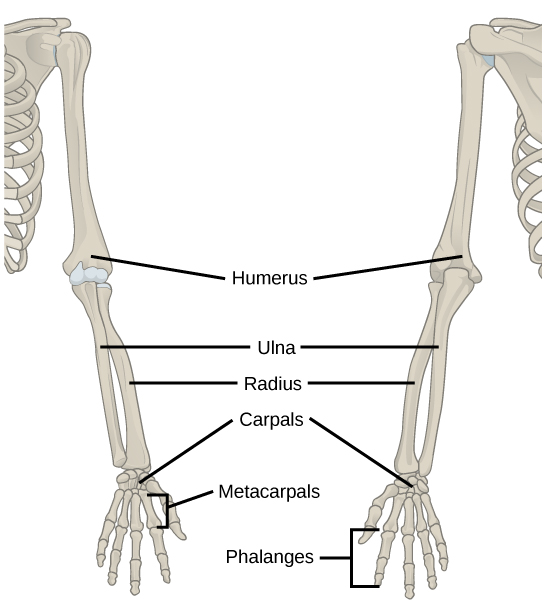


Figure 38.12図 38.12
The upper limb consists of the humerus of the upper arm, the radius and ulna of the forearm, eight bones of the carpus, five bones of the metacarpus, and 14 bones of the phalanges.
上肢は、上腕の上腕骨、前腕の橈骨と尺骨、8個の手根骨、5個の中手骨、14個の指骨からなる。
An articulation is any place at which two bones are joined. The humerus is the largest and longest bone of the upper limb and the only bone of the arm. It articulates with the scapula at the shoulder and with the forearm at the elbow. The forearm extends from the elbow to the wrist and consists of two bones: the ulna and the radius. The radius is located along the lateral (thumb) side of the forearm and articulates with the humerus at the elbow. The ulna is located on the medial aspect (pinky-finger side) of the forearm. It is longer than the radius. The ulna articulates with the humerus at the elbow. The radius and ulna also articulate with the carpal bones and with each other, which in vertebrates enables a variable degree of rotation of the carpus with respect to the long axis of the limb. The hand includes the eight bones of the carpus (wrist), the five bones of the metacarpus (palm), and the 14 bones of the phalanges (digits). Each digit consists of three phalanges, except for the thumb, when present, which has only two.
英語のヒント
関節とは、2つの骨がつながる場所をいう。上腕骨は上肢で最も大きく長い骨であり、上腕にある唯一の骨である。肩で肩甲骨と、肘で前腕と関節を形成する。前腕は肘から手首までの部分で、尺骨と橈骨の2個の骨からなる。橈骨は前腕の外側(親指側)にあり、肘で上腕骨と関節を形成する。尺骨は前腕の内側(小指側)にある。尺骨は橈骨より長く、肘で上腕骨と関節を形成する。橈骨と尺骨は、手根骨とも互いどうしとも関節を形成する。これによって、脊椎動物では、肢の長軸に対して手根部をさまざまな程度に回転させることができる。手には、手首の8個の手根骨、手のひらの5個の中手骨、指の14個の指骨が含まれる。各指は3個の指骨からなるが、親指がある場合、その親指だけは2個である。