第38章筋骨格系
Gliding Movement滑走運動
Gliding movements occur as relatively flat bone surfaces move past each other. Gliding movements produce very little rotation or angular movement of the bones. The joints of the carpal and tarsal bones are examples of joints that produce gliding movements.
滑走運動は、比較的平らな骨の表面が互いにずれることで起こる。この運動では、骨の回旋や角度の変化はごくわずかである。手根骨や足根骨の関節は、滑走運動を行う関節の例である。
Angular Movement角運動
Angular movements are produced when the angle between the bones of a joint changes. There are several different types of angular movements, including flexion, extension, hyperextension, abduction, adduction, and circumduction. Flexion, or bending, occurs when the angle between the bones decreases. Moving the forearm upward at the elbow or moving the wrist to move the hand toward the forearm are examples of flexion. Extension is the opposite of flexion in that the angle between the bones of a joint increases. Straightening a limb after flexion is an example of extension. Extension past the regular anatomical position is referred to as hyperextension. This includes moving the neck back to look upward, or bending the wrist so that the hand moves away from the forearm.
英語のヒント
角運動は、関節を構成する骨の間の角度が変わるときに生じる。屈曲、伸展、過伸展、外転、内転、分回しなど、いくつかの種類がある。屈曲、すなわち曲げる動きは、骨の間の角度が小さくなるときに起こる。肘で前腕を上に動かすことや、手首を動かして手を前腕へ近づけることは、屈曲の例である。伸展は、関節を構成する骨の間の角度が大きくなるという点で、屈曲と反対である。曲げた後の四肢をまっすぐ伸ばすことは、伸展の例である。通常の解剖学的位置を超えて伸展することを過伸展という。首を後ろへ動かして上を向くことや、手が前腕から遠ざかるように手首を曲げることが含まれる。
Abduction occurs when a bone moves away from the midline of the body. Examples of abduction are moving the arms or legs laterally to lift them straight out to the side. Adduction is the movement of a bone toward the midline of the body. Movement of the limbs inward after abduction is an example of adduction. Circumduction is the movement of a limb in a circular motion, as in moving the arm in a circular motion.
英語のヒント
外転は、骨が体の正中線から離れる方向へ動くことである。腕や脚を外側に動かして、真横へまっすぐ持ち上げる動きがその例である。内転は、骨が体の正中線へ近づく動きである。外転した四肢を内側へ戻す動きは内転の例である。分回しは、腕を円を描くように動かす場合のように、四肢を円状に動かすことである。
Rotational Movement回旋運動
Rotational movement is the movement of a bone as it rotates around its longitudinal axis. Rotation can be toward the midline of the body, which is referred to as medial rotation, or away from the midline of the body, which is referred to as lateral rotation. Movement of the head from side to side is an example of rotation.
英語のヒント
回旋運動は、骨が自身の長軸を中心に回転する動きである。体の正中線へ向かう回旋を内旋、正中線から離れる回旋を外旋という。頭を左右に向ける動きは、回旋の例である。
Special Movements特殊な運動
Some movements that cannot be classified as gliding, angular, or rotational are called special movements. Inversion involves the soles of the feet moving inward, toward the midline of the body. Eversion is the opposite of inversion, movement of the sole of the foot outward, away from the midline of the body. Protraction is the anterior movement of a bone in the horizontal plane. Retraction occurs as a joint moves back into position after protraction. Protraction and retraction can be seen in the movement of the mandible as the jaw is thrust outwards and then back inwards. Elevation is the movement of a bone upward, such as when the shoulders are shrugged, lifting the scapulae. Depression is the opposite of elevation—movement downward of a bone, such as after the shoulders are shrugged and the scapulae return to their normal position from an elevated position. Dorsiflexion is a bending at the ankle such that the toes are lifted toward the knee. Plantar flexion is a bending at the ankle when the heel is lifted, such as when standing on the toes. Supination is the movement of the radius and ulna bones of the forearm so that the palm faces forward. Pronation is the opposite movement, in which the palm faces backward. Opposition is the movement of the thumb toward the fingers of the same hand, making it possible to grasp and hold objects.
英語のヒント
滑走運動、角運動、回旋運動に分類できない動きの一部を、特殊な運動と呼ぶ。内反は、足の裏が内側、すなわち体の正中線へ向く動きである。外反はその反対で、足の裏が外側、すなわち体の正中線から離れる方向へ向く。前方突出は、水平面内で骨を前方へ動かすことである。後退は、前方突出の後に関節が元の位置へ戻るときに起こる。下顎を前へ突き出してから後ろへ引く動きで、前方突出と後退を見ることができる。挙上は、肩をすくめて肩甲骨を持ち上げるときのように、骨を上へ動かすことである。下制はその反対で、骨を下へ動かす。肩をすくめた後、肩甲骨が上がった位置から通常の位置へ戻る動きなどがその例である。背屈は、つま先を膝へ向けて持ち上げるように、足首を曲げることである。底屈は、つま先立ちのときのように、かかとを持ち上げる方向へ足首を曲げることである。回外は、前腕の橈骨と尺骨を動かし、手のひらを前へ向けることである。回内はその反対で、手のひらを後ろへ向ける動きである。対立は、親指を同じ手のほかの指へ近づける動きであり、物をつかんで保持することを可能にする。
Types of Synovial Joints滑膜性関節の種類
Synovial joints are further classified into six different categories on the basis of the shape and structure of the joint. The shape of the joint affects the type of movement permitted by the joint (Figure 38.26). These joints can be described as planar, hinge, pivot, condyloid, saddle, or ball-and-socket joints.
英語のヒント
滑膜性関節は、形と構造に基づいて、さらに6種類に分けられる。関節の形は、その関節が可能にする運動の種類に影響する(図38.26)。平面関節、蝶番関節、車軸関節、顆状関節、鞍関節、球関節がある。
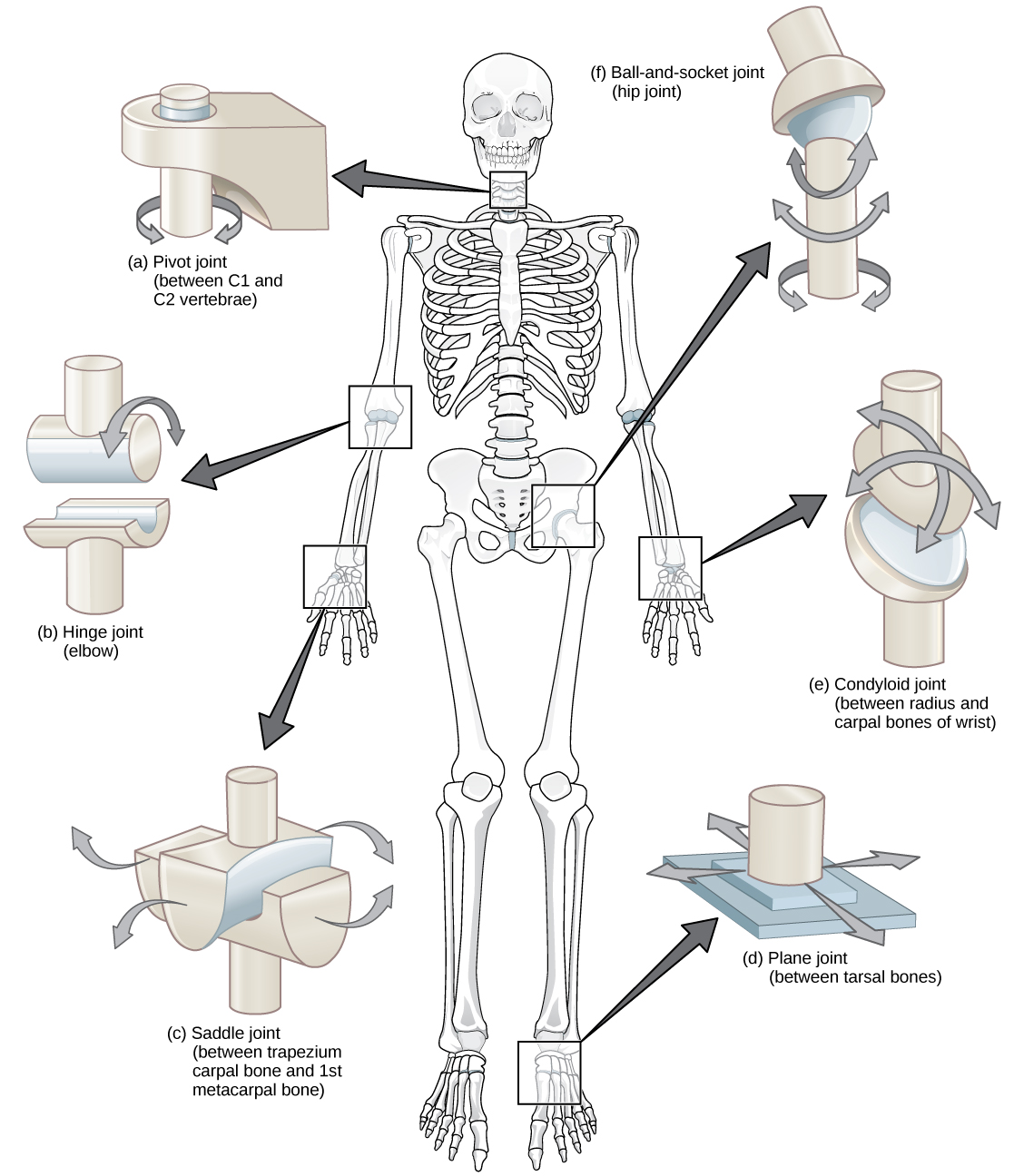

Figure 38.26図 38.26
Different types of joints allow different types of movement. Planar, hinge, pivot, condyloid, saddle, and ball-and-socket are all types of synovial joints.
異なる種類の関節は、それぞれ異なる種類の運動を可能にする。平面関節、蝶番関節、車軸関節、顆状関節、鞍関節、球関節は、すべて滑膜性関節の種類である。
Planar Joints平面関節
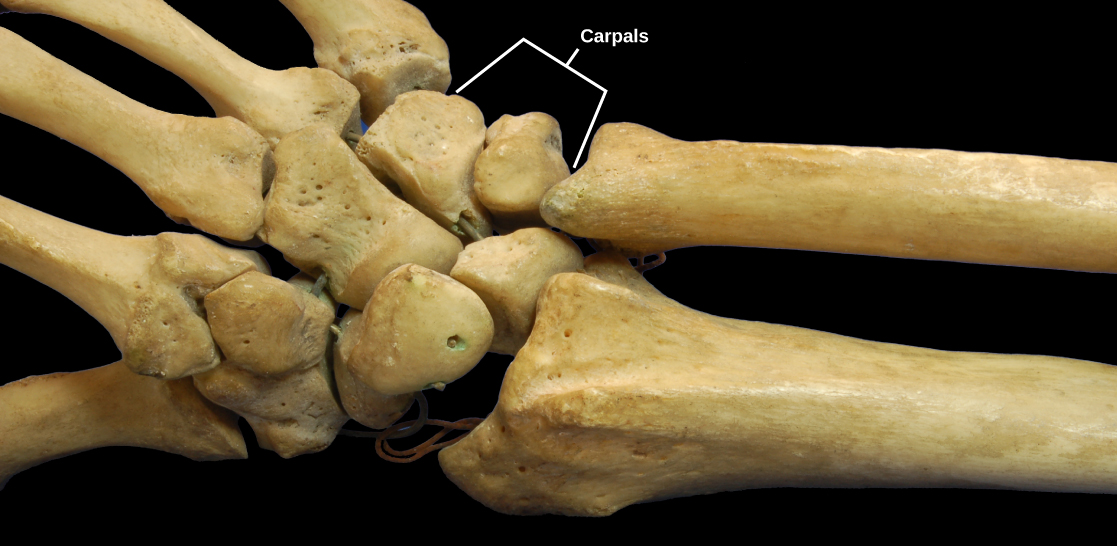
Planar joints have bones with articulating surfaces that are flat or slightly curved faces. These joints allow for gliding movements, and so the joints are sometimes referred to as gliding joints. The range of motion is limited in these joints and does not involve rotation. Planar joints are found in the carpal bones in the hand and the tarsal bones of the foot, as well as between vertebrae (Figure 38.27).
平面関節では、骨の関節面が平らか、わずかに曲がっている。この関節では滑走運動が可能なため、滑走関節と呼ばれることもある。可動域は限られ、回旋は起こらない。平面関節は、手の手根骨、足の足根骨、椎骨の間に見られる(図38.27)。
OpenStax, Rice University; Biology 2e. (credit: modification of work by Brian C. Goss) · CC BY 4.0 · Source出典

Figure 38.27図 38.27
The joints of the carpal bones in the wrist are examples of planar joints. (credit: modification of work by Brian C. Goss)
手首の手根骨の関節は、平面関節の例である。(出典:Brian C. Gossの作品を改変)