第38章筋骨格系
Hinge Joints蝶番関節
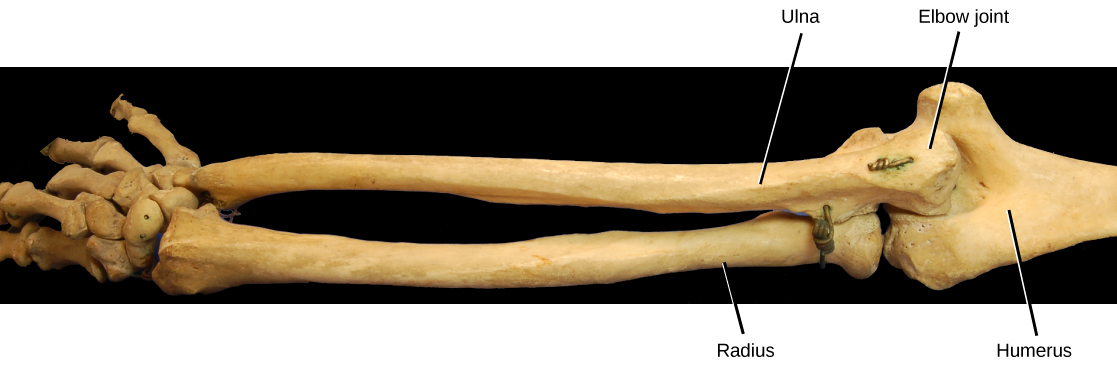
In hinge joints, the slightly rounded end of one bone fits into the slightly hollow end of the other bone. In this way, one bone moves while the other remains stationary, like the hinge of a door. The elbow is an example of a hinge joint. The knee is sometimes classified as a modified hinge joint (Figure 38.28).
英語のヒント
蝶番関節では、一方の骨の少し丸くなった端が、もう一方の骨の少しくぼんだ端にはまる。この構造により、ドアの蝶番のように、一方の骨が静止している間に、もう一方の骨が動く。肘は蝶番関節の例である。膝は、変形した蝶番関節として分類されることがある(図38.28)。
OpenStax, Rice University; Biology 2e. (credit: modification of work by Brian C. Goss) · CC BY 4.0 · Source出典
Figure 38.28図 38.28
The elbow joint, where the radius articulates with the humerus, is an example of a hinge joint. (credit: modification of work by Brian C. Goss)
橈骨が上腕骨と関節を形成する肘関節は、蝶番関節の例である。(出典:Brian C. Gossの作品を改変)
Pivot Joints車軸関節
Pivot joints consist of the rounded end of one bone fitting into a ring formed by the other bone. This structure allows rotational movement, as the rounded bone moves around its own axis. An example of a pivot joint is the joint of the first and second vertebrae of the neck that allows the head to move back and forth (Figure 38.29). The joint of the wrist that allows the palm of the hand to be turned up and down is also a pivot joint.
車軸関節では、一方の骨の丸い端が、もう一方の骨のつくる輪にはまる。丸い骨が自身の軸の周囲を動くため、この構造は回旋運動を可能にする。例として、第1頸椎と第2頸椎の関節がある。この関節によって、頭を往復させることができる(図38.29)。手のひらを上向きや下向きにする手首の関節も、車軸関節である。
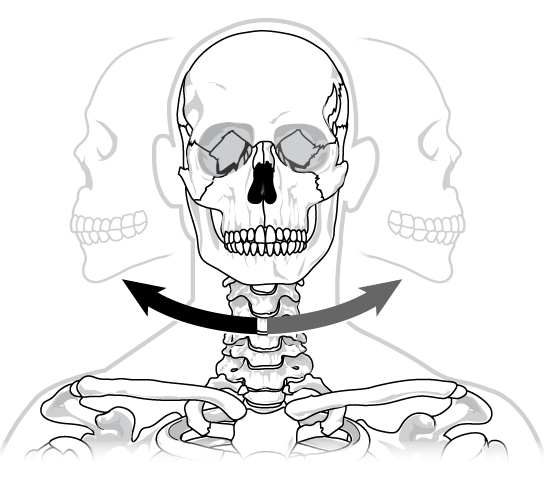
Figure 38.29図 38.29
The joint in the neck that allows the head to move back and forth is an example of a pivot joint.
頭を往復させることを可能にする首の関節は、車軸関節の例である。
Condyloid Joints顆状関節
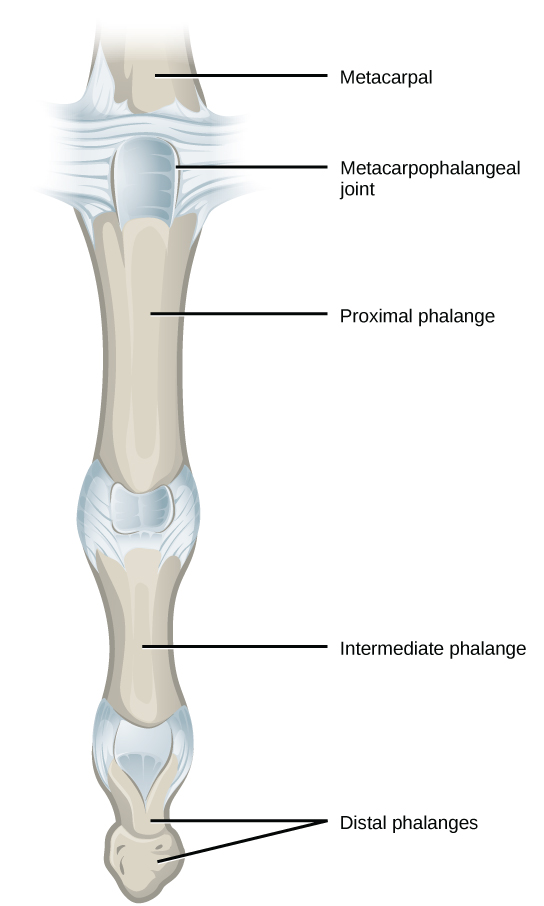
Condyloid joints consist of an oval-shaped end of one bone fitting into a similarly oval-shaped hollow of another bone (Figure 38.30). This is also sometimes called an ellipsoidal joint. This type of joint allows angular movement along two axes, as seen in the joints of the wrist and fingers, which can move both side to side and up and down.
英語のヒント
顆状関節では、一方の骨の楕円形の端が、もう一方の骨の同じく楕円形のくぼみにはまる(図38.30)。楕円関節と呼ばれることもある。この種類の関節では、2本の軸に沿う角運動が可能である。手首や指の関節がその例で、左右にも上下にも動くことができる。
OpenStax, Rice University; Biology 2e. (credit: modification of work by Gray's Anatomy) · CC BY 4.0 · Source出典
Figure 38.30図 38.30
The metacarpophalangeal joint in the finger is an example of a condyloid joint. (credit: modification of work by Gray's Anatomy)
指の中手指節関節は、顆状関節の例である。(出典:Gray’s Anatomyの作品を改変)
Saddle Joints鞍関節
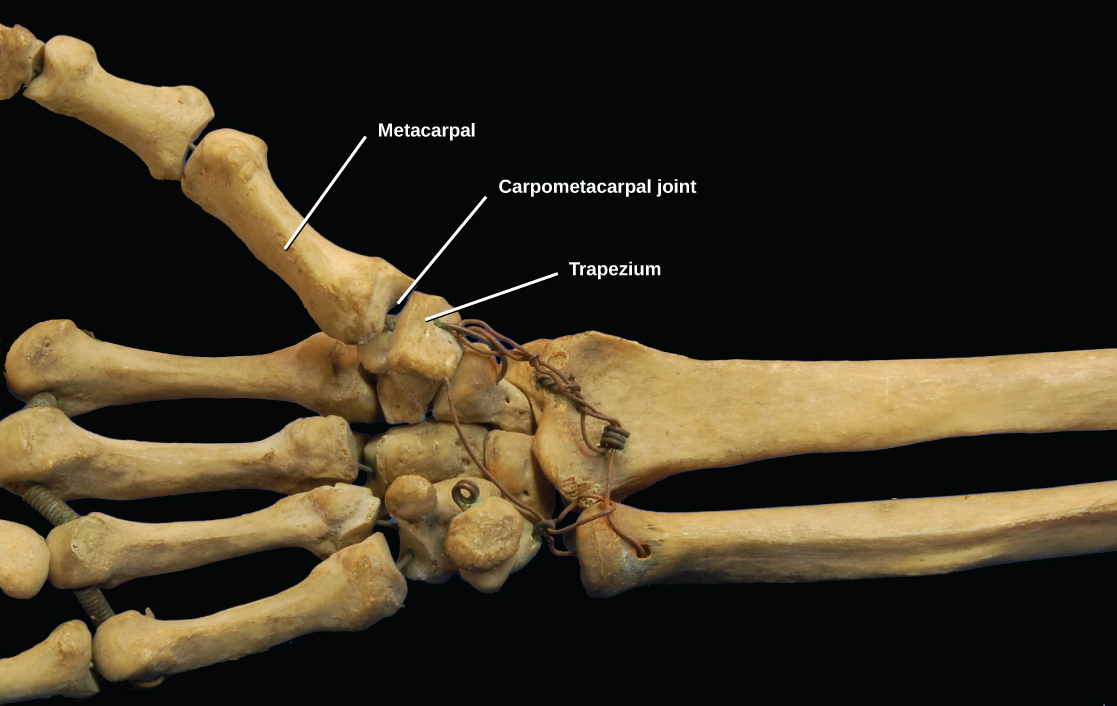
Saddle joints are so named because the ends of each bone resemble a saddle, with concave and convex portions that fit together. Saddle joints allow angular movements similar to condyloid joints but with a greater range of motion. An example of a saddle joint is the thumb joint, which can move back and forth and up and down, but more freely than the wrist or fingers (Figure 38.31).
英語のヒント
鞍関節は、各骨の端が、互いにはまり合う凹部と凸部をもつ鞍に似ていることから名付けられた。顆状関節に似た角運動ができるが、可動域はさらに広い。例として、親指の関節がある。この関節は前後にも上下にも動くが、手首やほかの指より自由に動く(図38.31)。
OpenStax, Rice University; Biology 2e. (credit: modification of work by Brian C. Goss) · CC BY 4.0 · Source出典
Figure 38.31図 38.31
The carpometacarpal joints in the thumb are examples of saddle joints. (credit: modification of work by Brian C. Goss)
親指の手根中手関節は、鞍関節の例である。(出典:Brian C. Gossの作品を改変)
Ball-and-Socket Joints球関節
Ball-and-socket joints possess a rounded, ball-like end of one bone fitting into a cuplike socket of another bone. This organization allows the greatest range of motion, as all movement types are possible in all directions. Examples of ball-and-socket joints are the shoulder and hip joints (Figure 38.32).
球関節では、一方の骨の球状に丸くなった端が、もう一方の骨の杯状のくぼみにはまる。この構造では、あらゆる方向にすべての種類の運動が可能なため、可動域が最も広い。肩関節と股関節は、球関節の例である(図38.32)。
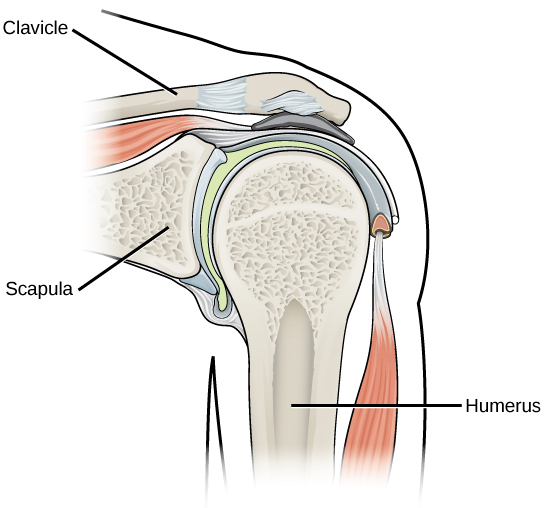


Figure 38.32図 38.32
The shoulder joint is an example of a ball-and-socket joint.
肩関節は、球関節の例である。