第34章動物の栄養と消化器系
34.3 Digestive System Processes34.3 消化系の過程
Learning Objectives学習目標
By the end of this section, you will be able to do the following:
この節を学ぶと、次のことができるようになる。
- Describe the process of digestion消化の過程を説明する。
- Detail the steps involved in digestion and absorption消化と吸収の各段階を詳しく述べる。
- Define elimination排出を定義する。
- Explain the role of both the small and large intestines in absorption吸収における小腸と大腸の役割を説明する。
Obtaining nutrition and energy from food is a multistep process. For true animals, the first step is ingestion, the act of taking in food. This is followed by digestion, absorption, and elimination. In the following sections, each of these steps will be discussed in detail.
食物から栄養とエネルギーを得るのは、複数の段階からなる過程である。真正の動物では、最初の段階は食物を取り込む行為、すなわち摂取である。その後に消化、吸収、排出が続く。以下では、これらの各段階を詳しく説明する。
Ingestion摂取
The large molecules found in intact food cannot pass through the cell membranes. Food needs to be broken into smaller particles so that animals can harness the nutrients and organic molecules. The first step in this process is ingestion. Ingestion is the process of taking in food through the mouth. In vertebrates, the teeth, saliva, and tongue play important roles in mastication (preparing the food into bolus). While the food is being mechanically broken down, the enzymes in saliva begin to chemically process the food as well. The combined action of these processes modifies the food from large particles to a soft mass that can be swallowed and can travel the length of the esophagus.
英語のヒント
未処理の食物にある大きな分子は、細胞膜を通過できない。動物が栄養素と有機分子を利用するには、食物を小さな粒子へ分解する必要がある。その最初の段階が摂取である。摂取とは、口から食物を取り込む過程をいう。脊椎動物では、歯、唾液、舌が咀嚼(食物を食塊に整えること)に重要な役割を果たす。食物が機械的に砕かれる間に、唾液の酵素も食物の化学的な処理を始める。これらの作用が組み合わさり、食物は大きな粒子から、飲み込んで食道全体を通過できる柔らかい塊へ変わる。
Digestion and Absorption消化と吸収
Digestion is the mechanical and chemical breakdown of food into small organic fragments. It is important to break down macromolecules into smaller fragments that are of suitable size for absorption across the digestive epithelium. Large, complex molecules of proteins, polysaccharides, and lipids must be reduced to simpler particles such as simple sugar before they can be absorbed by the digestive epithelial cells. Different organs play specific roles in the digestive process. The animal diet needs carbohydrates, protein, and fat, as well as vitamins and inorganic components for nutritional balance. How each of these components is digested is discussed in the following sections.
英語のヒント
消化とは、食物を機械的・化学的に小さな有機物の断片へ分解することである。高分子を、消化上皮を通して吸収するのに適した大きさへ分けることが重要となる。大きく複雑なタンパク質、多糖、脂質の分子は、消化上皮細胞に吸収される前に、単糖などのより単純な粒子へ分解されなければならない。消化では、器官ごとに特定の役割を果たす。動物の食事には、栄養のバランスを保つため、ビタミンや無機成分に加えて、炭水化物、タンパク質、脂肪が必要である。これらの各成分がどのように消化されるかを、以下で説明する。
Carbohydrates炭水化物
The digestion of carbohydrates begins in the mouth. The salivary enzyme amylase begins the breakdown of food starches into maltose, a disaccharide. As the bolus of food travels through the esophagus to the stomach, no significant digestion of carbohydrates takes place. The esophagus produces no digestive enzymes but does produce mucous for lubrication. The acidic environment in the stomach stops the action of the amylase enzyme.
英語のヒント
炭水化物の消化は口で始まる。唾液の酵素アミラーゼが、食物中のデンプンを二糖のマルトースへ分解し始める。食塊が食道を通って胃へ進む間、炭水化物の消化はほとんど起こらない。食道は消化酵素をつくらないが、潤滑のための粘液はつくる。胃の酸性環境は、アミラーゼの作用を止める。
The next step of carbohydrate digestion takes place in the duodenum. Recall that the chyme from the stomach enters the duodenum and mixes with the digestive secretion from the pancreas, liver, and gallbladder. Pancreatic juices also contain amylase, which continues the breakdown of starch and glycogen into maltose, a disaccharide. The disaccharides are broken down into monosaccharides by enzymes called maltases, sucrases, and lactases, which are also present in the brush border of the small intestinal wall. Maltase breaks down maltose into glucose. Other disaccharides, such as sucrose and lactose are broken down by sucrase and lactase, respectively. Sucrase breaks down sucrose (or “table sugar”) into glucose and fructose, and lactase breaks down lactose (or “milk sugar”) into glucose and galactose. The monosaccharides (glucose) thus produced are absorbed and then can be used in metabolic pathways to harness energy. The monosaccharides are transported across the intestinal epithelium into the bloodstream to be transported to the different cells in the body. The steps in carbohydrate digestion are summarized in Figure 34.16 and Table 34.5.
英語のヒント
炭水化物消化の次の段階は十二指腸で行われる。胃からのキームが十二指腸へ入り、膵臓、肝臓、胆嚢からの消化分泌物と混ざることを思い出そう。膵液にもアミラーゼが含まれ、デンプンとグリコーゲンを二糖のマルトースへ分解し続ける。二糖は、小腸壁の刷子縁にも存在するマルターゼ、スクラーゼ、ラクターゼという酵素によって単糖へ分解される。マルターゼはマルトースをグルコースへ分解する。スクロースやラクトースなど、他の二糖は、それぞれスクラーゼとラクターゼによって分解される。スクラーゼはスクロース(「砂糖」)をグルコースとフルクトースへ、ラクターゼはラクトース(「乳糖」)をグルコースとガラクトースへ分解する。こうしてできる単糖(グルコース)は吸収され、代謝経路に使われてエネルギーを得られるようになる。単糖は腸上皮を通って血流に入り、体のさまざまな細胞へ運ばれる。炭水化物消化の段階を図34.16と表34.5にまとめる。
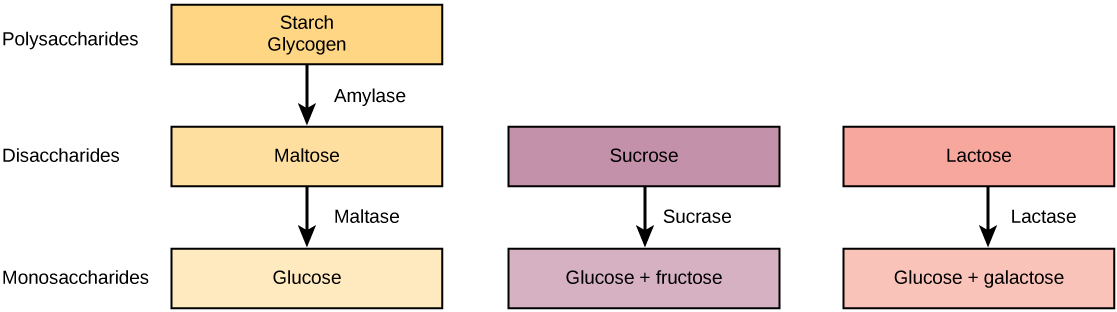
Figure 34.16図 34.16
Digestion of carbohydrates is performed by several enzymes. Starch and glycogen are broken down into glucose by amylase and maltase. Sucrose (table sugar) and lactose (milk sugar) are broken down by sucrase and lactase, respectively.
炭水化物の消化は複数の酵素が担う。デンプンとグリコーゲンは、アミラーゼとマルターゼによってグルコースへ分解される。スクロース(砂糖)とラクトース(乳糖)は、それぞれスクラーゼとラクターゼによって分解される。
Digestion of Carbohydrates 炭水化物の消化 |
||||
|---|---|---|---|---|
Enzyme 酵素 |
Produced By 産生部位 |
Site of Action 作用部位 |
Substrate Acting On 作用する基質 |
End Products 最終産物 |
Salivary amylase 唾液アミラーゼ |
Salivary glands 唾液腺 |
Mouth 口 |
Polysaccharides (Starch) 多糖(デンプン) |
Disaccharides (maltose), oligosaccharides 二糖(マルトース)、オリゴ糖 |
Pancreatic amylase 膵アミラーゼ |
Pancreas 膵臓 |
Small intestine 小腸 |
Polysaccharides (starch) 多糖(デンプン) |
Disaccharides (maltose), monosaccharides 二糖(マルトース)、単糖 |
Oligosaccharidases オリゴ糖分解酵素 |
Lining of the intestine; brush border membrane 腸の内面、刷子縁膜 |
Small intestine 小腸 |
Disaccharides 二糖 |
Monosaccharides (e.g., glucose, fructose, galactose) 単糖(例:グルコース、フルクトース、ガラクトース) |
Proteinタンパク質
A large part of protein digestion takes place in the stomach. The enzyme pepsin plays an important role in the digestion of proteins by breaking down the intact protein to peptides, which are short chains of four to nine amino acids. In the duodenum, other enzymes—trypsin, elastase, and chymotrypsin—act on the peptides reducing them to smaller peptides. Trypsin, elastase, carboxypeptidase, and chymotrypsin are produced by the pancreas and released into the duodenum where they act on the chyme. Further breakdown of peptides to single amino acids is aided by enzymes called peptidases (those that break down peptides). Specifically, carboxypeptidase, dipeptidase, and aminopeptidase play important roles in reducing the peptides to free amino acids. The amino acids are absorbed into the bloodstream through the small intestines. The steps in protein digestion are summarized in Figure 34.17 and Table 34.6.
英語のヒント
タンパク質消化のかなりの部分は胃で行われる。ペプシンは、未分解のタンパク質を、アミノ酸4〜9個からなる短い鎖であるペプチドへ分解し、タンパク質の消化に重要な役割を果たす。十二指腸では、トリプシン、エラスターゼ、キモトリプシンという他の酵素がペプチドに作用し、より小さなペプチドにする。トリプシン、エラスターゼ、カルボキシペプチダーゼ、キモトリプシンは膵臓でつくられて十二指腸へ放出され、キームに作用する。ペプチドを個々のアミノ酸へさらに分解するのを助けるのが、ペプチダーゼ(ペプチドを分解する酵素)である。特にカルボキシペプチダーゼ、ジペプチダーゼ、アミノペプチダーゼが、ペプチドを遊離アミノ酸へ分解するうえで重要である。アミノ酸は小腸を通して血流へ吸収される。タンパク質消化の段階を図34.17と表34.6にまとめる。
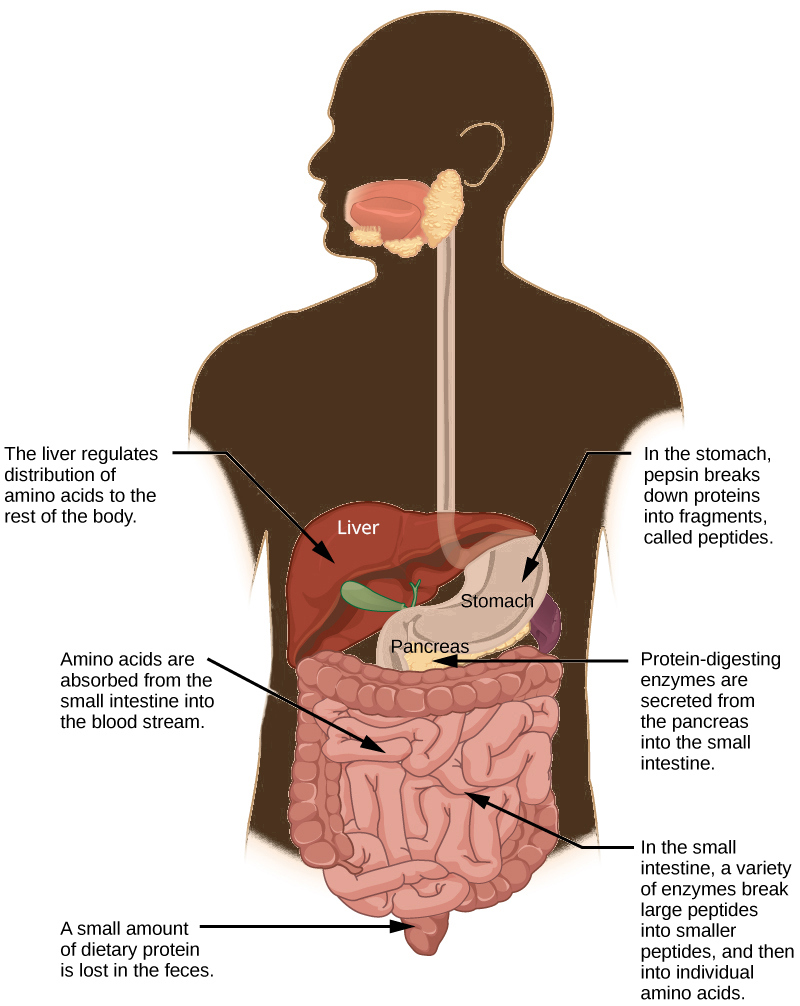


Figure 34.17図 34.17
Protein digestion is a multistep process that begins in the stomach and continues through the intestines.
タンパク質消化は、胃で始まり腸で続く、複数段階の過程である。
Digestion of Protein タンパク質の消化 |
||||
|---|---|---|---|---|
Enzyme 酵素 |
Produced By 産生部位 |
Site of Action 作用部位 |
Substrate Acting On 作用する基質 |
End Products 最終産物 |
Pepsin ペプシン |
Stomach chief cells 胃の主細胞 |
Stomach 胃 |
Proteins タンパク質 |
Peptides ペプチド |
|
Pancreas 膵臓 |
Small intestine 小腸 |
Peptides ペプチド |
Smaller Peptides より小さなペプチド |
Carboxypeptidase カルボキシペプチダーゼ |
Pancreas 膵臓 |
Small intestine 小腸 |
Peptides ペプチド |
Amino acids and peptides アミノ酸とペプチド |
|
Lining of intestine 腸の内面 |
Small intestine 小腸 |
Peptides ペプチド |
Amino acids アミノ酸 |