第34章動物の栄養と消化器系
Ruminants反芻動物
Ruminants are mainly herbivores like cows, sheep, and goats, whose entire diet consists of eating large amounts of roughage or fiber. They have evolved digestive systems that help them digest vast amounts of cellulose. An interesting feature of the ruminants’ mouth is that they do not have upper incisor teeth. They use their lower teeth, tongue and lips to tear and chew their food. From the mouth, the food travels to the esophagus and on to the stomach.
英語のヒント
反芻動物は主にウシ、ヒツジ、ヤギなどの草食動物で、その食事は大量の粗飼料、すなわち繊維質からなる。大量のセルロースの消化を助ける消化系を進化させてきた。反芻動物の口の興味深い特徴は、上顎の切歯がないことである。下の歯、舌、唇を使って食物を引きちぎり、かむ。食物は口から食道を通って胃へ進む。
To help digest the large amount of plant material, the stomach of the ruminants is a multi-chambered organ, as illustrated in Figure 34.8. The four compartments of the stomach are called the rumen, reticulum, omasum, and abomasum. These chambers contain many microbes that breakdown cellulose and ferment ingested food. The abomasum is the “true” stomach and is the equivalent of the monogastric stomach chamber where gastric juices are secreted. The four-compartment gastric chamber provides larger space and the microbial support necessary to digest plant material in ruminants. The fermentation process produces large amounts of gas in the stomach chamber, which must be eliminated. As in other animals, the small intestine plays an important role in nutrient absorption, and the large intestine helps in the elimination of waste.
英語のヒント
大量の植物質の消化を助けるため、反芻動物の胃は図34.8に示すように複数の部屋からなる。四つの区画は、第一胃(ルーメン)、第二胃(蜂巣胃)、第三胃(重弁胃)、第四胃(皺胃)と呼ばれる。これらの部屋には、セルロースを分解して摂取した食物を発酵させる微生物が多くいる。第四胃は「真の」胃で、胃液を分泌する単胃動物の胃に相当する。四室からなる胃は、反芻動物が植物質を消化するために必要な広い空間と微生物の助けを提供する。発酵では胃内に大量の気体が生じ、これを排出しなければならない。他の動物と同様、小腸は栄養吸収で重要な役割を果たし、大腸は不要物の排出を助ける。
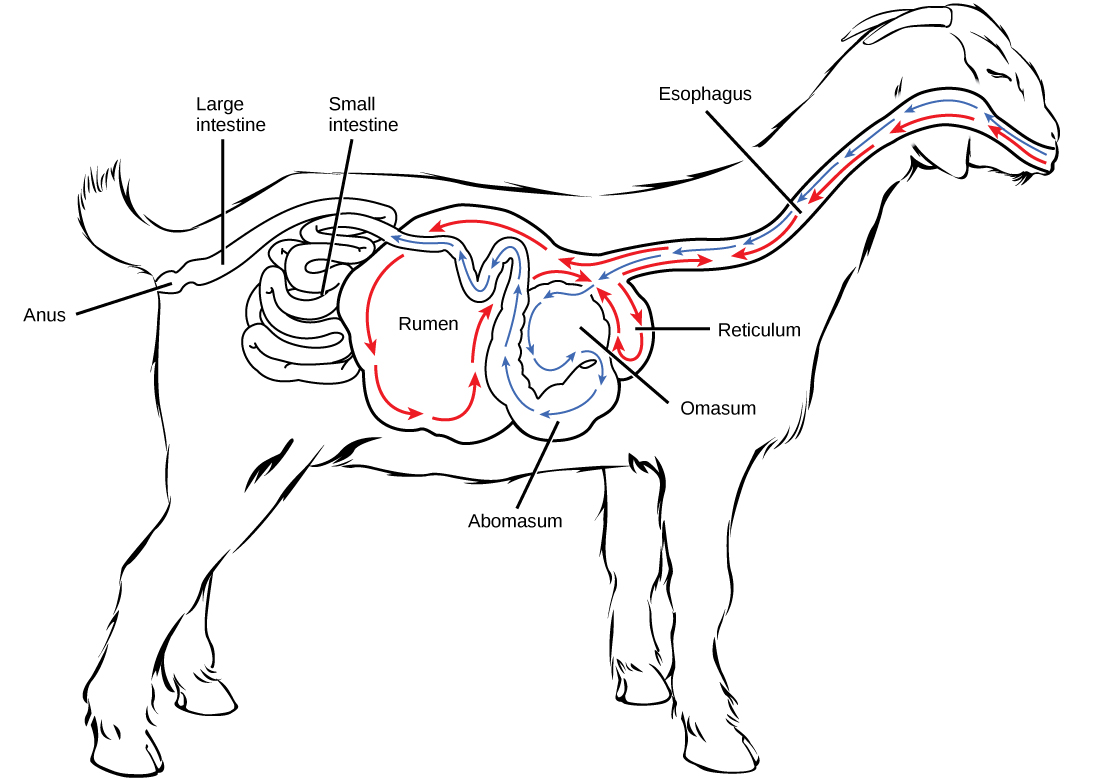

Figure 34.8図 34.8
Ruminant animals, such as goats and cows, have four stomachs. The first two stomachs, the rumen and the reticulum, contain prokaryotes and protists that are able to digest cellulose fiber. The ruminant regurgitates cud from the reticulum, chews it, and swallows it into a third stomach, the omasum, which removes water. The cud then passes onto the fourth stomach, the abomasum, where it is digested by enzymes produced by the ruminant.
ヤギやウシなどの反芻動物には、四つの胃がある。最初の二つである第一胃と第二胃には、セルロース繊維を消化できる原核生物や原生生物がいる。反芻動物は第二胃から反芻塊を吐き戻してかみ直し、水分を除く第三胃へ飲み込む。その後、反芻塊は第四胃へ進み、反芻動物が産生する酵素によって消化される。
Pseudo-ruminants擬反芻動物
Some animals, such as camels and alpacas, are pseudo-ruminants. They eat a lot of plant material and roughage. Digesting plant material is not easy because plant cell walls contain the polymeric sugar molecule cellulose. The digestive enzymes of these animals cannot breakdown cellulose, but microorganisms present in the digestive system can. Therefore, the digestive system must be able to handle large amounts of roughage and break down the cellulose. Pseudo-ruminants have a three-chamber stomach in the digestive system. However, their cecum—a pouched organ at the beginning of the large intestine containing many microorganisms that are necessary for the digestion of plant materials—is large and is the site where the roughage is fermented and digested. These animals do not have a rumen but have an omasum, abomasum, and reticulum.
英語のヒント
ラクダやアルパカなどの動物は擬反芻動物であり、多くの植物質や粗飼料を食べる。植物の細胞壁には、高分子の糖であるセルロースが含まれるため、植物質の消化は容易ではない。これらの動物の消化酵素はセルロースを分解できないが、消化系にいる微生物は分解できる。そのため消化系は、大量の粗飼料を処理し、セルロースを分解できなければならない。擬反芻動物の消化系には三室からなる胃がある。また、盲腸は大きく、粗飼料が発酵・消化される場所となる。盲腸は大腸の始まりにある袋状の器官で、植物質の消化に必要な微生物を多く含む。これらの動物には第一胃がなく、第三胃、第四胃、第二胃がある。
Parts of the Digestive System消化系の各部
The vertebrate digestive system is designed to facilitate the transformation of food matter into the nutrient components that sustain organisms.
脊椎動物の消化系は、食物を、生物を維持する栄養成分へ変換しやすくする構造になっている。
Oral Cavity口腔
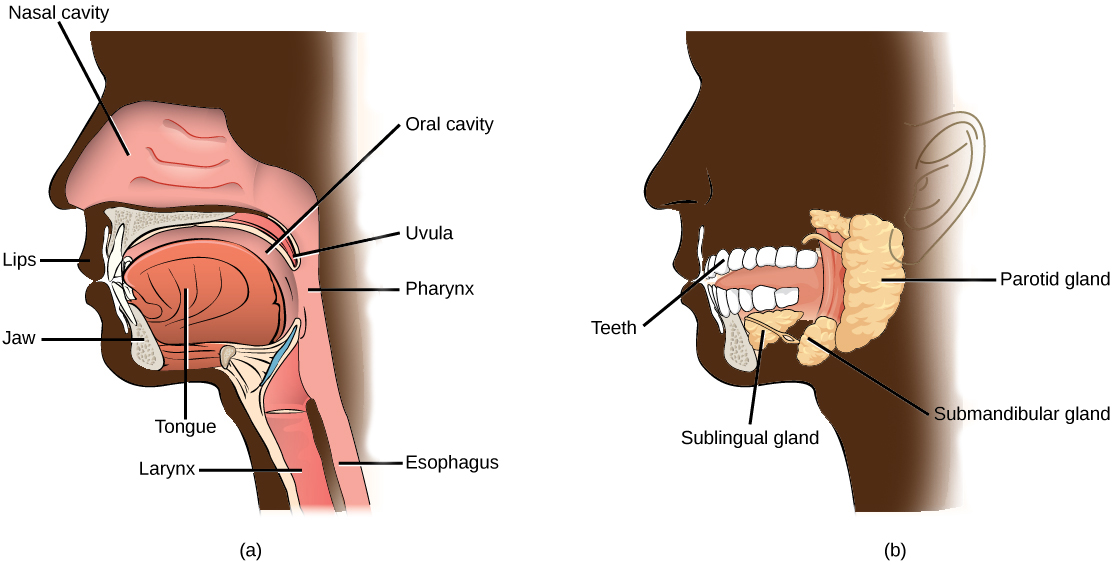
The oral cavity, or mouth, is the point of entry of food into the digestive system, illustrated in Figure 34.9. The food consumed is broken into smaller particles by mastication, the chewing action of the teeth. All mammals have teeth and can chew their food.
口腔、すなわち口は、図34.9に示す消化系へ食物が入る入口である。摂取した食物は咀嚼、すなわち歯でかむ作用によって小さな粒子へ分けられる。すべての哺乳類は歯を持ち、食物をかむことができる。
The extensive chemical process of digestion begins in the mouth. As food is being chewed, saliva, produced by the salivary glands, mixes with the food. Saliva is a watery substance produced in the mouths of many animals. There are three major glands that secrete saliva—the parotid, the submandibular, and the sublingual. Saliva contains mucus that moistens food and buffers the pH of the food. Saliva also contains immunoglobulins and lysozymes, which have antibacterial action to reduce tooth decay by inhibiting growth of some bacteria. Saliva also contains an enzyme called salivary amylase that begins the process of converting starches in the food into a disaccharide called maltose. Another enzyme called lipase is produced by the cells in the tongue. Lipases are a class of enzymes that can breakdown triglycerides. The lingual lipase begins the breakdown of fat components in the food. The chewing and wetting action provided by the teeth and saliva prepare the food into a mass called the bolus for swallowing. The tongue helps in swallowing—moving the bolus from the mouth into the pharynx. The pharynx opens to two passageways: the trachea, which leads to the lungs, and the esophagus, which leads to the stomach. The trachea has an opening called the glottis, which is covered by a cartilaginous flap called the epiglottis. When swallowing, the epiglottis closes the glottis and food passes into the esophagus and not the trachea. This arrangement allows food to be kept out of the trachea.
英語のヒント
消化という広範な化学的過程は口で始まる。食物をかんでいる間に、唾液腺でつくられた唾液が食物と混ざる。唾液は、多くの動物の口内でつくられる水分の多い物質である。唾液を分泌する主な腺は、耳下腺、顎下腺、舌下腺の三つである。唾液には、食物を湿らせ、そのpHの変化を緩衝する粘液が含まれる。免疫グロブリンやリゾチームも含まれ、これらは抗菌作用によって一部の細菌の増殖を抑え、虫歯を減らす。唾液には唾液アミラーゼという酵素も含まれ、食物中のデンプンをマルトースという二糖へ変換し始める。また、舌の細胞はリパーゼという別の酵素を産生する。リパーゼはトリグリセリドを分解できる酵素群であり、舌リパーゼは食物中の脂肪成分の分解を始める。歯による咀嚼と唾液による湿潤によって、食物は食塊という塊に整えられ、飲み込める状態になる。舌は、食塊を口から咽頭へ移す嚥下を助ける。咽頭は、肺へ続く気管と、胃へ続く食道という二つの通路へ開く。気管には声門という開口部があり、喉頭蓋という軟骨性の蓋で覆われる。嚥下の際には喉頭蓋が声門を閉じ、食物は気管ではなく食道へ進む。この仕組みによって、食物が気管に入らないようになっている。
OpenStax, Rice University; Biology 2e. (credit: modification of work by the National Cancer Institute) · CC BY 4.0 · Source出典

Figure 34.9図 34.9
Digestion of food begins in the (a) oral cavity. Food is masticated by teeth and moistened by saliva secreted from the (b) salivary glands. Enzymes in the saliva begin to digest starches and fats. With the help of the tongue, the resulting bolus is moved into the esophagus by swallowing. (credit: modification of work by the National Cancer Institute)
食物の消化は(a)口腔で始まる。食物は歯で咀嚼され、(b)唾液腺から分泌される唾液で湿らされる。唾液の酵素はデンプンと脂肪の消化を始める。できた食塊は、舌の助けを借りて嚥下され、食道へ運ばれる。(クレジット:National Cancer Instituteの作品を改変)