第34章動物の栄養と消化器系
Lipids脂質
Lipid digestion begins in the stomach with the aid of lingual lipase and gastric lipase. However, the bulk of lipid digestion occurs in the small intestine due to pancreatic lipase. When chyme enters the duodenum, the hormonal responses trigger the release of bile, which is produced in the liver and stored in the gallbladder. Bile aids in the digestion of lipids, primarily triglycerides by emulsification. Emulsification is a process in which large lipid globules are broken down into several small lipid globules. These small globules are more widely distributed in the chyme rather than forming large aggregates. Lipids are hydrophobic substances: in the presence of water, they will aggregate to form globules to minimize exposure to water. Bile contains bile salts, which are amphipathic, meaning they contain hydrophobic and hydrophilic parts. Thus, the bile salts hydrophilic side can interface with water on one side and the hydrophobic side interfaces with lipids on the other. By doing so, bile salts emulsify large lipid globules into small lipid globules.
英語のヒント
脂質の消化は、舌リパーゼと胃リパーゼの助けにより胃で始まる。ただし、脂質消化の大半は、膵リパーゼによって小腸で行われる。キームが十二指腸へ入ると、ホルモン応答によって胆汁の放出が引き起こされる。胆汁は肝臓でつくられ、胆嚢に貯蔵される。胆汁は乳化によって、主にトリグリセリドなどの脂質の消化を助ける。乳化とは、大きな脂質の球を、複数の小さな球へ分ける過程である。小さな球は大きな塊をつくる代わりに、キーム内へ広く分散する。脂質は疎水性の物質なので、水があると凝集して球をつくり、水に触れる面積を最小にする。胆汁には両親媒性の胆汁酸塩が含まれる。両親媒性とは、疎水性の部分と親水性の部分を持つことである。そのため、胆汁酸塩の親水性の側は水と接し、反対の疎水性の側は脂質と接することができる。こうして、胆汁酸塩は大きな脂質の球を小さな球へ乳化する。
Why is emulsification important for digestion of lipids? Pancreatic juices contain enzymes called lipases (enzymes that breakdown lipids). If the lipid in the chyme aggregates into large globules, very little surface area of the lipids is available for the lipases to act on, leaving lipid digestion incomplete. By forming an emulsion, bile salts increase the available surface area of the lipids manyfold. The pancreatic lipases can then act on the lipids more efficiently and digest them, as detailed in Figure 34.18. Lipases break down the lipids into fatty acids and glycerides. These molecules can pass through the plasma membrane of the cell and enter the epithelial cells of the intestinal lining. The bile salts surround long-chain fatty acids and monoglycerides forming tiny spheres called micelles. The micelles move into the brush border of the small intestine absorptive cells where the long-chain fatty acids and monoglycerides diffuse out of the micelles into the absorptive cells leaving the micelles behind in the chyme. The long-chain fatty acids and monoglycerides recombine in the absorptive cells to form triglycerides, which aggregate into globules and become coated with proteins. These large spheres are called chylomicrons. Chylomicrons contain triglycerides, cholesterol, and other lipids and have proteins on their surface. The surface is also composed of the hydrophilic phosphate "heads" of phospholipids. Together, they enable the chylomicron to move in an aqueous environment without exposing the lipids to water. Chylomicrons leave the absorptive cells via exocytosis. Chylomicrons enter the lymphatic vessels, and then enter the blood in the subclavian vein.
英語のヒント
なぜ乳化が脂質の消化に重要なのだろうか。膵液にはリパーゼ(脂質を分解する酵素)が含まれる。キーム中の脂質が大きな球に凝集すると、リパーゼが作用できる脂質の表面積はごく小さくなり、脂質の消化が不完全になる。胆汁酸塩は乳濁液をつくることで、利用できる脂質の表面積を何倍にも増やす。その結果、図34.18に示すように、膵リパーゼが脂質へより効率よく作用し、消化できるようになる。リパーゼは脂質を脂肪酸とグリセリドへ分解する。これらの分子は細胞膜を通り抜け、腸内面の上皮細胞に入ることができる。胆汁酸塩は長鎖脂肪酸とモノグリセリドを取り囲み、ミセルという小さな球をつくる。ミセルは小腸の吸収細胞の刷子縁へ移動する。そこで長鎖脂肪酸とモノグリセリドはミセルから拡散して吸収細胞へ入り、ミセルはキーム中に残される。吸収細胞内で長鎖脂肪酸とモノグリセリドは再結合してトリグリセリドをつくり、トリグリセリドは球状に凝集してタンパク質で覆われる。この大きな球をカイロミクロンという。カイロミクロンにはトリグリセリド、コレステロール、その他の脂質が含まれ、表面にはタンパク質がある。表面には、リン脂質の親水性のリン酸「頭部」もある。これらが一緒に働くことで、脂質を水にさらさずに、カイロミクロンが水性環境内を移動できる。カイロミクロンはエキソサイトーシスによって吸収細胞を出る。リンパ管に入り、その後、鎖骨下静脈で血液へ入る。
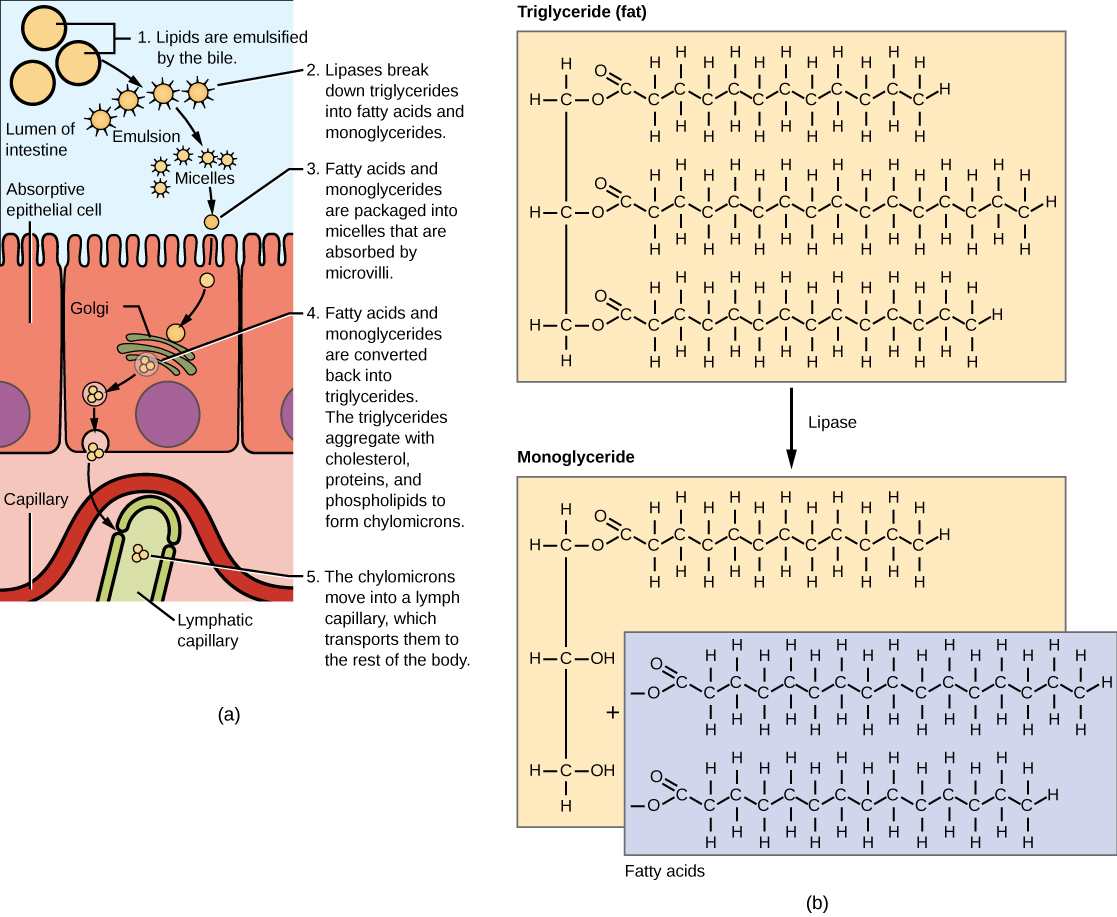

Figure 34.18図 34.18
Lipids are digested and absorbed in the small intestine.
脂質は小腸で消化・吸収される。
Vitaminsビタミン
Vitamins can be either water-soluble or lipid-soluble. Fat soluble vitamins are absorbed in the same manner as lipids. It is important to consume some amount of dietary lipid to aid the absorption of lipid-soluble vitamins. Water-soluble vitamins can be directly absorbed into the bloodstream from the intestine.
ビタミンには水溶性と脂溶性がある。脂溶性ビタミンは、脂質と同じ方法で吸収される。その吸収を助けるため、食事からある程度の脂質を摂取することが重要である。水溶性ビタミンは腸から血流へ直接吸収できる。
Elimination排出
The final step in digestion is the elimination of undigested food content and waste products. The undigested food material enters the colon, where most of the water is reabsorbed. Recall that the colon is also home to the microflora called “intestinal flora” that aid in the digestion process. The semi-solid waste is moved through the colon by peristaltic movements of the muscle and is stored in the rectum. As the rectum expands in response to storage of fecal matter, it triggers the neural signals required to set up the urge to eliminate. The solid waste is eliminated through the anus using peristaltic movements of the rectum.
英語のヒント
消化の最後の段階は、未消化の食物成分と老廃物の排出である。未消化の食物は結腸へ入り、水分の大半が再吸収される。結腸には、消化を助ける「腸内細菌叢」と呼ばれる微生物群も生息することを思い出そう。半固形の不要物は、筋の蠕動によって結腸内を移動し、直腸に貯蔵される。糞がたまって直腸が拡張すると、便意を起こすために必要な神経信号が引き起こされる。固形の不要物は、直腸の蠕動によって肛門から排出される。