第7章細胞呼吸
7.7 Regulation of Cellular Respiration7.7 細胞呼吸の調節
Learning Objectives学習目標
By the end of this section, you will be able to do the following:
この節を学び終えると、次のことができるようになる。
- Describe how feedback inhibition would affect the production of an intermediate or product in a pathwayフィードバック阻害が、経路の中間体や生成物の生産にどのように影響するか説明する。
- Identify the mechanism that controls the rate of the transport of electrons through the electron transport chain電子伝達系を通る電子の輸送速度を制御する仕組みを特定する。
Cellular respiration must be regulated in order to provide balanced amounts of energy in the form of ATP. The cell also must generate a number of intermediate compounds that are used in the anabolism and catabolism of macromolecules. Without controls, metabolic reactions would quickly come to a standstill as the forward and backward reactions reached a state of equilibrium. Resources would be used inappropriately. A cell does not need the maximum amount of ATP that it can make all the time: At times, the cell needs to shunt some of the intermediates to pathways for amino acid, protein, glycogen, lipid, and nucleic acid production. In short, the cell needs to control its metabolism.
英語のヒント
細胞呼吸は、ATPの形で適切な量のエネルギーを供給できるよう、調節されなければならない。細胞はまた、高分子の同化や異化に使う多くの中間化合物をつくる必要がある。制御がなければ、正反応と逆反応が平衡に達し、代謝反応はすぐに行き詰まる。資源も不適切に使われるだろう。細胞は、いつでも最大量のATPを必要としているわけではない。ときには中間体の一部を、アミノ酸、タンパク質、グリコーゲン、脂質、核酸の生産経路へ回す必要がある。つまり、細胞は自らの代謝を制御する必要があるのである。
Regulatory Mechanisms調節の仕組み
A variety of mechanisms is used to control cellular respiration. Some type of control exists at each stage of glucose metabolism. Access of glucose to the cell can be regulated using the GLUT (glucose transporter) proteins that transport glucose (Figure 7.20). Different forms of the GLUT protein control passage of glucose into the cells of specific tissues.
英語のヒント
細胞呼吸の制御には、さまざまな仕組みが使われる。グルコース代謝のどの段階にも、何らかの制御がある。グルコースが細胞へ入ることは、その輸送を担うGLUT(グルコース輸送体)タンパク質によって調節できる(図7.20)。異なる型のGLUTが、特定の組織の細胞へ入るグルコースを制御する。
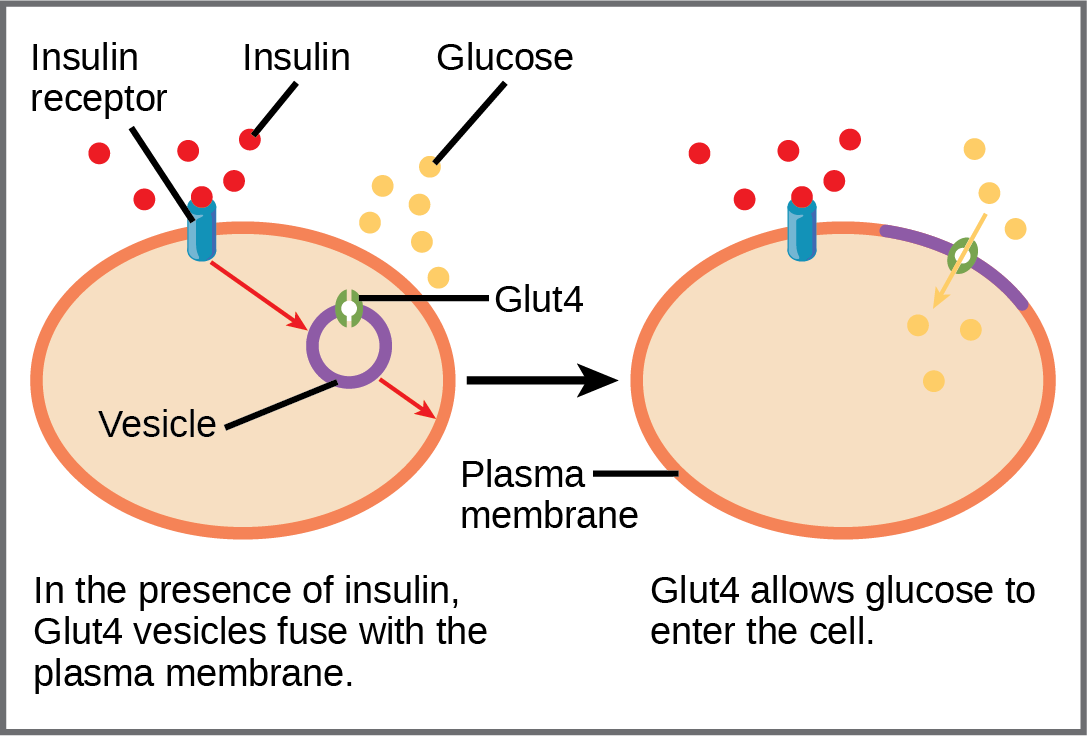
Figure 7.20図 7.20
GLUT4 is a glucose transporter that is stored in vesicles. A cascade of events that occurs upon insulin binding to a receptor in the plasma membrane causes GLUT4-containing vesicles to fuse with the plasma membrane so that glucose may be transported into the cell.
GLUT4は、小胞に蓄えられたグルコース輸送体である。インスリンが細胞膜の受容体に結合すると一連の反応が起こり、GLUT4を含む小胞が細胞膜と融合して、グルコースを細胞内へ運べるようになる。
Some reactions are controlled by having two different enzymes—one each for the two directions of a reversible reaction. Reactions that are catalyzed by only one enzyme can go to equilibrium, stalling the reaction. In contrast, if two different enzymes (each specific for a given direction) are necessary for a reversible reaction, the opportunity to control the rate of the reaction increases, and equilibrium is not reached.
英語のヒント
ある反応は、可逆反応の二つの方向にそれぞれ一つずつ、異なる酵素を用意することで制御される。一つの酵素だけが触媒する反応は、平衡に達して停滞することがある。それに対し、それぞれの方向に特異的な二つの酵素が可逆反応に必要なら、反応速度を制御する機会が増し、平衡に達しない。
A number of enzymes involved in each of the pathways—in particular, the enzyme catalyzing the first committed reaction of the pathway—are controlled by attachment of a molecule to an allosteric site on the protein. The molecules most commonly used in this capacity are the nucleotides ATP, ADP, AMP, NAD+, and NADH. These regulators—allosteric effectors—may increase or decrease enzyme activity, depending on the prevailing conditions. The allosteric effector alters the steric structure of the enzyme, usually affecting the configuration of the active site. This alteration of the protein’s (the enzyme’s) structure either increases or decreases its affinity for its substrate, with the effect of increasing or decreasing the rate of the reaction. The attachment signals to the enzyme. This binding can increase or decrease the enzyme’s activity, providing a feedback mechanism. This feedback type of control is effective as long as the chemical affecting it is attached to the enzyme. Once the overall concentration of the chemical decreases, it will diffuse away from the protein, and the control is relaxed.
英語のヒント
各経路の多数の酵素、特にその経路への進行を決定する最初の反応の酵素は、タンパク質のアロステリック部位への分子の結合によって制御される。最もよく使われる分子は、ヌクレオチドであるATP、ADP、AMP、NAD+、NADHである。これらの調節因子、すなわちアロステリックエフェクターは、そのときの条件に応じて酵素活性を上げたり下げたりする。エフェクターは酵素の立体構造を変え、通常は活性部位の配置に影響する。これによって基質への親和性が増減し、反応速度が上がったり下がったりする。結合が酵素へ信号を伝えるのである。酵素活性を増減させるこの結合が、フィードバックの仕組みを提供する。この制御は、調節する化学物質が酵素に結合している限り有効である。その全体的な濃度が下がると、タンパク質から拡散して離れ、制御は緩む。
Control of Catabolic Pathways異化経路の制御
Enzymes, proteins, electron carriers, and pumps that play roles in glycolysis, the citric acid cycle, and the electron transport chain tend to catalyze nonreversible reactions. In other words, if the initial reaction takes place, the pathway is committed to proceeding with the remaining reactions. Whether a particular enzyme activity is released depends upon the energy needs of the cell (as reflected by the levels of ATP, ADP, and AMP).
英語のヒント
解糖系、クエン酸回路、電子伝達系で働く酵素、タンパク質、電子運搬体、ポンプは、不可逆反応を触媒する傾向がある。言い換えると、最初の反応が起これば、その経路は残りの反応を進むことになる。特定の酵素活性が発揮されるかどうかは、ATP、ADP、AMPの量に反映される、細胞のエネルギー需要によって決まる。
Glycolysis解糖系
The control of glycolysis begins with the first enzyme in the pathway, hexokinase (Figure 7.21). This enzyme catalyzes the phosphorylation of glucose, which helps to prepare the compound for cleavage in a later step. The presence of the negatively charged phosphate in the molecule also prevents the sugar from leaving the cell. When hexokinase is inhibited, glucose diffuses out of the cell and does not become a substrate for the respiration pathways in that tissue. The product of the hexokinase reaction is glucose-6-phosphate, which accumulates when a later enzyme, phosphofructokinase, is inhibited.
英語のヒント
解糖系の制御は、最初の酵素ヘキソキナーゼから始まる(図7.21)。この酵素はグルコースのリン酸化を触媒し、後の段階で切断できるよう準備する。分子中の負に帯電したリン酸は、糖が細胞外へ出ることも防ぐ。ヘキソキナーゼが阻害されると、グルコースは細胞外へ拡散し、その組織の呼吸経路の基質にはならない。反応の生成物はグルコース6-リン酸であり、後段のホスホフルクトキナーゼが阻害されると蓄積する。
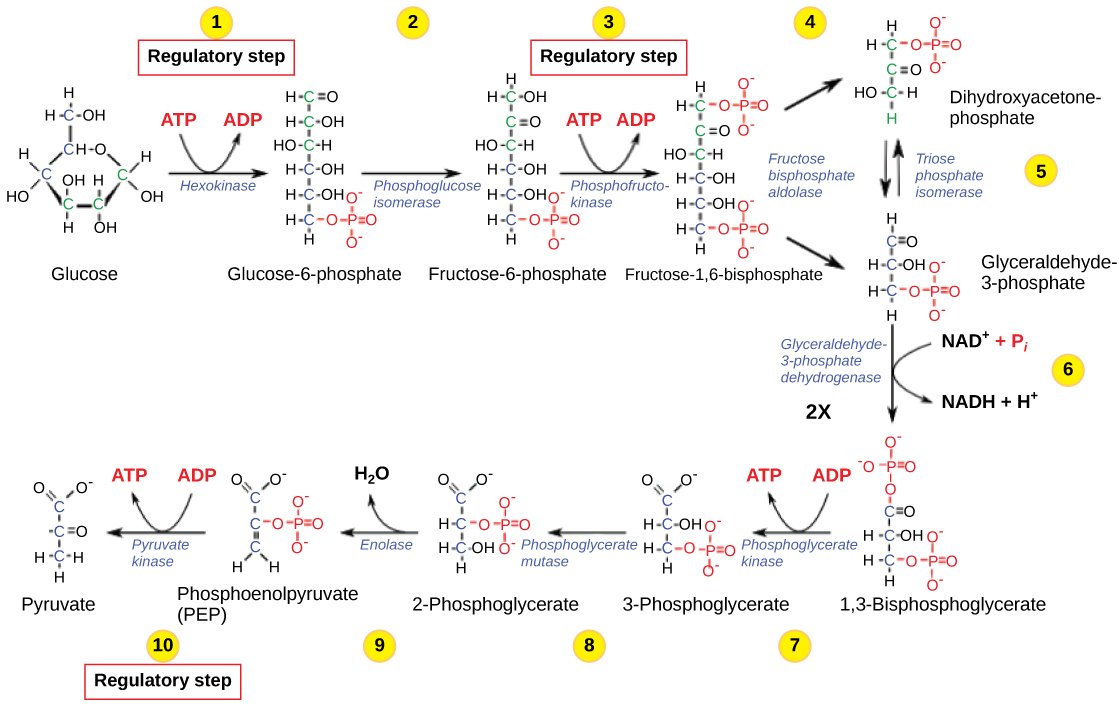


Figure 7.21図 7.21
The glycolysis pathway is primarily regulated at the three key enzymatic steps (1, 3, and 10) as indicated. Note that the first two steps that are regulated occur early in the pathway and involve hydrolysis of ATP.
解糖系は、図に示した三つの主要な酵素反応(第1、第3、第10段階)で主に調節される。調節される最初の二段階は経路の初期にあり、ATPの加水分解を伴うことに注意する。
Phosphofructokinase is the main enzyme controlled in glycolysis. High levels of ATP or citrate or a lower, more acidic pH decreases the enzyme’s activity. An increase in citrate concentration can occur because of a blockage in the citric acid cycle. Fermentation, with its production of organic acids such as lactic acid, frequently accounts for the increased acidity in a cell; however, the products of fermentation do not typically accumulate in cells.
英語のヒント
解糖系で制御される主な酵素は、ホスホフルクトキナーゼである。ATPやクエン酸が多い場合、またはpHが低く酸性が強い場合、活性は低下する。クエン酸濃度は、クエン酸回路が滞ると上昇することがある。乳酸などの有機酸を生む発酵は、細胞内の酸性度上昇の原因となることが多いものの、発酵の生成物は通常、細胞内に蓄積しない。
The last step in glycolysis is catalyzed by pyruvate kinase. The pyruvate produced can proceed to be catabolized or converted into the amino acid alanine. If no more energy is needed and alanine is in adequate supply, the enzyme is inhibited. The enzyme’s activity is increased when fructose-1,6-bisphosphate levels increase. (Recall that fructose-1,6-bisphosphate is an intermediate in the first half of glycolysis.) The regulation of pyruvate kinase involves phosphorylation by kinase, resulting in a less-active enzyme. Dephosphorylation by a phosphatase reactivates it. Pyruvate kinase is also regulated by ATP (a negative allosteric effect).
英語のヒント
解糖系の最後の段階は、ピルビン酸キナーゼが触媒する。生成したピルビン酸は、さらに異化されるか、アミノ酸のアラニンへ変換される。エネルギーがこれ以上必要なく、アラニンも十分なら、この酵素は阻害される。フルクトース1,6-ビスリン酸が増えると、活性は上がる。これは解糖系前半の中間体であることを思い出せ。ピルビン酸キナーゼは、キナーゼによるリン酸化を受けると活性が下がり、ホスファターゼによる脱リン酸化で再活性化される。また、ATPによる負のアロステリック作用でも調節される。
If more energy is needed, more pyruvate will be converted into acetyl CoA through the action of pyruvate dehydrogenase. If either acetyl groups or NADH accumulates, there is less need for the reaction, and the rate decreases. Pyruvate dehydrogenase is also regulated by phosphorylation: a kinase phosphorylates it to form an inactive enzyme, and a phosphatase reactivates it. The kinase and the phosphatase are also regulated.
英語のヒント
さらにエネルギーが必要なら、ピルビン酸デヒドロゲナーゼによって、より多くのピルビン酸がアセチルCoAへ変換される。アセチル基またはNADHが蓄積すると、反応の必要性が減り、速度が下がる。ピルビン酸デヒドロゲナーゼもリン酸化で調節される。キナーゼがリン酸化すると不活性になり、ホスファターゼが再活性化する。そのキナーゼとホスファターゼ自体も調節される。