第7章細胞呼吸
7.4 Oxidative Phosphorylation7.4 酸化的リン酸化
Learning Objectives学習目標
By the end of this section, you will be able to do the following:
この節を学び終えると、次のことができるようになる。
- Describe how electrons move through the electron transport chain and explain what happens to their energy levels during this process電子が電子伝達系をどう移動するかを述べ、その過程でエネルギー準位がどう変わるか説明する。
- Explain how a proton (H+) gradient is established and maintained by the electron transport chain電子伝達系が陽子(H+)勾配をどのようにつくり、維持するか説明する。
You have just read about two pathways in glucose catabolism—glycolysis and the citric acid cycle—that generate ATP. Most of the ATP generated during the aerobic catabolism of glucose, however, is not generated directly from these pathways. Instead, it is derived from a process that begins by moving electrons through a series of electron carriers that undergo redox reactions. This process causes hydrogen ions to accumulate within the intermembranous space. Therefore, a concentration gradient forms in which hydrogen ions diffuse out of the intermembranous space into the mitochondrial matrix by passing through ATP synthase. The current of hydrogen ions powers the catalytic action of ATP synthase, which phosphorylates ADP, producing ATP.
英語のヒント
ここまで、ATPを生産するグルコース異化の二つの経路、解糖系とクエン酸回路を見てきた。しかし、グルコースの好気的異化でできるATPの大部分は、それらから直接生じるのではない。酸化還元反応を行う一連の電子運搬体を通して電子を移動させることから始まる過程で、つくられる。この過程によって膜間腔に水素イオンが蓄積する。濃度勾配ができると、水素イオンはATP合成酵素を通り、膜間腔からミトコンドリアのマトリックスへ拡散する。この水素イオンの流れがATP合成酵素の触媒作用を駆動し、ADPをリン酸化してATPをつくる。
Electron Transport Chain電子伝達系
The electron transport chain (Figure 7.12) is the last component of aerobic respiration and is the only part of glucose metabolism that uses atmospheric oxygen. Oxygen continuously diffuses into plant tissues (typically through stomata), as well as into fungi and bacteria; however, in animals, oxygen enters the body through a variety of respiratory systems. Electron transport is a series of redox reactions that resembles a relay race or bucket brigade in that electrons are passed rapidly from one component to the next, to the endpoint of the chain where the electrons reduce molecular oxygen and, along with associated protons, produces water. There are four complexes composed of proteins, labeled I through IV in Figure 7.12, and the aggregation of these four complexes, together with associated mobile, accessory electron carriers, is called the electron transport chain. The electron transport chain is present with multiple copies in the inner mitochondrial membrane of eukaryotes and within the plasma membrane of prokaryotes.
英語のヒント
電子伝達系(図7.12)は好気呼吸の最後の部分で、グルコース代謝の中で大気中の酸素を使う唯一の部分である。酸素は、植物の組織へ通常は気孔を通じて、また菌類や細菌へも、絶えず拡散する。動物では、さまざまな呼吸器系を通じて体内へ入る。電子伝達は、リレー競走やバケツリレーに似た一連の酸化還元反応である。電子は一つの構成要素から次へと素早く渡され、最後には分子状酸素を還元し、関連する陽子とともに水をつくる。タンパク質からなる四つの複合体があり、図7.12ではI〜IVと表示されている。この四つと、それらに付随する移動可能な補助的電子運搬体をまとめて、電子伝達系と呼ぶ。電子伝達系は、真核生物ではミトコンドリア内膜に、原核生物では細胞膜に、複数組存在する。
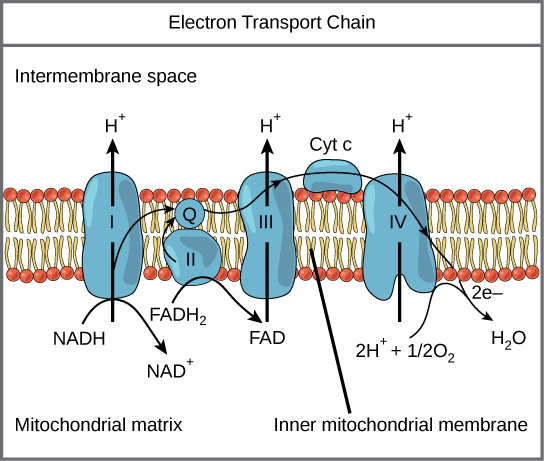

Figure 7.12図 7.12
The electron transport chain is a series of electron transporters embedded in the inner mitochondrial membrane that shuttles electrons from NADH and FADH2 to molecular oxygen. In the process, protons are pumped from the mitochondrial matrix to the intermembrane space, and oxygen is reduced to form water.
電子伝達系は、ミトコンドリア内膜に埋め込まれた一連の電子運搬体で、NADHとFADH2から分子状酸素へ電子を運ぶ。この過程で、陽子がマトリックスから膜間腔へ汲み出され、酸素が還元されて水ができる。
Complex I複合体I
First, two electrons are carried to the first complex via NADH. This complex, labeled I, is composed of flavin mononucleotide (FMN) and an iron-sulfur (Fe-S)-containing protein. FMN, which is derived from vitamin B2 (also called riboflavin), is one of several prosthetic groups or cofactors in the electron transport chain. A prosthetic group is a nonprotein molecule required for the activity of a protein. Prosthetic groups are organic or inorganic, nonpeptide molecules bound to a protein that facilitate its function. Prosthetic groups include coenzymes, which are the prosthetic groups of enzymes. The enzyme in complex I is NADH dehydrogenase and is composed of 44 separate polypeptide chains. Complex I can pump four hydrogen ions across the membrane from the matrix into the intermembrane space, and it is in this way that the hydrogen ion gradient is established and maintained between the two compartments separated by the inner mitochondrial membrane.
英語のヒント
最初に、NADHが電子2個を第1複合体へ運ぶ。Iと表示されるこの複合体は、フラビンモノヌクレオチド(FMN)と鉄–硫黄(Fe-S)を含むタンパク質からなる。FMNは、リボフラビンとも呼ばれるビタミンB2に由来し、電子伝達系のいくつかの補欠分子族または補因子の一つである。補欠分子族とは、タンパク質の活性に必要な、タンパク質以外の分子である。有機性または無機性の、ペプチドではない分子で、タンパク質に結合して機能を助ける。酵素の補欠分子族である補酵素も含まれる。複合体Iの酵素はNADHデヒドロゲナーゼで、44本の別々のポリペプチド鎖からなる。複合体Iは、水素イオン4個をマトリックスから膜間腔へ汲み出せる。このようにして、内膜で隔てられた二つの区画の間に水素イオン勾配ができ、維持される。
Q and Complex IIQと複合体II
Complex II directly receives FADH2—which does not pass through complex I. The compound connecting the first and second complexes to the third is ubiquinone B. The Q molecule is lipid soluble and freely moves through the hydrophobic core of the membrane. Once it is reduced (QH2), ubiquinone delivers its electrons to the next complex in the electron transport chain. Q receives the electrons derived from NADH from complex I, and the electrons derived from FADH2 from complex II. This enzyme and FADH2 form a small complex that delivers electrons directly to the electron transport chain, bypassing the first complex. Since these electrons bypass and thus do not energize the proton pump in the first complex, fewer ATP molecules are made from the FADH2 electrons. The number of ATP molecules ultimately obtained is directly proportional to the number of protons pumped across the inner mitochondrial membrane.
英語のヒント
複合体IIは、複合体Iを通らないFADH2を直接受け取る。第1・第2複合体を第3複合体へつなぐ化合物はユビキノンBである。Q分子は脂溶性で、膜の疎水性の中心部を自由に移動する。ユビキノンは還元されるとQH2となり、次の複合体へ電子を届ける。Qは、NADH由来の電子を複合体Iから、FADH2由来の電子を複合体IIから受け取る。この酵素とFADH2は小さな複合体をつくり、第1複合体を迂回して、電子を直接電子伝達系へ渡す。その電子は、第1複合体の陽子ポンプを駆動しないため、FADH2由来の電子からつくられるATP分子は少なくなる。最終的に得られるATP分子数は、ミトコンドリア内膜を挟んで汲み出される陽子の数に正比例する。