第7章細胞呼吸
7.2 Glycolysis7.2 解糖系
Learning Objectives学習目標
By the end of this section, you will be able to do the following:
この節を学び終えると、次のことができるようになる。
- Describe the overall result in terms of molecules produced during the chemical breakdown of glucose by glycolysis解糖系によるグルコースの化学的分解の全体的な結果を、生成する分子に着目して説明する。
- Compare the output of glycolysis in terms of ATP molecules and NADH molecules produced解糖系で生じるATP分子とNADH分子の量を比較する。
As you have read, nearly all of the energy used by living cells comes to them in the bonds of the sugar glucose. Glycolysis is the first step in the breakdown of glucose to extract energy for cellular metabolism. In fact, nearly all living organisms carry out glycolysis as part of their metabolism. The process does not use oxygen directly and therefore is termed anaerobic. Glycolysis takes place in the cytoplasm of both prokaryotic and eukaryotic cells. Glucose enters heterotrophic cells in two ways. One method is through secondary active transport in which the transport takes place against the glucose concentration gradient. The other mechanism uses a group of integral proteins called GLUT proteins, also known as glucose transporter proteins. These transporters assist in the facilitated diffusion of glucose.
英語のヒント
すでに読んだように、生細胞が使うエネルギーのほぼすべては、糖であるグルコースの結合を通じて供給される。解糖系は、細胞の代謝に使うエネルギーを取り出すためにグルコースを分解する、最初の段階である。実際、ほぼすべての生物が代謝の一部として解糖系を行う。この過程は酸素を直接使わないため、嫌気性と呼ばれる。原核細胞と真核細胞のいずれでも、解糖系は細胞質で起こる。グルコースは二つの方法で従属栄養細胞へ入る。一つは二次性能動輸送で、グルコースの濃度勾配に逆らって運ばれる。もう一つは、GLUTタンパク質、別名グルコース輸送体タンパク質と呼ばれる一群の内在性タンパク質を使う方法である。これらはグルコースの促進拡散を助ける。
Glycolysis begins with the six-carbon ring-shaped structure of a single glucose molecule and ends with two molecules of a three-carbon keto acid called pyruvate. Glycolysis consists of two distinct phases. The first part of the glycolysis pathway traps the glucose molecule in the cell and uses energy to modify it so that the six-carbon sugar molecule can be split evenly into the two three-carbon molecules. The second part of glycolysis extracts energy from the molecules and stores it in the form of ATP and NADH—remember: this is the reduced form of NAD.
英語のヒント
解糖系は、炭素6個の環状構造をもつグルコース1分子から始まり、ピルビン酸という炭素3個のケト酸2分子で終わる。明確に分かれた二つの段階から構成される。前半では、グルコースを細胞内に留め、エネルギーを使って変化させ、六炭糖を炭素3個ずつの二つの分子へ均等に分けられるようにする。後半では、その分子からエネルギーを取り出し、ATPとNADHの形で蓄える。NADHがNADの還元型であることを思い出せ。
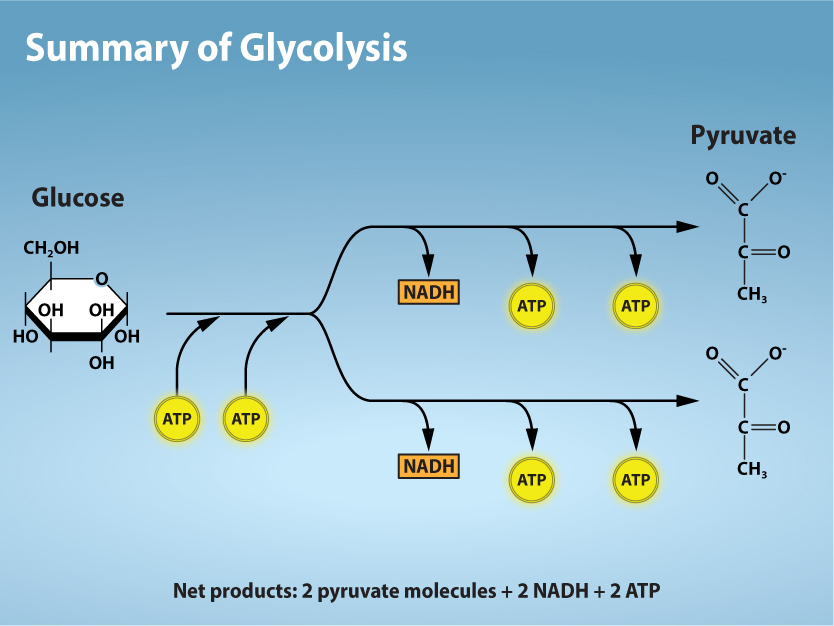
OpenStax, Rice University; Biology 2e. Credit: Rao, A. and Ryan, K. Department of Biology, Texas A&M University · CC BY 4.0 · Source出典
Figure 7.7図 7.7
Glycolysis begins with an energy investment phase which requires 2 ATP to phosphorylate the starting glucose molecule. The 6-carbon intermediate is then split into 2, 3-carbon sugar molecules. In the energy recovery phase, each 3-carbon sugar is then oxidized to pyruvate with the energy transferred to form NADH and 2 ATP. Credit: Rao, A. and Ryan, K. Department of Biology, Texas A&M University
解糖系は、出発物質のグルコースをリン酸化するためATPを2分子使う、エネルギー投資段階から始まる。炭素6個の中間体は、炭素3個の糖2分子に分かれる。エネルギー回収段階では、それぞれの三炭糖がピルビン酸へ酸化され、エネルギーが移されてNADHとATP2分子がつくられる。出典:Rao, A.、Ryan, K.、テキサスA&M大学生物学部。
First Half of Glycolysis (Energy-Requiring Steps)解糖系の前半(エネルギーを必要とする段階)
Step 1. The first step in glycolysis (Figure 7.8) is catalyzed by hexokinase, an enzyme with broad specificity that catalyzes the phosphorylation of six-carbon sugars. Hexokinase phosphorylates glucose using ATP as the source of the phosphate, producing glucose-6-phosphate, a more reactive form of glucose. This reaction prevents the phosphorylated glucose molecule from continuing to interact with the GLUT proteins, and it can no longer leave the cell because the negatively charged phosphate will not allow it to cross the hydrophobic interior of the plasma membrane.
英語のヒント
第1段階。解糖系の最初の反応(図7.8)は、六炭糖のリン酸化を触媒する、特異性の広い酵素ヘキソキナーゼによって進む。ヘキソキナーゼはATPをリン酸源としてグルコースをリン酸化し、より反応性の高いグルコース6-リン酸をつくる。この反応によって、リン酸化されたグルコースはGLUTタンパク質と相互作用し続けられなくなる。また、負に帯電したリン酸によって細胞膜の疎水性内部を通れなくなるため、細胞外へ出られなくなる。
Step 2. In the second step of glycolysis, an isomerase converts glucose-6-phosphate into one of its isomers, fructose-6-phosphate (this isomer has a phosphate attached at the location of the sixth carbon of the ring). An isomerase is an enzyme that catalyzes the conversion of a molecule into one of its isomers. (This change from phosphoglucose to phosphofructose allows the eventual split of the sugar into two three-carbon molecules.)
英語のヒント
第2段階。解糖系の第2段階では、イソメラーゼがグルコース6-リン酸を、その異性体の一つであるフルクトース6-リン酸へ変換する。この異性体には、環の第6炭素の位置にリン酸が付いている。イソメラーゼは、分子をその異性体へ変える反応を触媒する酵素である。(リン酸化グルコースからリン酸化フルクトースへのこの変化によって、糖は最終的に炭素3個の分子2個へ分かれることができる。)
Step 3. The third step is the phosphorylation of fructose-6-phosphate, catalyzed by the enzyme phosphofructokinase. A second ATP molecule donates a high-energy phosphate to fructose-6-phosphate, producing fructose-1,6-bisphosphate. In this pathway, phosphofructokinase is a rate-limiting enzyme. It is active when the concentration of ADP is high; it is less active when ADP levels are low and the concentration of ATP is high. Thus, if there is “sufficient” ATP in the system, the pathway slows down. This is a type of end product inhibition, since ATP is the end product of glucose catabolism.
英語のヒント
第3段階。第3段階は、ホスホフルクトキナーゼという酵素が触媒する、フルクトース6-リン酸のリン酸化である。2分子目のATPが高エネルギーリン酸を渡し、フルクトース1,6-ビスリン酸ができる。この経路では、ホスホフルクトキナーゼが律速酵素である。ADP濃度が高いと活性化し、ADPが少なくATPが多いと活性が低下する。したがって、系に「十分な」ATPがあれば、経路は遅くなる。ATPはグルコース異化の最終生成物なので、これは最終生成物阻害の一種である。
Step 4. The newly added high-energy phosphates further destabilize fructose-1,6-bisphosphate. The fourth step in glycolysis employs an enzyme, aldolase, to cleave fructose-1,6-bisphosphate into two three-carbon isomers: dihydroxyacetone phosphate and glyceraldehyde-3-phosphate.
英語のヒント
第4段階。新たに加わった高エネルギーリン酸が、フルクトース1,6-ビスリン酸をさらに不安定にする。解糖系の第4段階では、アルドラーゼという酵素を使って、この分子を二つの三炭素異性体、ジヒドロキシアセトンリン酸とグリセルアルデヒド3-リン酸へ切断する。
Step 5. In the fifth step, an isomerase transforms the dihydroxyacetone-phosphate into its isomer, glyceraldehyde-3-phosphate. Thus, the pathway will continue with two molecules of a glyceraldehyde-3-phosphate. At this point in the pathway, there is a net investment of energy from two ATP molecules in the breakdown of one glucose molecule.
英語のヒント
第5段階。第5段階では、イソメラーゼがジヒドロキシアセトンリン酸を、その異性体のグリセルアルデヒド3-リン酸へ変える。したがって、この先の経路にはグリセルアルデヒド3-リン酸が2分子進む。この時点では、グルコース1分子を分解するため、正味でATP2分子分のエネルギーを投資したことになる。
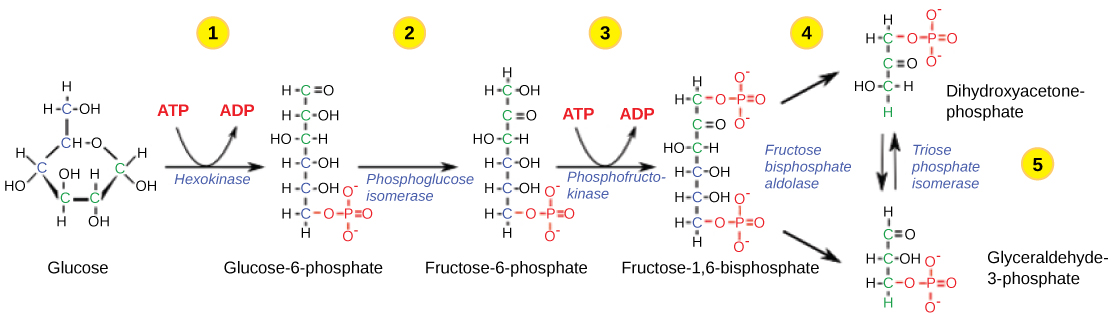


Figure 7.8図 7.8
The first half of glycolysis uses two ATP molecules in the phosphorylation of glucose, which is then split into two three-carbon molecules.
解糖系の前半は、ATP2分子をグルコースのリン酸化に使う。その後、グルコースは炭素3個の分子2個へ分かれる。