第7章細胞呼吸
7.3 Oxidation of Pyruvate and the Citric Acid Cycle7.3 ピルビン酸の酸化とクエン酸回路
Learning Objectives学習目標
By the end of this section, you will be able to do the following:
この節を学び終えると、次のことができるようになる。
- Explain how a circular pathway, such as the citric acid cycle, fundamentally differs from a linear biochemical pathway, such as glycolysisクエン酸回路のような環状経路と、解糖系のような直線状の生化学経路の、本質的な違いを説明する。
- Describe how pyruvate, the product of glycolysis, is prepared for entry into the citric acid cycle解糖系の生成物であるピルビン酸が、クエン酸回路へ入るためにどのように準備されるか説明する。
If oxygen is available, aerobic respiration will go forward. In eukaryotic cells, the pyruvate molecules produced at the end of glycolysis are transported into the mitochondria, which are the sites of cellular respiration. There, pyruvate is transformed into an acetyl group that will be picked up and activated by a carrier compound called coenzyme A (CoA). The resulting compound is called acetyl CoA. CoA is derived from vitamin B5, pantothenic acid. Acetyl CoA can be used in a variety of ways by the cell, but its major function is to deliver the acetyl group derived from pyruvate to the next stage of the pathway in glucose catabolism.
英語のヒント
酸素があれば、好気呼吸が進む。真核細胞では、解糖系の最後にできるピルビン酸分子が、細胞呼吸の場であるミトコンドリアへ運ばれる。そこでピルビン酸はアセチル基へ変わり、補酵素A(CoA)という運搬化合物に受け取られて活性化される。生じた化合物をアセチルCoAと呼ぶ。CoAは、ビタミンB5であるパントテン酸に由来する。細胞はアセチルCoAをさまざまに利用できるが、主な機能は、ピルビン酸由来のアセチル基を、グルコース異化経路の次の段階へ届けることである。
Breakdown of Pyruvateピルビン酸の分解
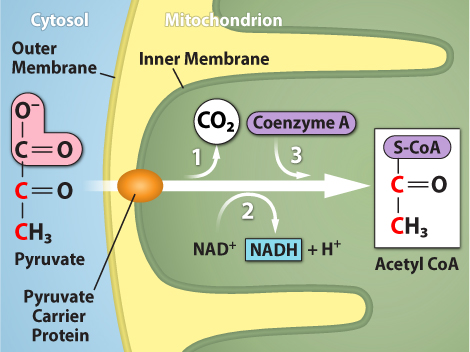
In order for pyruvate, the product of glycolysis, to enter the next pathway, it must undergo several changes. The conversion is a three-step process (Figure 7.10).
英語のヒント
解糖系の生成物であるピルビン酸が次の経路へ入るには、いくつかの変化を受ける必要がある。この変換は3段階からなる(図7.10)。
Step 1. A carboxyl group is removed from pyruvate, releasing a molecule of carbon dioxide into the surrounding medium. This reaction creates a two-carbon hydroxyethyl group bound to the enzyme (pyruvate dehydrogenase). We should note that this is the first of the six carbons from the original glucose molecule to be removed. (This step proceeds twice because there are two pyruvate molecules produced at the end of glycolsis for every molecule of glucose metabolized anaerobically; thus, two of the six carbons will have been removed at the end of both steps.)
英語のヒント
第1段階。ピルビン酸からカルボキシ基が取り除かれ、二酸化炭素1分子が周囲の媒体へ放出される。この反応により、酵素(ピルビン酸デヒドロゲナーゼ)に結合した、炭素2個のヒドロキシエチル基が生じる。ここで、元のグルコース分子の炭素6個のうち、最初の1個が取り除かれることに注意せよ。グルコース1分子が嫌気的に代謝されるたび、解糖系の最後にはピルビン酸が2分子できるので、この段階は2回進む。したがって、2回が終わると炭素6個のうち2個が取り除かれている。
Step 2. The hydroxyethyl group is oxidized to an acetyl group, and the electrons are picked up by NAD+, forming NADH. The high-energy electrons from NADH will be used later to generate ATP.
英語のヒント
第2段階。ヒドロキシエチル基がアセチル基へ酸化され、電子をNAD+が受け取り、NADHができる。NADHの高エネルギー電子は、後でATPをつくるために使われる。
Step 3. The enzyme-bound acetyl group is transferred to CoA, producing a molecule of acetyl CoA.
第3段階。酵素に結合したアセチル基がCoAへ移され、アセチルCoAが1分子できる。
OpenStax, Rice University; Biology 2e. Credit: Rao, A., Ryan, K. and Tag, A. Department of Biology, Texas A&M University. · CC BY 4.0 · Source出典

Figure 7.10図 7.10
Upon entering the mitochondrial matrix, a multienzyme complex converts pyruvate into acetyl CoA. In the process, carbon dioxide is released, and one molecule of NADH is formed. Credit: Rao, A., Ryan, K. and Tag, A. Department of Biology, Texas A&M University.
ピルビン酸がミトコンドリアのマトリックスに入ると、多酵素複合体によってアセチルCoAへ変換される。この過程で二酸化炭素が放出され、NADHが1分子できる。出典:Rao, A.、Ryan, K.、Tag, A.、テキサスA&M大学生物学部。
Note that during the second stage of glucose metabolism, whenever a carbon atom is removed, it is bound to two oxygen atoms, producing carbon dioxide, one of the major end products of cellular respiration.
英語のヒント
グルコース代謝の第2段階では、炭素原子が取り除かれるたびに酸素原子2個と結合し、細胞呼吸の主な最終生成物の一つである二酸化炭素になることに注意せよ。
Acetyl CoA to CO2アセチルCoAからCO2へ
In the presence of oxygen, acetyl CoA delivers its acetyl (2C) group to a four-carbon molecule, oxaloacetate, to form citrate, a six-carbon molecule with three carboxyl groups; this pathway will harvest the remainder of the extractable energy from what began as a glucose molecule and release the remaining four CO2 molecules. This single pathway is called by different names: the citric acid cycle (for the first intermediate formed—citric acid, or citrate—when acetate joins to the oxaloacetate), the TCA cycle (because citric acid or citrate and isocitrate are tricarboxylic acids), and the Krebs cycle, after Hans Krebs, who first identified the steps in the pathway in the 1930s in pigeon flight muscles.
英語のヒント
酸素の存在下で、アセチルCoAは、炭素4個のオキサロ酢酸へアセチル基(2C)を渡し、カルボキシ基を三つもつ炭素6個のクエン酸を形成する。この経路では、もとはグルコースだった分子から、取り出せるエネルギーの残りを回収し、残る4分子のCO2を放出する。この一つの経路には、複数の名前がある。酢酸がオキサロ酢酸と結合して最初にできる中間体、クエン酸にちなむ「クエン酸回路」。クエン酸やイソクエン酸がトリカルボン酸であることにちなむ「TCA回路」。そして、1930年代にハトの飛翔筋で各段階を初めて特定したハンス・クレブスにちなむ「クレブス回路」である。
Citric Acid Cycleクエン酸回路
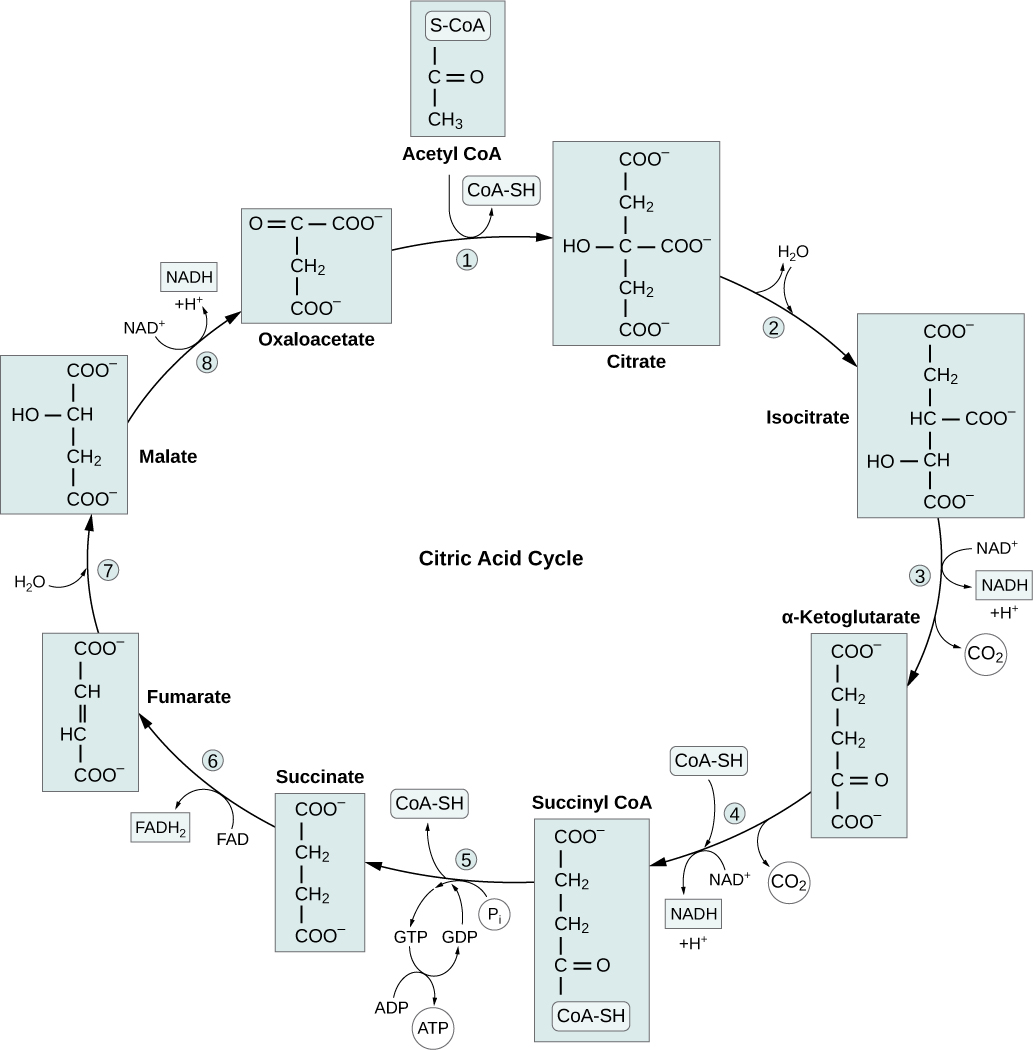
Like the conversion of pyruvate to acetyl CoA, the citric acid cycle takes place in the matrix of mitochondria. Almost all of the enzymes of the citric acid cycle are soluble, with the single exception of the enzyme succinate dehydrogenase, which is embedded in the inner membrane of the mitochondrion. Unlike glycolysis, the citric acid cycle is a closed loop: the last part of the pathway regenerates the compound used in the first step. The eight steps of the cycle are a series of redox, dehydration, hydration, and decarboxylation reactions that produce two carbon dioxide molecules, one GTP/ATP, and the reduced carriers NADH and FADH2 (Figure 7.11). This is considered an aerobic pathway because the NADH and FADH2 produced must transfer their electrons to the next pathway in the system, which will use oxygen. If this transfer does not occur, the oxidation steps of the citric acid cycle also do not occur. Note that the citric acid cycle produces very little ATP directly and does not directly consume oxygen.
英語のヒント
ピルビン酸からアセチルCoAへの変換と同じく、クエン酸回路はミトコンドリアのマトリックスで起こる。回路の酵素はほぼすべて可溶性で、唯一の例外はミトコンドリア内膜に埋め込まれたコハク酸デヒドロゲナーゼである。解糖系と異なり、クエン酸回路は閉じた輪になっている。最後の段階が、最初に使った化合物を再生するのである。回路の8段階は、一連の酸化還元、脱水、水和、脱炭酸反応からなり、二酸化炭素2分子、GTPまたはATP1分子、還元型運搬体のNADHとFADH2を生じる(図7.11)。生じたNADHとFADH2は、酸素を使う次の経路へ電子を渡す必要があるため、これは好気性の経路とみなされる。この移動が起こらなければ、クエン酸回路の酸化段階も起こらない。クエン酸回路が直接つくるATPはごくわずかで、酸素を直接消費するわけではないことに注意せよ。
OpenStax, Rice University; Biology 2e. Credit: Rao, A., Ryan, K., Tag, A., and Fletcher, S. Department of Biology, Texas A&M University. · CC BY 4.0 · Source出典

Figure 7.11図 7.11
In the citric acid cycle, the acetyl group from acetyl CoA is attached to a four-carbon oxaloacetate molecule to form a six-carbon citrate molecule. Through a series of steps, citrate is oxidized, releasing two carbon dioxide molecules for each acetyl group fed into the cycle. In the process, three NAD+ molecules are reduced to NADH, one FAD molecule is reduced to FADH2, and one ATP or GTP (depending on the cell type) is produced (by substrate-level phosphorylation). Because the final product of the citric acid cycle is also the first reactant, the cycle runs continuously in the presence of sufficient reactants. Credit: Rao, A., Ryan, K., Tag, A., and Fletcher, S. Department of Biology, Texas A&M University.
クエン酸回路では、アセチルCoAのアセチル基が四炭素のオキサロ酢酸分子と結合し、六炭素のクエン酸をつくる。一連の段階を通じてクエン酸が酸化され、回路へ入るアセチル基1個当たり二酸化炭素2分子が放出される。この過程でNAD+3分子がNADHへ、FAD1分子がFADH2へ還元され、細胞の種類に応じてATPまたはGTP1分子が基質レベルのリン酸化によってつくられる。最終生成物が最初の反応物でもあるため、十分な反応物があれば回路は連続して進む。出典:Rao, A.、Ryan, K.、Tag, A.、Fletcher, S.、テキサスA&M大学生物学部。