第7章細胞呼吸
ATP in Living Systems生命の系におけるATP
A living cell cannot store significant amounts of free energy. Excess free energy would result in an increase of heat in the cell, which would result in excessive thermal motion that could damage and then destroy the cell. Rather, a cell must be able to handle that energy in a way that enables the cell to store energy safely and release it for use only as needed. Living cells accomplish this by using the compound adenosine triphosphate (ATP). ATP is often called the “energy currency” of the cell, and, like currency, this versatile compound can be used to fill any energy need of the cell. How? It functions similarly to a rechargeable battery.
英語のヒント
生きた細胞は、大量の自由エネルギーを蓄えておくことができない。過剰な自由エネルギーは細胞内の熱を増やし、その結果、過度の熱運動によって細胞が損傷し、やがて壊れる可能性がある。そのため、細胞はエネルギーを安全に蓄え、必要なときだけ放出して使える形で扱う必要がある。細胞はアデノシン三リン酸(ATP)という化合物を利用して、これを実現している。ATPはしばしば細胞の「エネルギー通貨」と呼ばれる。通貨と同じように、この多用途の化合物は細胞のあらゆるエネルギー需要を満たすのに使える。どのようにしてか。充電式電池のように働くのである。
When ATP is broken down, usually by the removal of its terminal phosphate group, energy is released. The energy is used to do work by the cell, usually when the released phosphate binds to another molecule, thereby activating it. For example, in the mechanical work of muscle contraction, ATP supplies the energy to move the contractile muscle proteins. Recall the active transport work of the sodium-potassium pump in cell membranes. ATP alters the structure of the integral protein that functions as the pump, changing its affinity for sodium and potassium. In this way, the cell performs work, pumping ions against their electrochemical gradients.
英語のヒント
通常、ATPが末端のリン酸基を取り除かれて分解すると、エネルギーが放出される。そのエネルギーは細胞の仕事に使われ、多くの場合、放出されたリン酸が別の分子に結合して、その分子を活性化する。たとえば筋収縮という機械的な仕事では、ATPが収縮性の筋タンパク質を動かすエネルギーを供給する。細胞膜のナトリウム–カリウムポンプによる能動輸送を思い出せ。ATPはポンプとして働く内在性タンパク質の構造を変え、ナトリウムとカリウムへの親和性を変化させる。このように、細胞はイオンを電気化学的勾配に逆らって汲み出す仕事を行う。
ATP Structure and FunctionATPの構造と機能
At the heart of ATP is a molecule of adenosine monophosphate (AMP), which is composed of an adenine molecule bonded to a ribose molecule and to a single phosphate group (Figure 7.4). Ribose is a five-carbon sugar found in RNA, and AMP is one of the nucleotides in RNA. The addition of a second phosphate group to this core molecule results in the formation of adenosine diphosphate (ADP); the addition of a third phosphate group forms adenosine triphosphate (ATP).
英語のヒント
ATPの中心をなすのはアデノシン一リン酸(AMP)分子で、アデニン分子がリボース分子と一つのリン酸基に結合したものである(図7.4)。リボースはRNAに含まれる五炭糖であり、AMPはRNAを構成するヌクレオチドの一つである。この中心分子に2個目のリン酸基を加えるとアデノシン二リン酸(ADP)ができ、3個目を加えるとアデノシン三リン酸(ATP)ができる。
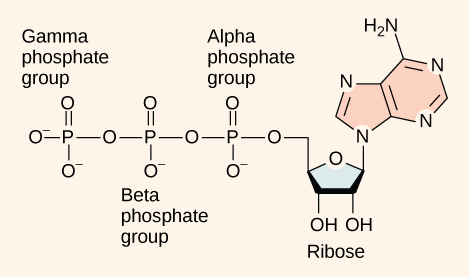

Figure 7.4図 7.4
ATP (adenosine triphosphate) has three phosphate groups that can be removed by hydrolysis (addition of H2O) to form ADP (adenosine diphosphate) or AMP (adenosine monophosphate). The negative charges on the phosphate group naturally repel each other, requiring energy to bond them together and releasing energy when these bonds are broken.
ATP(アデノシン三リン酸)は三つのリン酸基をもち、加水分解(H2Oの付加)によってリン酸基を外すと、ADP(アデノシン二リン酸)やAMP(アデノシン一リン酸)ができる。リン酸基の負電荷同士は反発するため、結合させるにはエネルギーが必要であり、結合を切るとエネルギーが放出される。
The addition of a phosphate group to a molecule requires energy. Phosphate groups are negatively charged and thus repel one another when they are arranged in series, as they are in ADP and ATP. This repulsion makes the ADP and ATP molecules inherently unstable. The release of one or two phosphate groups from ATP, a process called dephosphorylation, releases energy.
英語のヒント
分子にリン酸基を加えるには、エネルギーが必要である。リン酸基は負に帯電しているため、ADPやATPのように連なって配置されると、互いに反発する。この反発によって、ADPとATPの分子は本質的に不安定になる。ATPから一つまたは二つのリン酸基が外れる脱リン酸化という過程では、エネルギーが放出される。
Energy from ATPATPから得られるエネルギー
Hydrolysis is the process of breaking complex macromolecules apart. During hydrolysis, water is split, or lysed, and the resulting hydrogen atom (H+) and a hydroxyl group (OH-), or hydroxide, are added to the larger molecule. The hydrolysis of ATP produces ADP, together with an inorganic phosphate ion (Pi), and the release of free energy. To carry out life processes, ATP is continuously broken down into ADP, and like a rechargeable battery, ADP is continuously regenerated into ATP by the reattachment of a third phosphate group. Water, which was broken down into its hydrogen atom and hydroxyl group (hydroxide) during ATP hydrolysis, is regenerated when a third phosphate is added to the ADP molecule, reforming ATP.
英語のヒント
加水分解は、複雑な高分子を分解する過程である。このとき水が分解され、その結果生じる水素原子(H+)とヒドロキシ基(OH-)、すなわち水酸化物が、大きな分子に付加される。ATPの加水分解では、ADPと無機リン酸イオン(Pi)が生じ、自由エネルギーが放出される。生命活動を行うため、ATPは絶えずADPへ分解される。一方、充電式電池と同様に、ADPは3個目のリン酸基が再び結合することで、絶えずATPへ再生される。ATPの加水分解の際に水素原子とヒドロキシ基(水酸化物)へ分かれた水も、ADPに3個目のリン酸が付加されATPが再形成されると、再生される。
Obviously, energy must be infused into the system to regenerate ATP. Where does this energy come from? In nearly every living thing on Earth, the energy comes from the metabolism of glucose, fructose, or galactose, all isomers with the chemical formula C6H12O6 but different molecular configurations. In this way, ATP is a direct link between the limited set of exergonic pathways of glucose catabolism and the multitude of endergonic pathways that power living cells.
英語のヒント
当然ながら、ATPを再生するには、系にエネルギーを注ぎ込まなければならない。このエネルギーはどこから来るのだろうか。地球上のほぼすべての生物では、グルコース、フルクトース、ガラクトースの代謝から得られる。これらはすべて、化学式C6H12O6をもちながら、分子の配置が異なる異性体である。このようにATPは、グルコースの異化に関わる限られた発エルゴン経路と、生きた細胞を動かす多数の吸エルゴン経路とを、直接結び付けている。
Phosphorylationリン酸化
Recall that, in some chemical reactions, enzymes may bind to several substrates that react with each other on the enzyme, forming an intermediate complex. An intermediate complex is a temporary structure, and it allows one of the substrates (such as ATP) and reactants to more readily react with each other; in reactions involving ATP, ATP is one of the substrates and ADP is a product. During an endergonic chemical reaction, ATP forms an intermediate complex with the substrate and enzyme in the reaction. This intermediate complex allows the ATP to transfer its third phosphate group, with its energy, to the substrate, a process called phosphorylation. Phosphorylation refers to the addition of the phosphate (~P). This is illustrated by the following generic reaction, in which A and B represent two different substrates:
英語のヒント
ある種の化学反応では、酵素が複数の基質と結合し、それらが酵素上で反応して中間複合体をつくることを思い出せ。中間複合体は一時的な構造であり、ATPなどの基質の一つと反応物が、より容易に反応できるようにする。ATPが関わる反応では、ATPが基質の一つで、ADPが生成物である。吸エルゴン性の化学反応で、ATPは基質や酵素と中間複合体を形成する。これによってATPは、エネルギーとともに3個目のリン酸基を基質へ移せる。この過程がリン酸化である。リン酸化とは、リン酸(~P)を付加することを指す。次の一般的な反応でこれを示す。AとBは、異なる二つの基質を表す。
When the intermediate complex breaks apart, the energy is used to modify the substrate and convert it into a product of the reaction. The ADP molecule and a free phosphate ion are released into the medium and are available for recycling through cell metabolism.
英語のヒント
中間複合体が分かれると、エネルギーは基質を変化させ、反応の生成物へ変換するのに使われる。ADP分子と遊離リン酸イオンは周囲の媒体へ放出され、細胞の代謝を通じて再利用できるようになる。