第7章細胞呼吸
7.6 Connections of Carbohydrate, Protein, and Lipid Metabolic Pathways7.6 炭水化物・タンパク質・脂質の代謝経路のつながり
Learning Objectives学習目標
By the end of this section, you will be able to do the following:
この節を学び終えると、次のことができるようになる。
- Discuss the ways in which carbohydrate metabolic pathways, glycolysis, and the citric acid cycle interrelate with protein and lipid metabolic pathways炭水化物の代謝経路である解糖系やクエン酸回路が、タンパク質・脂質の代謝経路とどのように関係するか論じる。
- Explain why metabolic pathways are not considered closed systems代謝経路を閉鎖系と考えない理由を説明する。
You have learned about the catabolism of glucose, which provides energy to living cells. But living things consume organic compounds other than glucose for food. How does a turkey sandwich end up as ATP in your cells? This happens because all of the catabolic pathways for carbohydrates, proteins, and lipids eventually connect into glycolysis and the citric acid cycle pathways (see Figure 7.19). Metabolic pathways should be thought of as porous and interconnecting—that is, substances enter from other pathways, and intermediates leave for other pathways. These pathways are not closed systems! Many of the substrates, intermediates, and products in a particular pathway are reactants in other pathways.
英語のヒント
生細胞にエネルギーを供給する、グルコースの異化を学んできた。しかし、生物はグルコース以外の有機化合物も食物として摂取する。七面鳥のサンドイッチは、どうやって細胞内のATPになるのだろうか。炭水化物、タンパク質、脂質のすべての異化経路が、最終的に解糖系とクエン酸回路へつながるからである(図7.19参照)。代謝経路は、物質が出入りし、相互につながったものと考える必要がある。ほかの経路から物質が入り、中間体が別の経路へ出ていくのである。これらは閉鎖系ではない。ある経路の基質、中間体、生成物の多くが、別の経路では反応物になる。
Connections of Other Sugars to Glucose Metabolism他の糖とグルコース代謝のつながり
Glycogen, a polymer of glucose, is an energy storage molecule in animals. When there is adequate ATP present, excess glucose is stored as glycogen in both liver and muscle cells. The glycogen will be hydrolyzed into glucose 1-phosphate monomers (G-1-P) if blood sugar levels drop. The presence of glycogen as a source of glucose allows ATP to be produced for a longer period of time during exercise. Glycogen is broken down into glucose-1-phosphate (G-1-P) and converted into glucose-6-phosphate (G-6-P) in both muscle and liver cells, and this product enters the glycolytic pathway.
英語のヒント
グルコースの重合体であるグリコーゲンは、動物のエネルギー貯蔵分子である。ATPが十分にあれば、余剰のグルコースは肝細胞と筋細胞でグリコーゲンとして蓄えられる。血糖値が下がると、グリコーゲンはグルコース1-リン酸(G-1-P)の単量体へ加水分解される。グルコース源としてグリコーゲンが存在することで、運動中により長時間ATPを生産できる。筋細胞でも肝細胞でも、グリコーゲンはG-1-Pへ分解された後、グルコース6-リン酸(G-6-P)へ変換され、解糖系へ入る。
Sucrose is a disaccharide with a molecule of glucose and a molecule of fructose bonded together with a glycosidic linkage. Fructose is one of the three “dietary” monosaccharides, along with glucose and galactose (part of the milk sugar disaccharide lactose), which are absorbed directly into the bloodstream during digestion. The catabolism of fructose, galactose, and glucose produces the same number of ATP molecules.
英語のヒント
スクロースは、グルコース1分子とフルクトース1分子がグリコシド結合した二糖である。フルクトースは、グルコースおよびガラクトースとともに、消化の際に血流へ直接吸収される、食事由来の三つの単糖の一つである。ガラクトースは、乳糖という二糖の一部である。フルクトース、ガラクトース、グルコースの異化では、同じ数のATP分子が生じる。
Connections of Proteins to Glucose Metabolismタンパク質とグルコース代謝のつながり
Proteins are hydrolyzed by a variety of enzymes in cells. Most of the time, the amino acids are recycled into the synthesis of new proteins. If there are excess amino acids, however, or if the body is in a state of starvation, some amino acids will be shunted into the pathways of glucose catabolism (Figure 7.18). It is very important to note that each amino acid must have its amino group removed prior to entry into these pathways. The amino group is converted into ammonia. In mammals, the liver synthesizes urea from two ammonia molecules and a carbon dioxide molecule. Thus, urea is the principal waste product in mammals, produced from the nitrogen originating in amino acids, and it leaves the body in urine. It should be noted that amino acids can be synthesized from the intermediates and reactants in the cellular respiration cycle.
英語のヒント
タンパク質は、細胞内のさまざまな酵素によって加水分解される。通常、アミノ酸は新しいタンパク質の合成へ再利用される。しかし、アミノ酸が余っている場合や、体が飢餓状態にある場合には、一部がグルコースの異化経路へ回される(図7.18)。これらの経路へ入る前に、各アミノ酸からアミノ基を取り除く必要があることは重要である。アミノ基はアンモニアへ変えられる。哺乳類では、肝臓がアンモニア2分子と二酸化炭素1分子から尿素を合成する。したがって、尿素はアミノ酸由来の窒素からつくられる哺乳類の主要な老廃物であり、尿中へ排泄される。また、アミノ酸は細胞呼吸の回路の中間体や反応物から合成できることにも注意せよ。
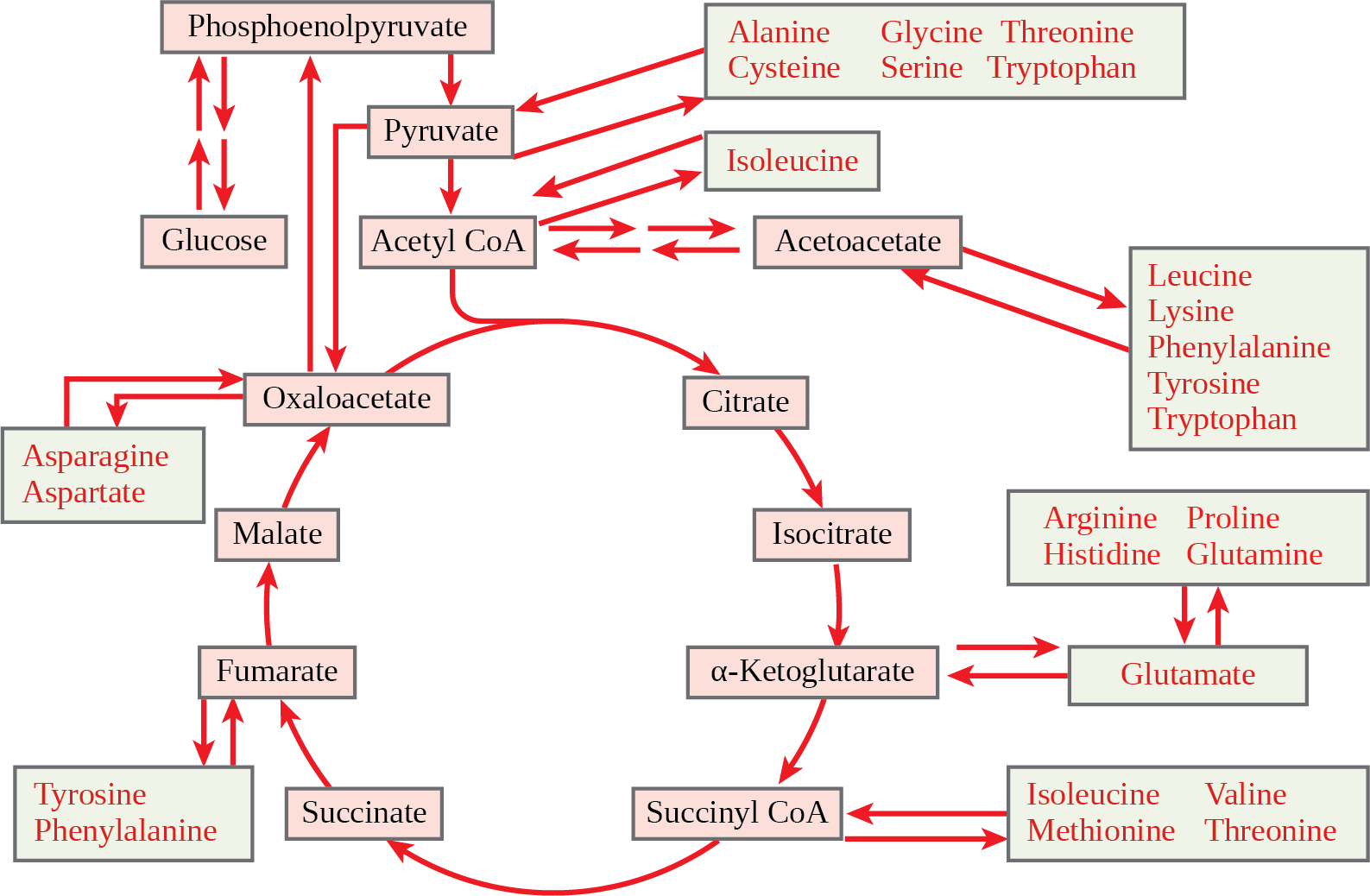
OpenStax, Rice University; Biology 2e. (credit: modification of work by Mikael Häggström) · CC BY 4.0 · Source出典
Figure 7.18図 7.18
The carbon skeletons of certain amino acids (indicated in boxes) derived from proteins can feed into the citric acid cycle. (credit: modification of work by Mikael Häggström)
タンパク質に由来する特定のアミノ酸(枠内に表示)の炭素骨格は、クエン酸回路へ入ることができる。(出典:Mikael Häggströmの作品を改変)
Connections of Lipid and Glucose Metabolisms脂質代謝とグルコース代謝のつながり
The lipids connected to the glucose pathway include cholesterol and triglycerides. Cholesterol is a lipid that contributes to cell membrane flexibility and is a precursor of steroid hormones. The synthesis of cholesterol starts with acetyl groups and proceeds in only one direction. The process cannot be reversed.
英語のヒント
グルコースの経路につながる脂質には、コレステロールとトリグリセリドがある。コレステロールは細胞膜の柔軟性に寄与し、ステロイドホルモンの前駆体となる脂質である。その合成はアセチル基から始まり、一方向にしか進まない。この過程を逆向きに進めることはできない。
Triglycerides—made from the bonding of glycerol and three fatty acids—are a form of long-term energy storage in animals. Animals can make most of the fatty acids they need. Triglycerides can be both made and broken down through parts of the glucose catabolism pathways. Glycerol can be phosphorylated to glycerol-3-phosphate, which continues through glycolysis. Fatty acids are catabolized in a process called beta-oxidation, which takes place in the matrix of the mitochondria and converts their fatty acid chains into two-carbon units of acetyl groups. The acetyl groups are picked up by CoA to form acetyl CoA that proceeds into the citric acid cycle.
英語のヒント
グリセロールに脂肪酸3個が結合したトリグリセリドは、動物の長期的なエネルギー貯蔵形態である。動物は、必要な脂肪酸の大部分を自分でつくれる。トリグリセリドは、グルコース異化経路の一部を通じて合成も分解もされる。グリセロールはグリセロール3-リン酸へリン酸化され、解糖系へ進める。脂肪酸は、ミトコンドリアのマトリックスで起こるβ酸化という過程で異化され、脂肪酸鎖が炭素2個ずつのアセチル基へ変わる。このアセチル基をCoAが受け取り、アセチルCoAとしてクエン酸回路へ進む。
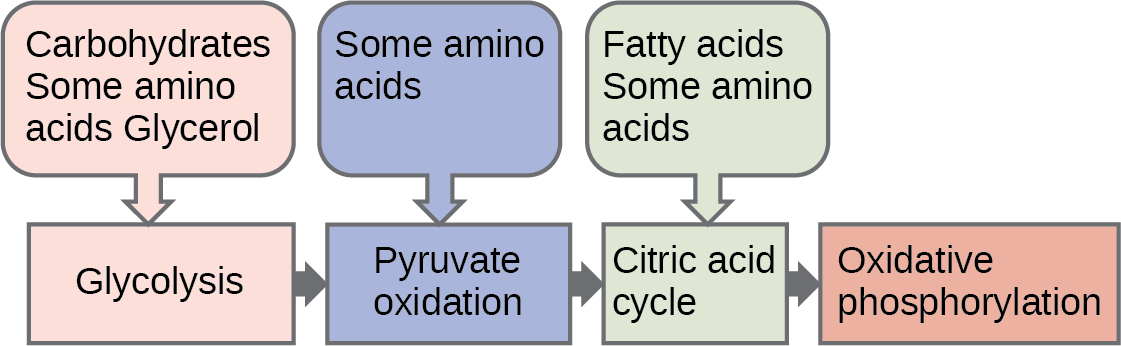


Figure 7.19図 7.19
Glycogen from the liver and muscles, as well as other carbohydrates, hydrolyzed into glucose-1-phosphate, together with fats and proteins, can feed into the catabolic pathways for carbohydrates.
肝臓や筋肉のグリコーゲン、および他の炭水化物は、グルコース1-リン酸へ加水分解され、脂肪やタンパク質とともに、炭水化物の異化経路へ入ることができる。