第7章細胞呼吸
7.1 Energy in Living Systems7.1 生命の系におけるエネルギー
Learning Objectives学習目標
By the end of this section, you will be able to do the following:
この節を学び終えると、次のことができるようになる。
- Discuss the importance of electrons in the transfer of energy in living systems生命の系でのエネルギー移動における電子の重要性を論じる。
- Explain how ATP is used by cells as an energy source細胞がATPをエネルギー源としてどのように使うか説明する。
Energy conversion within a cell involves many coordinated chemical pathways. Most of these pathways are combinations of oxidation and reduction reactions, which occur at the same time. An oxidation reaction strips an electron from an atom in a compound, and the addition of this electron to another compound is a reduction reaction. Because oxidation and reduction usually occur together, these pairs of reactions are called oxidation reduction reactions, or redox reactions.
英語のヒント
細胞内のエネルギー変換には、多くの化学経路が協調して関わっている。その多くは、同時に起こる酸化反応と還元反応の組み合わせである。酸化反応は化合物の原子から電子を奪い、その電子を別の化合物へ加える反応が還元反応である。通常、酸化と還元は一緒に起こるため、この対になった反応を酸化還元反応、またはレドックス反応と呼ぶ。
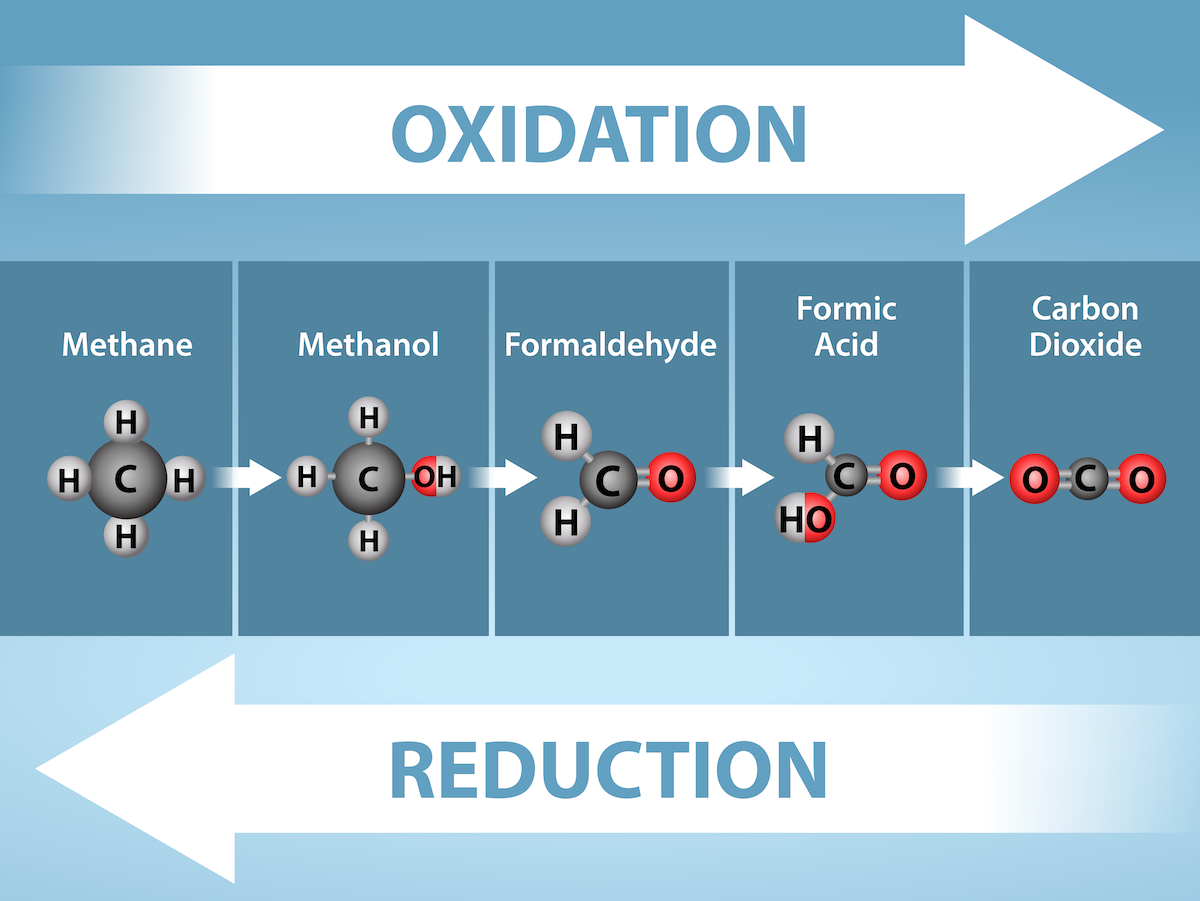
OpenStax, Rice University; Biology 2e. Credit: Ryan, K., Rao, A.and Fletcher, S. Department of Biology, Texas A&M University. · CC BY 4.0 · Source出典
Figure 7.2図 7.2
Stages of oxidation/reduction of a single carbon. Electrons are lost from carbon as methane is oxidized to carbon dioxide. The loss of electrons is also accompanied by the loss of energy. Electrons are gained during the reduction of carbon dioxide to methane. The gain of an electron is accompanied by a gain in potential energy and often by the addition of a proton (H+). Credit: Ryan, K., Rao, A.and Fletcher, S. Department of Biology, Texas A&M University.
一つの炭素の酸化・還元の段階。メタンが二酸化炭素へ酸化されると、炭素から電子が失われる。電子の喪失にはエネルギーの喪失も伴う。二酸化炭素からメタンへの還元では電子が加わる。電子を得ることには位置エネルギーの増加が伴い、多くの場合、陽子(H+)の付加も伴う。出典:Ryan, K.、Rao, A.、Fletcher, S.、テキサスA&M大学生物学部。
Electrons and Energy電子とエネルギー
The removal of an electron from a molecule (oxidizing it), results in a decrease in potential energy in the oxidized compound. However, the electron (sometimes as part of a hydrogen atom) does not remain unbonded in the cytoplasm of a cell. Rather, the electron is shifted to a second compound, reducing the second compound. The shift of an electron from one compound to another removes some potential energy from the first compound (the oxidized compound) and increases the potential energy of the second compound (the reduced compound). The transfer of electrons between molecules is important because most of the energy stored in atoms and used to fuel cell functions is in the form of high-energy electrons. The transfer of energy in the form of high-energy electrons allows the cell to transfer and use energy in an incremental fashion—in small packages rather than in a single, destructive burst. This chapter focuses on the extraction of energy from food; you will see that as you track the path of the transfers, you are tracking the path of electrons moving through metabolic pathways.
英語のヒント
分子から電子を取り除く、すなわち酸化すると、酸化された化合物の位置エネルギーは減少する。しかし、その電子は、ときに水素原子の一部となりながらも、細胞質内で結合せずに残ることはない。電子は別の化合物へ移され、その化合物を還元する。一つの化合物から別の化合物への電子の移動は、最初の化合物(酸化された化合物)の位置エネルギーの一部を減らし、次の化合物(還元された化合物)の位置エネルギーを増やす。分子間の電子移動が重要なのは、原子に蓄えられ、細胞機能を動かすために使われるエネルギーの多くが、高エネルギー電子の形だからである。この形で移動することで、細胞は一度の破壊的な放出ではなく、小さな単位に分けて、段階的にエネルギーを移動・利用できる。この章では、食物からエネルギーを取り出す過程を扱う。エネルギー移動の経路をたどることは、代謝経路を移動する電子の道筋をたどることだと分かるだろう。
Electron Carriers電子運搬体
In living systems, a small class of compounds functions as electron shuttles: they bind and carry high-energy electrons between compounds in biochemical pathways. The principal electron carriers we will consider are derived from the B vitamin group and are derivatives of nucleotides. These compounds can be easily reduced (that is, they accept electrons) or oxidized (they lose electrons). Nicotinamide adenine dinucleotide (NAD) (Figure 7.3) is derived from vitamin B3, niacin. NAD+ is the oxidized form of the molecule; NADH is the reduced form of the molecule after it has accepted two electrons and a proton (which together are the equivalent of a hydrogen atom with an extra electron). Note that if a compound has an “H” on it, it is generally reduced (e.g., NADH is the reduced form of NAD).
英語のヒント
生命の系では、少数の種類の化合物が電子の運搬役として働く。生化学的経路の化合物同士の間で、高エネルギー電子を結合させて運ぶ。ここで扱う主要な電子運搬体は、ビタミンB群に由来する、ヌクレオチドの誘導体である。これらは容易に還元(電子を受け取る)されたり、酸化(電子を失う)されたりする。ニコチンアミドアデニンジヌクレオチド(NAD)(図7.3)は、ビタミンB3であるナイアシンに由来する。NAD+が酸化型で、電子2個と陽子1個を受け取ったものが還元型のNADHである。この電子と陽子の組み合わせは、余分な電子を1個もつ水素原子に相当する。化合物の表記に「H」が付いている場合、一般に還元型であることに注意せよ。たとえばNADHは、NADの還元型である。
NAD+ can accept electrons from an organic molecule according to the general equation:
NAD+は、次の一般式に従って有機分子から電子を受け取ることができる。
When electrons are added to a compound, it is reduced. A compound that reduces another is called a reducing agent. In the above equation, RH is a reducing agent, and NAD+ is reduced to NADH. When electrons are removed from a compound, it is oxidized. A compound that oxidizes another is called an oxidizing agent. In the above equation, NAD+ is an oxidizing agent, and RH is oxidized to R.
英語のヒント
化合物に電子が加わると、その化合物は還元される。別の化合物を還元するものを、還元剤と呼ぶ。上の式では、RHが還元剤であり、NAD+はNADHへ還元される。化合物から電子が取り去られると、その化合物は酸化される。別の化合物を酸化するものを、酸化剤と呼ぶ。上の式では、NAD+が酸化剤であり、RHはRへ酸化される。
Similarly, flavin adenine dinucleotide (FAD) is derived from vitamin B2, also called riboflavin. Its reduced form is FADH2. A second variation of NAD, NADP, contains an extra phosphate group. Both NAD+ and FAD are extensively used in energy extraction from sugars, and NADP plays an important role in anabolic reactions and photosynthesis in plants.
英語のヒント
同様に、フラビンアデニンジヌクレオチド(FAD)は、リボフラビンとも呼ばれるビタミンB2に由来し、その還元型はFADH2である。NADの別の型であるNADPは、追加のリン酸基を一つもつ。NAD+とFADはいずれも、糖からエネルギーを取り出す際に広く利用される。NADPは、同化反応や植物の光合成で重要な役割を果たす。
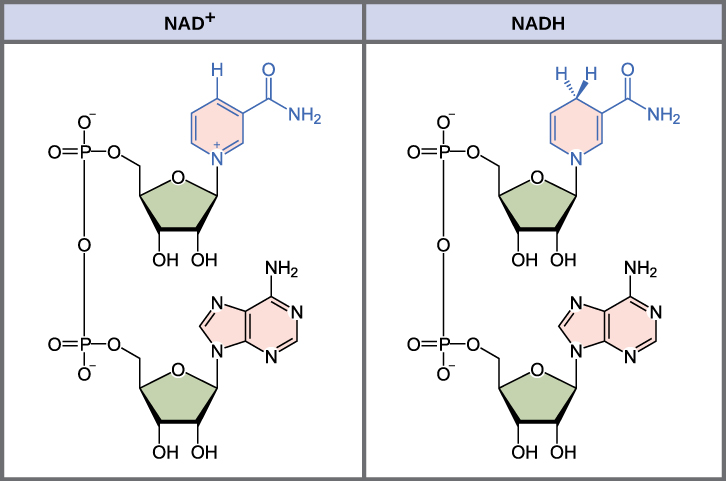


Figure 7.3図 7.3
The oxidized form of the electron carrier (NAD+) is shown on the left, and the reduced form (NADH) is shown on the right. The nitrogenous base in NADH has one more hydrogen ion and two more electrons than in NAD+.
電子運搬体の酸化型(NAD+)を左に、還元型(NADH)を右に示す。NADHの窒素を含む塩基は、NAD+に比べて水素イオンが1個、電子が2個多い。