第7章細胞呼吸
Second Half of Glycolysis (Energy-Releasing Steps)解糖系の後半(エネルギーを放出する段階)
So far, glycolysis has cost the cell two ATP molecules and produced two small, three-carbon sugar molecules. Both of these molecules will proceed through the second half of the pathway, and sufficient energy will be extracted to pay back the two ATP molecules used as an initial investment and produce a profit for the cell of two additional ATP molecules and two even higher-energy NADH molecules.
英語のヒント
ここまでで、解糖系は細胞のATPを2分子消費し、小さな三炭糖を2分子生み出した。どちらも経路の後半へ進み、最初の投資に使ったATP2分子を回収したうえで、さらにATP2分子と、もっと高エネルギーのNADH2分子を細胞の利益として得られるだけのエネルギーが取り出される。
Step 6. The sixth step in glycolysis (Figure 7.9) oxidizes the sugar (glyceraldehyde-3-phosphate), extracting high-energy electrons, which are picked up by the electron carrier NAD+, producing NADH. The sugar is then phosphorylated by the addition of a second phosphate group, producing 1,3-bisphosphoglycerate. Note that the second phosphate group does not require another ATP molecule.
英語のヒント
第6段階。解糖系の第6段階(図7.9)では、糖(グリセルアルデヒド3-リン酸)を酸化し、高エネルギー電子を取り出す。電子運搬体NAD+がこれを受け取り、NADHになる。続いて、糖に2個目のリン酸基が加わってリン酸化され、1,3-ビスホスホグリセリン酸ができる。この2個目のリン酸基を加えるのに、別のATP分子は必要ないことに注意せよ。
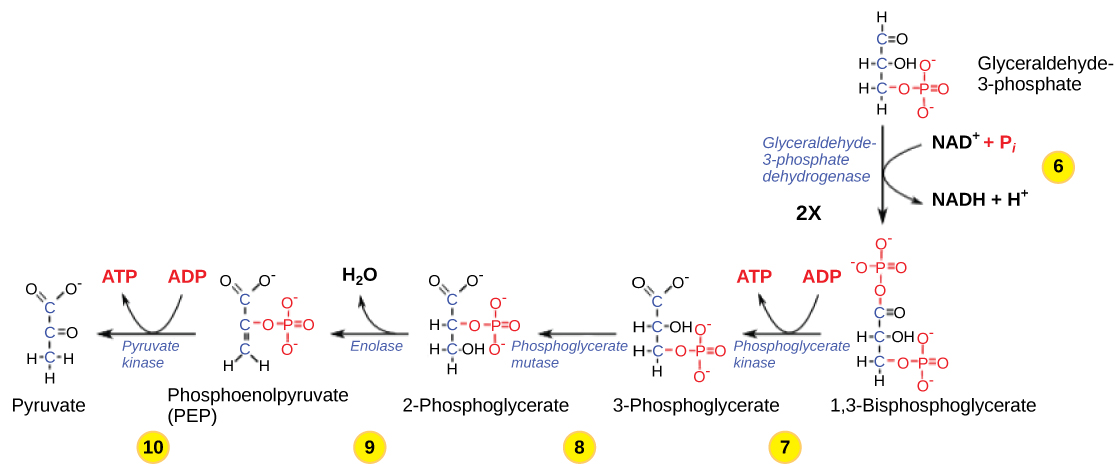

Figure 7.9図 7.9
The second half of glycolysis involves phosphorylation without ATP investment (step 6) and produces two NADH and four ATP molecules per glucose.
解糖系の後半では、ATPを投入せずにリン酸化が起こり(第6段階)、グルコース1分子当たりNADH2分子とATP4分子がつくられる。
Here again is a potential limiting factor for this pathway. The continuation of the reaction depends upon the availability of the oxidized form of the electron carrier, NAD+. Thus, NADH must be continuously oxidized back into NAD+ in order to keep this step going. If NAD+ is not available, the second half of glycolysis slows down or stops. If oxygen is available in the system, the NADH will be oxidized readily, though indirectly, and the high-energy electrons from the hydrogen released in this process will be used to produce ATP. In an environment without oxygen, an alternate pathway (fermentation) can provide the oxidation of NADH to NAD+.
英語のヒント
ここにも、この経路を制限しうる要因がある。反応が続くかどうかは、電子運搬体の酸化型であるNAD+が使えるかに依存する。そのため、この段階を続けるには、NADHを絶えずNAD+へ酸化して戻さなければならない。NAD+がなければ、解糖系の後半は遅くなるか停止する。系に酸素があれば、NADHは間接的ながら容易に酸化され、その際に放出される水素由来の高エネルギー電子がATPの生産に使われる。酸素のない環境では、別の経路である発酵によって、NADHをNAD+へ酸化できる。
Step 7. In the seventh step, catalyzed by phosphoglycerate kinase (an enzyme named for the reverse reaction), 1,3-bisphosphoglycerate donates a high-energy phosphate to ADP, forming one molecule of ATP. (This is an example of substrate-level phosphorylation.) A carbonyl group on the 1,3-bisphosphoglycerate is oxidized to a carboxyl group, and 3-phosphoglycerate is formed.
英語のヒント
第7段階。ホスホグリセリン酸キナーゼが触媒する第7段階では、1,3-ビスホスホグリセリン酸がADPに高エネルギーリン酸を渡し、ATPを1分子つくる。この酵素は逆反応に基づいて命名されている。(これは基質レベルのリン酸化の例である。)1,3-ビスホスホグリセリン酸のカルボニル基がカルボキシ基へ酸化され、3-ホスホグリセリン酸が生じる。
Step 8. In the eighth step, the remaining phosphate group in 3-phosphoglycerate moves from the third carbon to the second carbon, producing 2-phosphoglycerate (an isomer of 3-phosphoglycerate). The enzyme catalyzing this step is a mutase (isomerase).
英語のヒント
第8段階。第8段階では、3-ホスホグリセリン酸に残るリン酸基が、第3炭素から第2炭素へ移り、異性体の2-ホスホグリセリン酸が生じる。この段階を触媒する酵素は、ムターゼ(イソメラーゼ)である。
Step 9. Enolase catalyzes the ninth step. This enzyme causes 2-phosphoglycerate to lose water from its structure; this is a dehydration reaction, resulting in the formation of a double bond that increases the potential energy in the remaining phosphate bond and produces phosphoenolpyruvate (PEP).
英語のヒント
第9段階。第9段階はエノラーゼが触媒する。この酵素は2-ホスホグリセリン酸の構造から水を取り去る。これは脱水反応で、二重結合が形成される結果、残ったリン酸結合の位置エネルギーが増加し、ホスホエノールピルビン酸(PEP)ができる。
Step 10. The last step in glycolysis is catalyzed by the enzyme pyruvate kinase (the enzyme in this case is named for the reverse reaction of pyruvate’s conversion into PEP) and results in the production of a second ATP molecule by substrate-level phosphorylation and the compound pyruvic acid (or its salt form, pyruvate). Many enzymes in enzymatic pathways are named for the reverse reactions, since the enzyme can catalyze both forward and reverse reactions (these may have been described initially by the reverse reaction that takes place in vitro, under nonphysiological conditions).
英語のヒント
第10段階。解糖系の最後の段階は、ピルビン酸キナーゼが触媒する。この場合も、ピルビン酸をPEPへ変える逆反応に基づく名前である。この反応によって、基質レベルのリン酸化で2分子目のATPができ、ピルビン酸、またはその塩の形であるピルビン酸イオンが生じる。酵素経路の多くの酵素は、正反応と逆反応の両方を触媒できるため、逆反応に基づいて命名されている。最初に、非生理的条件の試験管内で起こる逆反応として記載されたものもあるのである。
Outcomes of Glycolysis解糖系で得られるもの
Glycolysis begins with glucose and produces two pyruvate molecules, four new ATP molecules, and two molecules of NADH. (Note: two ATP molecules are used in the first half of the pathway to prepare the six-carbon ring for cleavage, so the cell has a net gain of two ATP molecules and two NADH molecules for its use). If the cell cannot catabolize the pyruvate molecules further, it will harvest only two ATP molecules from one molecule of glucose. Mature mammalian red blood cells do not have mitochondria and thus are not capable of aerobic respiration—the process in which organisms convert energy in the presence of oxygen—and glycolysis is their sole source of ATP. If glycolysis is interrupted, these cells lose their ability to maintain their sodium-potassium pumps, and eventually, they die.
英語のヒント
解糖系はグルコースから始まり、ピルビン酸2分子、新たなATP4分子、NADH2分子を生じる。ただし、前半で六炭素環を切断できる状態にするためATP2分子を使うので、細胞が使える正味の獲得量はATP2分子とNADH2分子である。ピルビン酸をさらに異化できない細胞は、グルコース1分子からATPを2分子しか得られない。哺乳類の成熟した赤血球はミトコンドリアをもたず、酸素の存在下でエネルギーを変換する好気呼吸ができないため、解糖系が唯一のATP源である。解糖系が中断されると、ナトリウム–カリウムポンプを維持できなくなり、やがて死に至る。
The last step in glycolysis will not occur if pyruvate kinase, the enzyme that catalyzes the formation of pyruvate, is not available in sufficient quantities. In this situation, the entire glycolysis pathway will proceed, but only two ATP molecules will be made in the second half. Thus, pyruvate kinase is a rate-limiting enzyme for glycolysis.
英語のヒント
ピルビン酸の生成を触媒する酵素、ピルビン酸キナーゼが十分な量なければ、解糖系の最後の段階は起こらない。この場合、解糖系全体は進むが、後半でできるATPは2分子だけである。このため、ピルビン酸キナーゼは解糖系の律速酵素である。