第7章細胞呼吸
Substrate Phosphorylation基質リン酸化
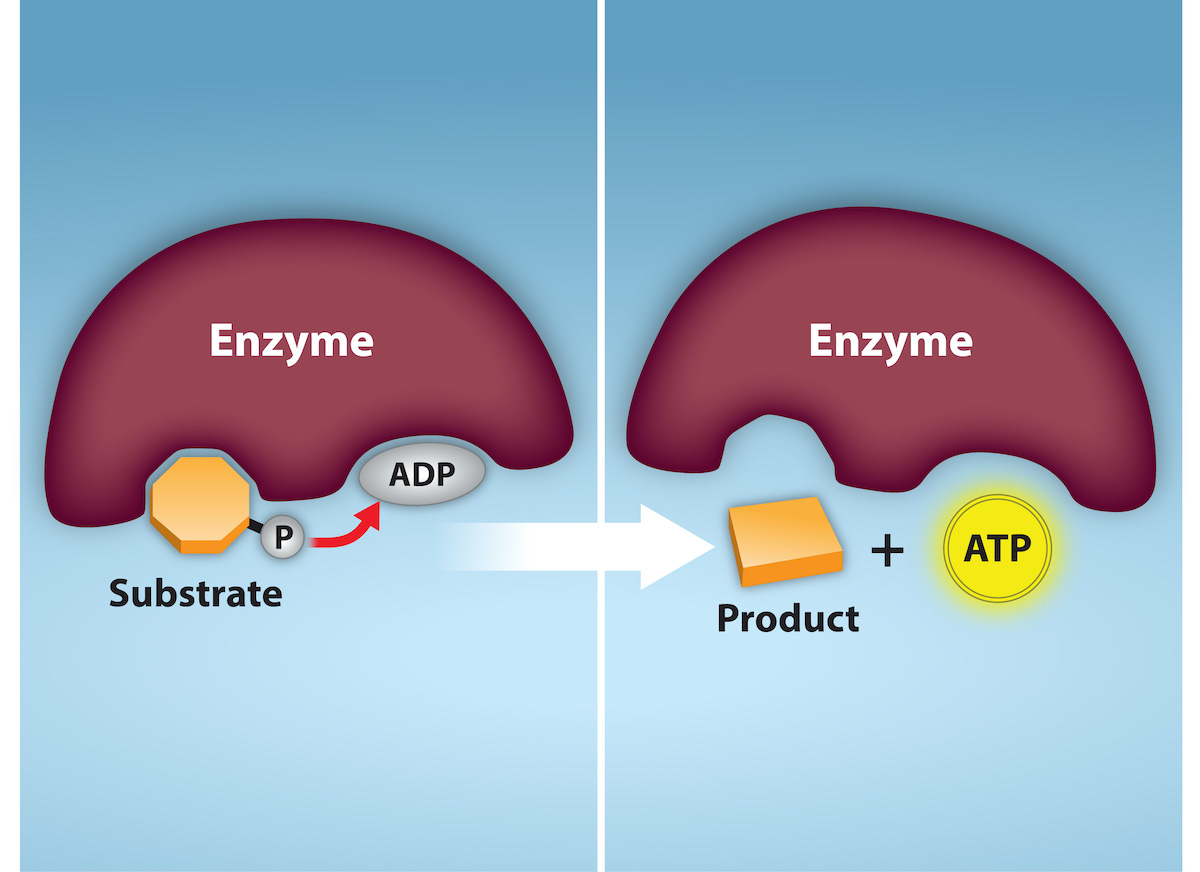
ATP is generated through two mechanisms during the breakdown of glucose. A few ATP molecules are generated (that is, regenerated from ADP) as a direct result of the chemical reactions that occur in the catabolic pathways. A phosphate group is removed from an intermediate reactant in the pathway, and the free energy of the reaction is used to add the third phosphate to an available ADP molecule, producing ATP (Figure 7.5). This very direct method of phosphorylation is called substrate-level phosphorylation.
英語のヒント
グルコースの分解中、ATPは二つの仕組みでつくられる。少数のATP分子は、異化経路で起こる化学反応の直接の結果として生成、すなわちADPから再生される。経路の中間反応物からリン酸基が取り除かれ、その反応の自由エネルギーを使って、利用可能なADP分子に3個目のリン酸を加え、ATPをつくる(図7.5)。この非常に直接的なリン酸化の方法を、基質レベルのリン酸化と呼ぶ。
OpenStax, Rice University; Biology 2e. Credit: Rao, A., Ryan, K. and Fletcher, S. Department of Biology, Texas A&M University. · CC BY 4.0 · Source出典

Figure 7.5図 7.5
In phosphorylation reactions, the gamma (third) phosphate of ATP is attached to a protein. In substrate-level phosphorylation, a phosphate group that is covalently attached to another molecule is transferred to ADP to form ATP. Credit: Rao, A., Ryan, K. and Fletcher, S. Department of Biology, Texas A&M University.
リン酸化反応では、ATPのγ(第3)リン酸がタンパク質に付加される。基質レベルのリン酸化では、別の分子に共有結合しているリン酸基がADPへ移され、ATPができる。出典:Rao, A.、Ryan, K.、Fletcher, S.、テキサスA&M大学生物学部。
Oxidative Phosphorylation酸化的リン酸化
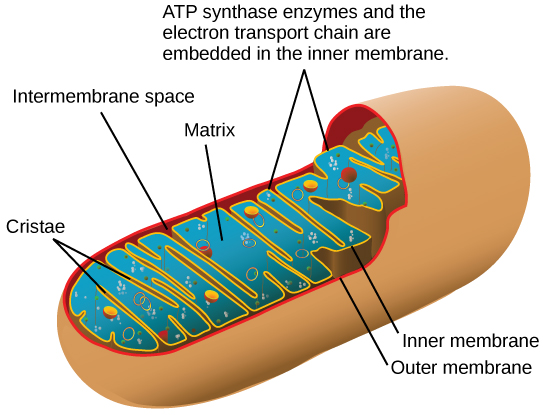
Most of the ATP generated during glucose catabolism, however, is derived from a much more complex process, chemiosmosis, which takes place in mitochondria (Figure 7.6) within a eukaryotic cell or the plasma membrane of a prokaryotic cell. Chemiosmosis, a process of ATP production in cellular metabolism, is used to generate 90 percent of the ATP made during glucose catabolism and is also the method used in the light reactions of photosynthesis to harness the energy of sunlight. The production of ATP using the process of chemiosmosis is called oxidative phosphorylation because of the involvement of oxygen in the process.
英語のヒント
しかし、グルコースの異化で生じるATPの大部分は、はるかに複雑な化学浸透という過程から得られる。これは真核細胞のミトコンドリア(図7.6)、または原核細胞の細胞膜で起こる。細胞の代謝でATPをつくる化学浸透は、グルコース異化で生じるATPの90パーセントを生成し、光合成の明反応で太陽光のエネルギーを利用する方法でもある。化学浸透によるATPの生成は、その過程に酸素が関与するため、酸化的リン酸化と呼ばれる。
OpenStax, Rice University; Biology 2e. (Credit: modification of work by Mariana Ruiz Villareal) · CC BY 4.0 · Source出典

Figure 7.6図 7.6
In eukaryotes, oxidative phosphorylation takes place in mitochondria. In prokaryotes, this process takes place in the plasma membrane. (Credit: modification of work by Mariana Ruiz Villareal)
真核生物では、酸化的リン酸化はミトコンドリアで起こる。原核生物では、細胞膜で起こる。(出典:Mariana Ruiz Villarealの作品を改変)
Section Summary節のまとめ
ATP functions as the energy currency for cells. It allows the cell to store energy briefly and transport it within the cell to support endergonic chemical reactions. The structure of ATP is that of an RNA nucleotide with three phosphates attached. As ATP is used for energy, a phosphate group or two are detached, and either ADP or AMP is produced. Energy derived from glucose catabolism is used to convert ADP into ATP. When ATP is used in a reaction, the third phosphate is temporarily attached to a substrate in a process called phosphorylation. The two processes of ATP regeneration that are used in conjunction with glucose catabolism are substrate-level phosphorylation and oxidative phosphorylation through the process of chemiosmosis.
ATPは細胞のエネルギー通貨として働く。エネルギーを短時間蓄え、細胞内で運んで、吸エルゴン性の化学反応を支える。ATPは、三つのリン酸が結合したRNAヌクレオチドの構造をもつ。エネルギーに利用されるとき、一つまたは二つのリン酸基が外れ、ADPまたはAMPが生じる。グルコースの異化から得られたエネルギーは、ADPをATPへ変換するのに使われる。反応でATPを使うと、リン酸化という過程で3個目のリン酸が一時的に基質へ結合する。グルコースの異化と組み合わせてATPを再生する二つの過程は、基質レベルのリン酸化と、化学浸透を通じた酸化的リン酸化である。
Review Questions確認問題
Exercises 1–2練習問題 1–2
Exercise 1問題 1
The energy currency used by cells is ________.
細胞が使うエネルギー通貨は________である。
- ATPATP
- ADPADP
- AMPAMP
- adenosineアデノシン
Solution解き方
A
A
Exercise 2問題 2
A reducing chemical reaction ________.
還元反応は、________。
- reduces the compound to a simpler form化合物をより単純な形へ小さくする。
- adds an electron to the substrate基質に電子を加える。
- removes a hydrogen atom from the substrate基質から水素原子を取り除く。
- is a catabolic reaction異化反応である。
Solution解き方
B
B
Critical Thinking Questions考察問題
Exercises 3練習問題 3
Exercise 3問題 3
Why is it beneficial for cells to use ATP rather than energy directly from the bonds of carbohydrates? What are the greatest drawbacks to harnessing energy directly from the bonds of several different compounds?
細胞が炭水化物の結合から直接エネルギーを使う代わりに、ATPを使う利点は何か。異なる複数の化合物の結合から直接エネルギーを利用する場合、最大の欠点は何だろうか。
Solution解き方
ATP provides the cell with a way to handle energy in an efficient manner. The molecule can be charged, stored, and used as needed. Moreover, the energy from hydrolyzing ATP is delivered as a consistent amount. Harvesting energy from the bonds of several different compounds would result in energy deliveries of different quantities.
ATPは、細胞が効率よくエネルギーを扱う手段を与える。分子にエネルギーを充填して蓄え、必要なときに使える。さらに、ATPの加水分解から得られるエネルギー量は一定である。異なる複数の化合物の結合からエネルギーを取り出すと、供給される量がまちまちになってしまう。
chemiosmosis
化学浸透
process in which there is a production of adenosine triphosphate (ATP) in cellular metabolism by the involvement of a proton gradient across a membrane
細胞の代謝で、膜を挟んだ陽子勾配を利用して、アデノシン三リン酸(ATP)を生産する過程。
dephosphorylation
脱リン酸化
removal of a phosphate group from a molecule
分子からリン酸基を取り除くこと。
oxidative phosphorylation
酸化的リン酸化
production of ATP using the process of chemiosmosis in the presence of oxygen
酸素の存在下で、化学浸透を利用してATPを生産すること。
phosphorylation
リン酸化
addition of a high-energy phosphate to a compound, usually a metabolic intermediate, a protein, or ADP
通常は代謝中間体、タンパク質、またはADPである化合物に、高エネルギーリン酸を付加すること。
redox reaction
酸化還元反応
chemical reaction that consists of the coupling of an oxidation reaction and a reduction reaction
酸化反応と還元反応が共役して成り立つ化学反応。
substrate-level phosphorylation
基質レベルのリン酸化
production of ATP from ADP using the excess energy from a chemical reaction and a phosphate group from a reactant
化学反応の余剰エネルギーと、反応物由来のリン酸基を使って、ADPからATPを生産すること。