第3章生体高分子
3.5 Nucleic Acids3.5 核酸
Learning Objectives学習目標
By the end of this section, you will be able to do the following:
この節を学び終えると、次のことができるようになる。
- Describe nucleic acids' structure and define the two types of nucleic acids核酸の構造を説明し、二種類の核酸を定義する。
- Explain DNA's structure and roleDNAの構造と役割を説明する。
- Explain RNA's structure and rolesRNAの構造と役割を説明する。
Nucleic acids are the most important macromolecules for the continuity of life. They carry the cell's genetic blueprint and carry instructions for its functioning.
英語のヒント
核酸は、生命の連続性を保つうえで最も重要な高分子である。細胞の遺伝的な設計図を担い、細胞が働くための指示を伝える。
DNA and RNADNAとRNA
The two main types of nucleic acids are deoxyribonucleic acid (DNA) and ribonucleic acid (RNA). DNA is the genetic material in all living organisms, ranging from single-celled bacteria to multicellular mammals. It is in the nucleus of eukaryotes and in the organelles, chloroplasts, and mitochondria. In prokaryotes, the DNA is not enclosed in a membranous envelope.
英語のヒント
核酸の主な二種類は、デオキシリボ核酸(DNA)とリボ核酸(RNA)である。DNAは、単細胞の細菌から多細胞の哺乳類まで、すべての生物で遺伝物質となる。真核生物では核に加え、細胞小器官の葉緑体やミトコンドリアにも存在する。原核生物では、DNAは膜状の包みに囲まれていない。
The cell's entire genetic content is its genome, and the study of genomes is genomics. In eukaryotic cells but not in prokaryotes, DNA forms a complex with histone proteins to form chromatin, the substance of eukaryotic chromosomes. A chromosome may contain tens of thousands of genes. Many genes contain the information to make protein products. Other genes code for RNA products. DNA controls all of the cellular activities by turning the genes “on” or “off.”
英語のヒント
細胞の遺伝情報全体をゲノムといい、ゲノムを研究する分野がゲノミクスである。原核生物と違い、真核細胞ではDNAがヒストンタンパク質と複合体を作ってクロマチンとなる。クロマチンは、真核生物の染色体を構成する物質である。一本の染色体に数万の遺伝子が含まれることもある。多くの遺伝子はタンパク質を作る情報を持ち、ほかの遺伝子はRNAをコードする。DNAは遺伝子の「オン」と「オフ」を切り替えることで、細胞のすべての活動を制御する。
The other type of nucleic acid, RNA, is mostly involved in protein synthesis. The DNA molecules never leave the nucleus but instead use an intermediary to communicate with the rest of the cell. This intermediary is the messenger RNA (mRNA). Other types of RNA—like rRNA, tRNA, and microRNA—are involved in protein synthesis and its regulation.
英語のヒント
もう一方の核酸であるRNAは、主としてタンパク質合成に関わる。DNA分子は核を離れず、仲介役を使って細胞のほかの部分と情報をやり取りする。この仲介役がメッセンジャーRNA(mRNA)である。rRNA、tRNA、マイクロRNAなど、ほかの種類のRNAも、タンパク質合成とその調節に関わる。
DNA and RNA are comprised of monomers that scientists call nucleotides. The nucleotides combine with each other to form a polynucleotide, DNA or RNA. Three components comprise each nucleotide: a nitrogenous base, a pentose (five-carbon) sugar, and a phosphate group (Figure 3.31). Each nitrogenous base in a nucleotide is attached to a sugar molecule, which is attached to one or more phosphate groups.
英語のヒント
DNAとRNAは、ヌクレオチドと呼ばれる単量体からできている。ヌクレオチド同士が結合して、ポリヌクレオチドであるDNAまたはRNAを作る。各ヌクレオチドは、含窒素塩基、五炭糖(炭素五つの糖)、リン酸基という三つの成分からなる(図3.31)。ヌクレオチド内では、含窒素塩基が糖分子につながり、その糖が一つ以上のリン酸基につながっている。
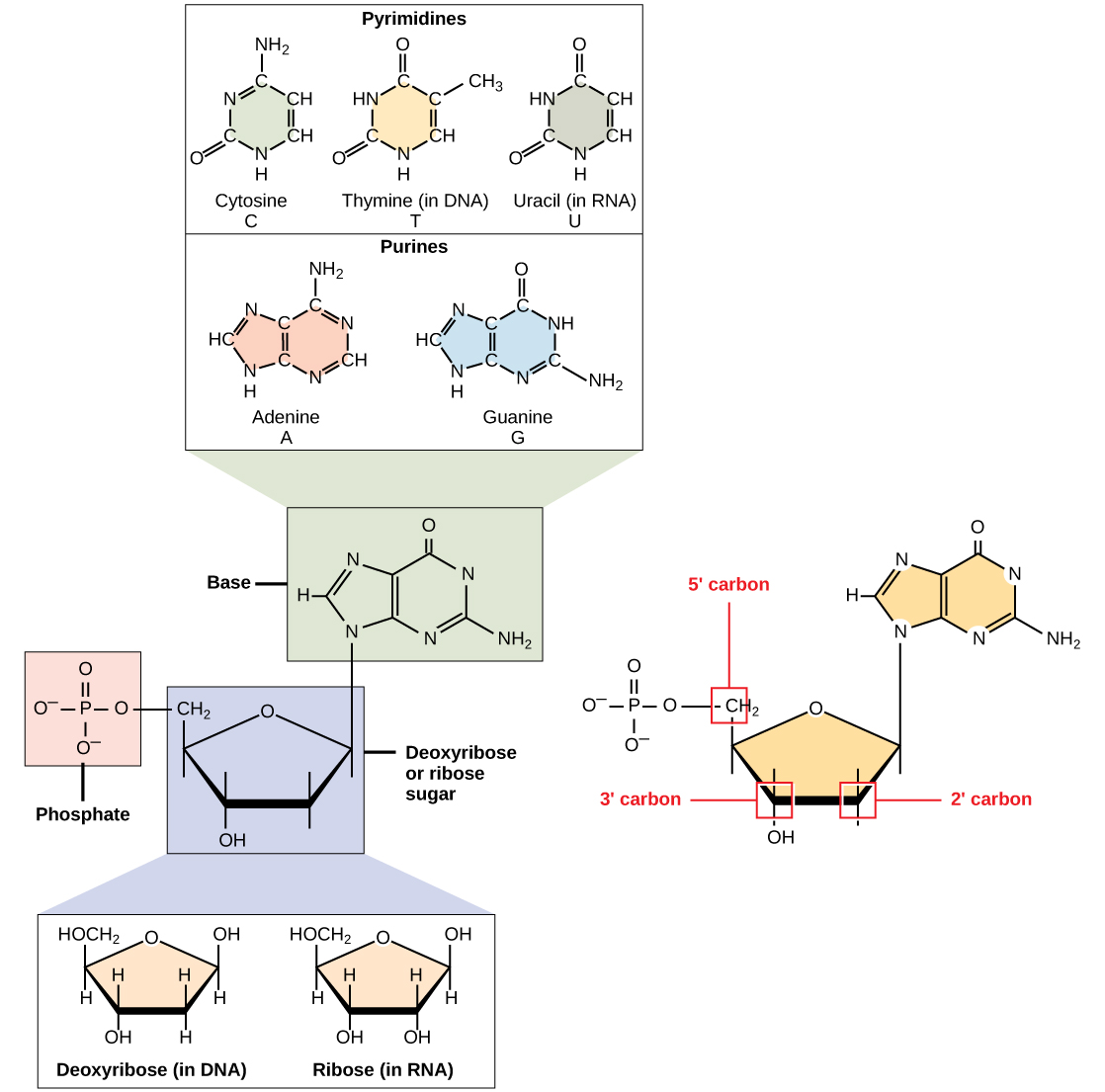

Figure 3.31図 3.31
Three components comprise a nucleotide: a nitrogenous base, a pentose sugar, and one or more phosphate groups. Carbon residues in the pentose are numbered 1′ through 5′ (the prime distinguishes these residues from those in the base, which are numbered without using a prime notation). The base is attached to the ribose's 1′ position, and the phosphate is attached to the 5′ position. When a polynucleotide forms, the incoming nucleotide's 5′ phosphate attaches to the 3′ hydroxyl group at the end of the growing chain. Two types of pentose are in nucleotides, deoxyribose (found in DNA) and ribose (found in RNA). Deoxyribose is similar in structure to ribose, but it has an H instead of an OH at the 2′ position. We can divide bases into two categories: purines and pyrimidines. Purines have a double ring structure, and pyrimidines have a single ring.
ヌクレオチドは、含窒素塩基、五炭糖、一つ以上のリン酸基からなる。五炭糖の炭素には1′から5′までの番号を付ける。プライム記号は、プライムを使わずに番号を付ける塩基内の炭素と区別するためのものである。塩基はリボースの1′位に、リン酸は5′位に付く。ポリヌクレオチドができるとき、新たに加わるヌクレオチドの5′リン酸が、伸長中の鎖の末端にある3′ヒドロキシ基につながる。ヌクレオチドには、DNAにあるデオキシリボースと、RNAにあるリボースという二種類の五炭糖がある。デオキシリボースはリボースと似た構造だが、2′位ではOHの代わりにHを持つ。塩基はプリンとピリミジンに分けられる。プリンは二つの環、ピリミジンは一つの環を持つ。
The nitrogenous bases, important components of nucleotides, are organic molecules and are so named because they contain carbon and nitrogen. They are bases because they contain an amino group that has the potential of binding an extra hydrogen, and thus decreasing the hydrogen ion concentration in its environment, making it more basic. Each nucleotide in DNA contains one of four possible nitrogenous bases: adenine (A), guanine (G) cytosine (C), and thymine (T).
英語のヒント
ヌクレオチドの重要な構成成分である含窒素塩基は有機分子であり、炭素と窒素を含むためそう呼ばれる。アミノ基を持ち、さらに水素と結合することができるので、周囲の水素イオン濃度を下げて塩基性を高める。そのため塩基なのである。DNAの各ヌクレオチドは、アデニン(A)、グアニン(G)、シトシン(C)、チミン(T)の四つの含窒素塩基のいずれかを含む。
Scientists classify adenine and guanine as purines. The purine's primary structure is two carbon-nitrogen rings. Scientists classify cytosine, thymine, and uracil as pyrimidines which have a single carbon-nitrogen ring as their primary structure (Figure 3.31). Each of these basic carbon-nitrogen rings has different functional groups attached to it. In molecular biology shorthand, we know the nitrogenous bases by their symbols A, T, G, C, and U. DNA contains A, T, G, and C; whereas, RNA contains A, U, G, and C.
英語のヒント
アデニンとグアニンはプリンに分類される。プリンの基本構造は、炭素と窒素からなる二つの環である。シトシン、チミン、ウラシルはピリミジンに分類され、基本構造として炭素と窒素からなる一つの環を持つ(図3.31)。これらの基本的な炭素–窒素環には、それぞれ異なる官能基が付いている。分子生物学では、含窒素塩基をA、T、G、C、Uという略号で表す。DNAはA、T、G、Cを含み、RNAはA、U、G、Cを含む。
The pentose sugar in DNA is deoxyribose, and in RNA, the sugar is ribose (Figure 3.31). The difference between the sugars is the presence of the hydroxyl group on the ribose's second carbon and hydrogen on the deoxyribose's second carbon. The carbon atoms of the sugar molecule are numbered as 1′, 2′, 3′, 4′, and 5′ (1′ is read as “one prime”). The phosphate residue attaches to the hydroxyl group of the 5′ carbon of one sugar and the hydroxyl group of the 3′ carbon of the sugar of the next nucleotide, which forms a 5′–3′ phosphodiester linkage. A simple dehydration reaction like the other linkages connecting monomers in macromolecules does not form the phosphodiester linkage. Its formation involves removing two phosphate groups. A polynucleotide may have thousands of such phosphodiester linkages.
英語のヒント
DNAの五炭糖はデオキシリボース、RNAの五炭糖はリボースである(図3.31)。両者の違いは、2番目の炭素に、リボースではヒドロキシ基、デオキシリボースでは水素が付いている点である。糖分子の炭素には1′、2′、3′、4′、5′と番号を付ける。1′は「ワン・プライム」と読む。リン酸残基は、一方の糖の5′炭素のヒドロキシ基と、次のヌクレオチドの糖の3′炭素のヒドロキシ基につながり、5′–3′ホスホジエステル結合を形成する。高分子の単量体同士をつなぐほかの結合のような、単純な脱水反応では、この結合はできない。その形成には二つのリン酸基の除去が伴う。一つのポリヌクレオチドに、こうしたホスホジエステル結合が何千も存在することがある。