第3章生体高分子
DNA Double-Helix StructureDNAの二重らせん構造
DNA has a double-helix structure (Figure 3.32). The sugar and phosphate lie on the outside of the helix, forming the DNA's backbone. The nitrogenous bases are stacked in the interior, like a pair of staircase steps. Hydrogen bonds bind the pairs to each other. Every base pair in the double helix is separated from the next base pair by 0.34 nm. The helix's two strands run in opposite directions, meaning that the 5′ carbon end of one strand will face the 3′ carbon end of its matching strand. (Scientists call this an antiparallel orientation and is important to DNA replication and in many nucleic acid interactions.)
英語のヒント
DNAは二重らせん構造を持つ(図3.32)。糖とリン酸はらせんの外側にあり、DNAの骨格を形成する。含窒素塩基は、階段の段のように対になって内側に積み重なり、水素結合が対同士を結び付ける。二重らせんでは、隣り合う塩基対の間隔は0.34 nmである。らせんの二本の鎖は逆向きに走る。つまり、一方の鎖の5′炭素側の末端は、対応する鎖の3′炭素側の末端と向かい合う。(これを逆平行の配向といい、DNA複製や核酸の多くの相互作用で重要である。)
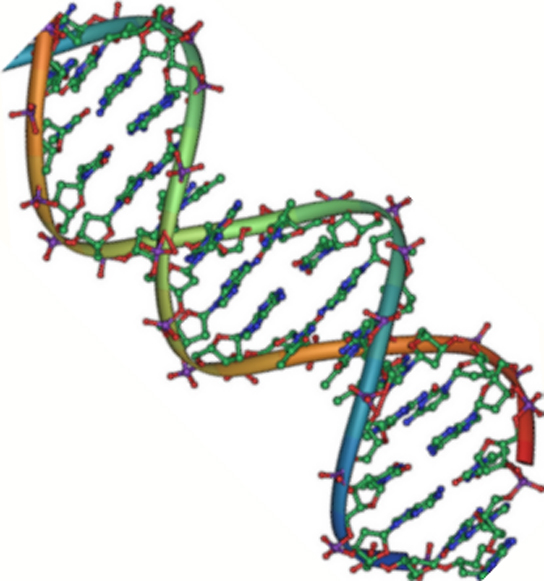
Figure 3.32図 3.32
Native DNA is an antiparallel double helix. The phosphate backbone (indicated by the curvy lines) is on the outside, and the bases are on the inside. Each base from one strand interacts via hydrogen bonding with a base from the opposing strand. (credit: Jerome Walker/Dennis Myts)
天然のDNAは、逆平行な二重らせんである。リン酸の骨格(曲線で表示)は外側に、塩基は内側にある。一方の鎖の各塩基は、向かい合う鎖の塩基と水素結合で相互作用する。(出典:Jerome Walker/Dennis Myts)
Only certain types of base pairing are allowed. For example, a certain purine can only pair with a certain pyrimidine. This means A can pair with T, and G can pair with C, as Figure 3.33 shows. This is the base complementary rule. In other words, the DNA strands are complementary to each other. If the sequence of one strand is AATTGGCC, the complementary strand would have the sequence TTAACCGG. During DNA replication, each strand copies itself, resulting in a daughter DNA double helix containing one parental DNA strand and a newly synthesized strand.
英語のヒント
塩基対には、特定の組み合わせしか許されない。例えば、あるプリンは特定のピリミジンとのみ対を作れる。図3.33に示すように、AはT、GはCと対を作る。これが塩基の相補性の規則である。言い換えると、DNAの鎖は互いに相補的である。一方の鎖の配列がAATTGGCCなら、相補鎖の配列はTTAACCGGとなる。DNA複製の際には各鎖が自身を複製し、親のDNA鎖一本と新しく合成された鎖一本を含む、娘DNAの二重らせんができる。
RNARNA
Ribonucleic acid, or RNA, is mainly involved in the process of protein synthesis under the direction of DNA. RNA is usually single-stranded and is comprised of ribonucleotides that are linked by phosphodiester bonds. A ribonucleotide in the RNA chain contains ribose (the pentose sugar), one of the four nitrogenous bases (A, U, G, and C), and the phosphate group.
英語のヒント
リボ核酸、すなわちRNAは、主にDNAの指示の下で行われるタンパク質合成に関わる。RNAは通常一本鎖で、リボヌクレオチドがホスホジエステル結合でつながったものである。RNA鎖のリボヌクレオチドは、五炭糖のリボース、四つの含窒素塩基(A、U、G、C)のいずれか、リン酸基を含む。
There are four major types of RNA: messenger RNA (mRNA), ribosomal RNA (rRNA), transfer RNA (tRNA), and microRNA (miRNA). The first, mRNA, carries the message from DNA, which controls all of the cellular activities in a cell. If a cell requires synthesizing a certain protein, the gene for this product turns “on” and the messenger RNA synthesizes in the nucleus. The RNA base sequence is complementary to the DNA's coding sequence from which it has been copied. However, in RNA, the base T is absent and U is present instead. If the DNA strand has a sequence AATTGCGC, the sequence of the complementary RNA is UUAACGCG. In the cytoplasm, the mRNA interacts with ribosomes and other cellular machinery (Figure 3.34).
英語のヒント
RNAには、メッセンジャーRNA(mRNA)、リボソームRNA(rRNA)、転移RNA(tRNA)、マイクロRNA(miRNA)という主な四種類がある。最初のmRNAは、細胞のすべての活動を制御するDNAからの情報を運ぶ。細胞が特定のタンパク質を合成する必要があると、その産物の遺伝子が「オン」になり、核内でメッセンジャーRNAが合成される。RNAの塩基配列は、コピー元となったDNAのコード配列に相補的である。ただし、RNAにはTがなく、代わりにUがある。DNA鎖の配列がAATTGCGCなら、相補的なRNAの配列はUUAACGCGとなる。細胞質では、mRNAがリボソームや細胞内のほかの仕組みと相互作用する(図3.34)。
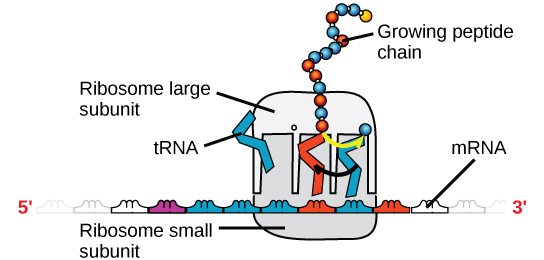


Figure 3.34図 3.34
A ribosome has two parts: a large subunit and a small subunit. The mRNA sits in between the two subunits. A tRNA molecule recognizes a codon on the mRNA, binds to it by complementary base pairing, and adds the correct amino acid to the growing peptide chain.
リボソームは、大サブユニットと小サブユニットの二つの部分からなる。mRNAはその間に位置する。tRNA分子はmRNA上のコドンを認識し、相補的な塩基対を作って結合し、伸長中のペプチド鎖に正しいアミノ酸を加える。
The mRNA is read in sets of three bases known as codons. Each codon codes for a single amino acid. In this way, the mRNA is read and the protein product is made. Ribosomal RNA (rRNA) is a major constituent of ribosomes on which the mRNA binds. The rRNA ensures the proper alignment of the mRNA and the Ribosomes. The ribosome's rRNA also has an enzymatic activity (peptidyl transferase) and catalyzes peptide bond formation between two aligned amino acids. Transfer RNA (tRNA) is one of the smallest of the four types of RNA, usually 70–90 nucleotides long. It carries the correct amino acid to the protein synthesis site. It is the base pairing between the tRNA and mRNA that allows for the correct amino acid to insert itself in the polypeptide chain. MicroRNAs are the smallest RNA molecules and their role involves regulating gene expression by interfering with the expression of certain mRNA messages. Table 3.2 summarizes DNA and RNA features.
英語のヒント
mRNAは、コドンと呼ばれる三塩基ずつの組で読み取られる。各コドンは一つのアミノ酸をコードする。このようにしてmRNAが読まれ、タンパク質が作られる。リボソームRNA(rRNA)は、mRNAが結合するリボソームの主要成分である。rRNAはmRNAとリボソームの正しい位置合わせを確実にする。また、リボソームのrRNAはペプチジルトランスフェラーゼという酵素活性を持ち、並んだ二つのアミノ酸間にペプチド結合を作る反応を触媒する。転移RNA(tRNA)は、この四種類のRNAのうち最も小さいものの一つで、通常は70〜90ヌクレオチドの長さである。タンパク質合成の場所へ正しいアミノ酸を運ぶ。正しいアミノ酸がポリペプチド鎖に組み込まれることを可能にするのは、tRNAとmRNAの間の塩基対形成である。マイクロRNAは最も小さいRNA分子で、その役割は、特定のmRNAの情報の発現を妨げることによる遺伝子発現の調節にある。表3.2に、DNAとRNAの特徴をまとめる。
DNA and RNA Features DNAとRNAの特徴 |
||
|---|---|---|
DNA |
RNA |
|
Function 機能 |
Carries genetic information 遺伝情報を担う |
Involved in protein synthesis タンパク質合成に関わる |
Location 所在 |
Remains in the nucleus 核内にとどまる |
Leaves the nucleus 核から出る |
Structure 構造 |
Double helix 二重らせん |
Usually single-stranded 通常は一本鎖 |
Sugar 糖 |
Deoxyribose デオキシリボース |
Ribose リボース |
Pyrimidines ピリミジン |
Cytosine, thymine シトシン、チミン |
Cytosine, uracil シトシン、ウラシル |
Purines プリン |
Adenine, guanine アデニン、グアニン |
Adenine, guanine アデニン、グアニン |
Even though the RNA is single stranded, most RNA types show extensive intramolecular base pairing between complementary sequences, creating a predictable three-dimensional structure essential for their function.
英語のヒント
RNAは一本鎖だが、大部分の種類では、分子内の相補的な配列間で広範な塩基対形成が起こる。その結果、機能に不可欠な、予測可能な三次元構造ができる。
As you have learned, information flow in an organism takes place from DNA to RNA to protein. DNA dictates the structure of mRNA in a process scientists call transcription, and RNA dictates the protein's structure in a process scientists call translation. This is the Central Dogma of Life, which holds true for all organisms; however, exceptions to the rule occur in connection with viral infections.
英語のヒント
これまで学んだように、生物の情報はDNAからRNA、そしてタンパク質へ流れる。DNAは、転写と呼ばれる過程でmRNAの構造を決め、RNAは、翻訳と呼ばれる過程でタンパク質の構造を決める。これが生命のセントラルドグマであり、すべての生物に当てはまる。ただし、ウイルス感染に関連して、この規則の例外が生じる。