第3章生体高分子
3.1 Synthesis of Biological Macromolecules3.1 生体高分子の合成
Learning Objectives学習目標
By the end of this section, you will be able to do the following:
この節を学び終えると、次のことができるようになる。
- Understand macromolecule synthesis高分子の合成を理解する。
- Explain dehydration (or condensation) and hydrolysis reactions脱水(または縮合)反応と加水分解反応を説明する。
As you’ve learned, biological macromolecules are large molecules, necessary for life, that are built from smaller organic molecules. There are four major biological macromolecule classes (carbohydrates, lipids, proteins, and nucleic acids). Each is an important cell component and performs a wide array of functions. Combined, these molecules make up the majority of a cell’s dry mass (recall that water makes up the majority of its complete mass). Biological macromolecules are organic, meaning they contain carbon and are bound to hydrogen, and may contain oxygen, nitrogen, and additional minor elements.
英語のヒント
これまでに学んだように、生体高分子は、より小さな有機分子から作られる、生命に不可欠な大きな分子である。主に四つの種類があり、炭水化物、脂質、タンパク質、核酸に分けられる。いずれも細胞の重要な構成成分で、多種多様な機能を果たす。これらの分子を合わせると、細胞の乾燥質量の大部分を占める(細胞の全質量の大部分は水であることを思い出そう)。生体高分子は有機物、つまり炭素を含み、それが水素と結合している物質である。酸素、窒素、その他の微量元素を含むこともある。
Dehydration Synthesis脱水合成
Most macromolecules are made from single subunits, or building blocks, called monomers. The monomers combine with each other using covalent bonds to form larger molecules known as polymers. In doing so, monomers release water molecules as byproducts. This type of reaction is dehydration synthesis, which means “to put together while losing water.”
英語のヒント
高分子の多くは、単量体と呼ばれる個々の構成単位、すなわち材料からできている。単量体同士が共有結合でつながることで、重合体と呼ばれる、より大きな分子になる。その際、単量体は副産物として水分子を放出する。この種の反応を脱水合成という。これは「水を失いながら組み合わせる」という意味である。
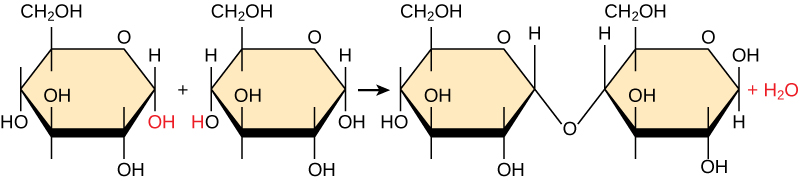
Figure 3.2図 3.2
In the dehydration synthesis reaction above, two glucose molecules link to form the disaccharide maltose. In the process, it forms a water molecule.
上の脱水合成反応では、グルコース分子二つがつながり、二糖のマルトースを作る。この過程で水分子ができる。
In a dehydration synthesis reaction (Figure 3.2), the hydrogen of one monomer combines with the hydroxyl group of another monomer, releasing a water molecule. At the same time, the monomers share electrons and form covalent bonds. As additional monomers join, this chain of repeating monomers forms a polymer. Different monomer types can combine in many configurations, giving rise to a diverse group of macromolecules. Even one kind of monomer can combine in a variety of ways to form several different polymers. For example, glucose monomers are the constituents of starch, glycogen, and cellulose.
英語のヒント
脱水合成反応(図3.2)では、一方の単量体の水素が、もう一方の単量体のヒドロキシ基と結び付き、水分子を放出する。それと同時に、単量体同士が電子を共有し、共有結合を形成する。さらに単量体が加わるにつれて、単量体が繰り返し並ぶこの鎖は重合体になる。異なる種類の単量体がさまざまな配置で結合し、多様な高分子が生じる。単量体が一種類だけでも、さまざまな方法でつながることで、いくつもの異なる重合体を作れる。例えば、グルコース単量体は、デンプン、グリコーゲン、セルロースの構成単位である。
Hydrolysis加水分解
Polymers break down into monomers during hydrolysis. A chemical reaction occurs when inserting a water molecule across the bond. Breaking a covalent bond with this water molecule in the compound achieves this (Figure 3.3). During these reactions, the polymer breaks into two components: one part gains a hydrogen atom (H+) and the other gains a hydroxyl molecule (OH–) from a split water molecule.
英語のヒント
加水分解では、重合体が単量体に分解する。結合をまたぐように水分子が挿入されると、化学反応が起こる。この水分子によって化合物の共有結合を切ることで、分解が達成される(図3.3)。反応の際、重合体は二つに分かれる。一方は、分かれた水分子から水素原子(H+)を受け取り、もう一方はヒドロキシ分子(OH−)を受け取る。
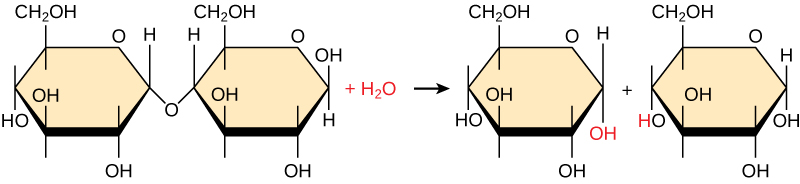


Figure 3.3図 3.3
In the hydrolysis reaction here, the disaccharide maltose breaks down to form two glucose monomers by adding a water molecule. Note that this reaction is the reverse of the synthesis reaction in Figure 3.2.
この加水分解反応では、水分子を加えることで二糖のマルトースが分解し、二つのグルコース単量体になる。この反応が図3.2の合成反応の逆であることに注目しよう。
Dehydration and hydrolysis reactions are catalyzed, or “sped up,” by specific enzymes; dehydration reactions involve the formation of new bonds, requiring energy, while hydrolysis reactions break bonds and release energy. These reactions are similar for most macromolecules, but each monomer and polymer reaction is specific for its class. For example, catalytic enzymes in the digestive system hydrolyze or break down the food we ingest into smaller molecules. This allows cells in our body to easily absorb nutrients in the intestine. A specific enzyme breaks down each macromolecule. For instance, amylase, sucrase, lactase, or maltase break down carbohydrates. Enzymes called proteases, such as pepsin and peptidase, and hydrochloric acid break down proteins. Lipases break down lipids. These broken down macromolecules provide energy for cellular activities.
英語のヒント
脱水反応と加水分解反応は、特定の酵素によって触媒される、つまり「速められる」。脱水反応では新しい結合が作られ、エネルギーが必要となる。一方、加水分解反応では結合が切れ、エネルギーが放出される。これらの反応は大部分の高分子で似ているが、個々の単量体と重合体の反応は、その種類に固有である。例えば消化器系の触媒酵素は、摂取した食物を加水分解して、より小さな分子にする。これによって、体の細胞は腸内で栄養素を吸収しやすくなる。各高分子は、特定の酵素によって分解される。炭水化物を分解するのは、例えばアミラーゼ、スクラーゼ、ラクターゼ、マルターゼである。タンパク質は、ペプシンやペプチダーゼなどのプロテアーゼと呼ばれる酵素と、塩酸によって分解される。脂質はリパーゼによって分解される。こうして分解された高分子が、細胞の活動にエネルギーを与える。
Section Summaryこの節のまとめ
Proteins, carbohydrates, nucleic acids, and lipids are the four major classes of biological macromolecules—large molecules necessary for life that are built from smaller organic molecules. Macromolecules are comprised of single units scientists call monomers that are joined by covalent bonds to form larger polymers. The polymer is more than the sum of its parts: it acquires new characteristics, and leads to an osmotic pressure that is much lower than that formed by its ingredients. This is an important advantage in maintaining cellular osmotic conditions. A monomer joins with another monomer with water molecule release, leading to a covalent bond forming. Scientists call these dehydration or condensation reactions. When polymers break down into smaller units (monomers), they use a water molecule for each bond broken by these reactions. Such reactions are hydrolysis reactions. Dehydration and hydrolysis reactions are similar for all macromolecules, but each monomer and polymer reaction is specific to its class. Dehydration reactions typically require an investment of energy for new bond formation, while hydrolysis reactions typically release energy by breaking bonds.
英語のヒント
タンパク質、炭水化物、核酸、脂質は、生体高分子の主要な四種類である。これらは、より小さな有機分子から作られる、生命に必要な大きな分子である。高分子は単量体と呼ばれる個々の単位からなり、それらが共有結合でつながって、より大きな重合体を作る。重合体は、単に部分を足し合わせただけのものではない。新しい特徴を獲得し、構成材料がばらばらに存在するときよりも、はるかに低い浸透圧を生じさせる。これは、細胞の浸透圧条件を保つうえで重要な利点である。単量体が別の単量体とつながると、水分子が放出され、共有結合ができる。こうした反応を脱水反応または縮合反応という。重合体がより小さな単位である単量体に分解するときには、切られる結合一つにつき水分子一つを使う。このような反応を加水分解という。脱水反応と加水分解反応はすべての高分子で似ているが、各単量体と重合体の反応は、その種類に固有である。脱水反応では一般に、新しい結合を作るためにエネルギーを投入する必要がある。一方、加水分解反応では一般に、結合を切ることでエネルギーが放出される。