第3章生体高分子
Trans Fatsトランス脂肪
The food industry artificially hydrogenates oils to make them semi-solid and of a consistency desirable for many processed food products. Simply speaking, hydrogen gas is bubbled through oils to solidify them. During this hydrogenation process, double bonds of the cis- conformation in the hydrocarbon chain may convert to double bonds in the trans- conformation.
英語のヒント
食品産業では、油を人工的に水素添加して半固体にし、多くの加工食品に適した硬さにする。簡単に言えば、油の中に水素ガスを泡として通し、固化させるのである。この水素添加の過程で、炭化水素鎖のシス配置の二重結合が、トランス配置の二重結合へ変わることがある。
Margarine, some types of peanut butter, and shortening are examples of artificially hydrogenated trans fats. Recent studies have shown that an increase in trans fats in the human diet may lead to higher levels of low-density lipoproteins (LDL), or “bad” cholesterol, which in turn may lead to plaque deposition in the arteries, resulting in heart disease. Many fast food restaurants have recently banned using trans fats, and food labels are required to display the trans fat content.
英語のヒント
マーガリン、一部のピーナッツバター、ショートニングは、人工的な水素添加でできるトランス脂肪の例である。近年の研究では、食事中のトランス脂肪が増えると、低密度リポタンパク質(LDL)、いわゆる「悪玉」コレステロールの量が増える可能性が示されている。これがさらに動脈へのプラーク沈着につながり、心疾患をもたらす場合がある。近年、多くのファストフード店がトランス脂肪の使用を禁止し、食品ラベルにはトランス脂肪の含有量を表示することが義務付けられている。
Omega Fatty Acidsオメガ脂肪酸
Essential fatty acids are those that the human body requires but does not synthesize. Consequently, they have to be supplemented through ingestion via the diet. Omega-3 fatty acids (like those in Figure 3.17) fall into this category and are one of only two known for humans (the other is omega-6 fatty acid). These are polyunsaturated fatty acids and are omega-3 because a double bond connects the third carbon from the hydrocarbon chain's end to its neighboring carbon.
英語のヒント
必須脂肪酸とは、ヒトの体が必要とするにもかかわらず、体内では合成しない脂肪酸である。そのため、食事から摂取して補わなければならない。図3.17のようなオメガ3脂肪酸はこの分類に入り、ヒトで知られている二つの種類のうちの一つである(もう一つはオメガ6脂肪酸)。これらは多価不飽和脂肪酸であり、炭化水素鎖の末端から3番目の炭素と隣の炭素が二重結合でつながっているため、オメガ3と呼ばれる。
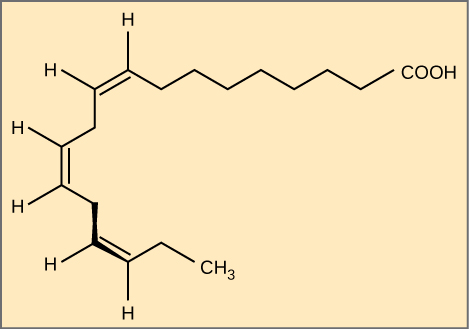
Figure 3.17図 3.17
Alpha-linolenic acid is an example of an omega-3 fatty acid. It has three cis double bonds and, as a result, a curved shape. For clarity, the diagram does not show the carbons. Each singly bonded carbon has two hydrogens associated with it, which the diagram also does not show.
α-リノレン酸は、オメガ3脂肪酸の一例である。三つのシス二重結合を持ち、そのため曲がった形になる。図を見やすくするため、炭素は省略している。単結合した各炭素には二つの水素が結び付くが、その水素も図には示していない。
The farthest carbon away from the carboxyl group is numbered as the omega (ω) carbon, and if the double bond is between the third and fourth carbon from that end, it is an omega-3 fatty acid. Nutritionally important because the body does not make them, omega-3 fatty acids include alpha-linoleic acid (ALA), eicosapentaenoic acid (EPA), and docosahexaenoic acid (DHA), all of which are polyunsaturated. Salmon, trout, and tuna are good sources of omega-3 fatty acids. Research indicates that omega-3 fatty acids reduce the risk of sudden death from heart attacks, lower triglycerides in the blood, decrease blood pressure, and prevent thrombosis by inhibiting blood clotting. They also reduce inflammation, and may help lower the risk of some cancers in animals.
英語のヒント
カルボキシ基から最も遠い炭素をオメガ(ω)炭素と呼ぶ。この末端から3番目と4番目の炭素の間に二重結合があれば、オメガ3脂肪酸である。体内で作られないため栄養上重要なオメガ3脂肪酸には、α-リノール酸(ALA)、エイコサペンタエン酸(EPA)、ドコサヘキサエン酸(DHA)があり、いずれも多価不飽和脂肪酸である。サケ、マス、マグロは、オメガ3脂肪酸を摂るよい供給源になる。研究によると、オメガ3脂肪酸は心臓発作による突然死のリスクを減らし、血中トリグリセリド値や血圧を下げ、血液凝固を抑えることで血栓症を防ぐ。また炎症を抑え、動物では一部のがんのリスクを下げるのに役立つ可能性がある。
Like carbohydrates, fats have received considerable bad publicity. It is true that eating an excess of fried foods and other “fatty” foods leads to weight gain. However, fats do have important functions. Many vitamins are fat soluble, and fats serve as a long-term storage form of fatty acids: a source of energy. They also provide insulation for the body. Therefore, we should consume “healthy” fats in moderate amounts on a regular basis.
英語のヒント
炭水化物と同様に、脂肪もかなり悪い評判を受けてきた。揚げ物や、ほかの「脂っこい」食品を食べ過ぎると体重が増えるのは事実である。しかし、脂肪には確かに重要な働きがある。多くのビタミンは脂溶性であり、脂肪はエネルギー源となる脂肪酸を長期保存する形態でもある。また、体の断熱にも役立つ。したがって、「健康によい」脂肪を適量、日常的に摂取すべきである。
Waxesろう
Wax covers some aquatic birds' feathers and some plants' leaf surfaces. Because of waxes' hydrophobic nature, they prevent water from sticking on the surface (Figure 3.18). Long fatty acid chains esterified to long-chain alcohols comprise waxes.
英語のヒント
一部の水鳥の羽毛や植物の葉の表面は、ろうで覆われている。ろうは疎水性なので、水が表面に付着するのを防ぐ(図3.18)。ろうは、長い脂肪酸鎖が長鎖アルコールとエステル化したものからなる。
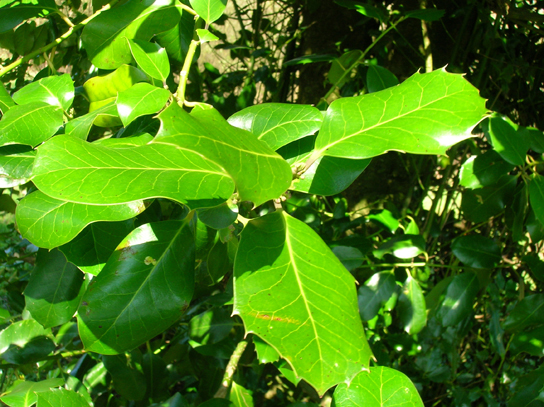
Figure 3.18図 3.18
Lipids comprise waxy coverings on some leaves. (credit: Roger Griffith)
一部の葉を覆うろう状の被膜は、脂質からできている。(出典:Roger Griffith)
Phospholipidsリン脂質
Phospholipids are major plasma membrane constituents that comprise cells' outermost layer. Like fats, they are comprised of fatty acid chains attached to a glycerol or sphingosine backbone. However, instead of three fatty acids attached as in triglycerides, there are two fatty acids forming diacylglycerol, and a modified phosphate group occupies the glycerol backbone's third carbon (Figure 3.19). A phosphate group alone attached to a diacylglycerol does not qualify as a phospholipid. It is phosphatidate (diacylglycerol 3-phosphate), the precursor of phospholipids. An alcohol modifies the phosphate group. Phosphatidylcholine and phosphatidylserine are two important phospholipids that are in plasma membranes.
英語のヒント
リン脂質は、細胞の最も外側の層をなす細胞膜の主要な構成成分である。脂肪と同じように、グリセロールまたはスフィンゴシンの骨格に脂肪酸鎖が付いた構造を持つ。ただし、トリグリセリドのように脂肪酸が三つ付いているのではなく、二つの脂肪酸がジアシルグリセロールを形成し、グリセロール骨格の3番目の炭素には修飾されたリン酸基が付いている(図3.19)。ジアシルグリセロールにリン酸基だけが付いたものは、リン脂質には該当しない。それはリン脂質の前駆体であるホスファチジン酸(ジアシルグリセロール3-リン酸)である。リン酸基はアルコールによって修飾される。ホスファチジルコリンとホスファチジルセリンは、細胞膜に含まれる二つの重要なリン脂質である。
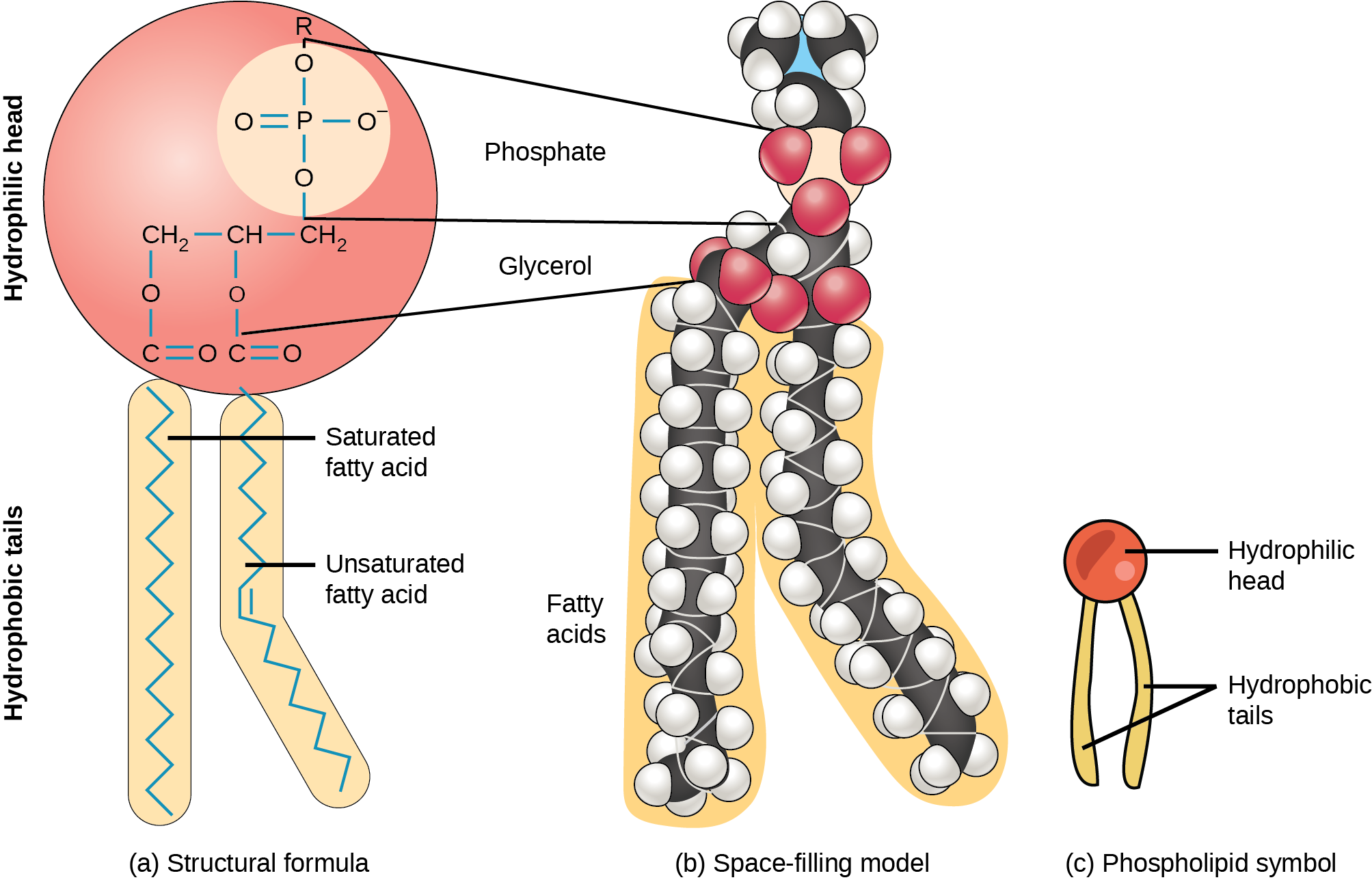
Figure 3.19図 3.19
A phospholipid is a molecule with two fatty acids and a modified phosphate group attached to a glycerol backbone. Adding a charged or polar chemical group may modify the phosphate.
リン脂質は、グリセロール骨格に二つの脂肪酸と、修飾されたリン酸基が付いた分子である。電荷を持つ化学基や極性の化学基を加えることで、リン酸を修飾できる。
A phospholipid is an amphipathic molecule, meaning it has a hydrophobic and a hydrophilic part. The fatty acid chains are hydrophobic and cannot interact with water; whereas, the phosphate-containing group is hydrophilic and interacts with water (Figure 3.20).
英語のヒント
リン脂質は両親媒性分子であり、疎水性の部分と親水性の部分を持つ。脂肪酸鎖は疎水性で、水と相互作用できない。一方、リン酸を含む基は親水性で、水と相互作用する(図3.20)。
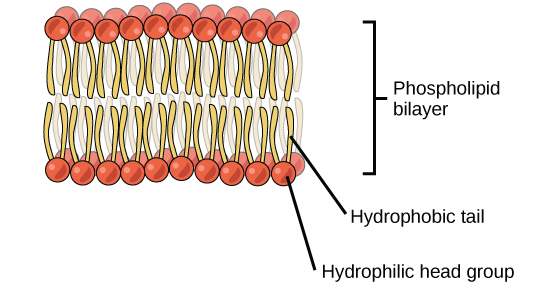


Figure 3.20図 3.20
The phospholipid bilayer is the major component of all cellular membranes. The hydrophilic head groups of the phospholipids face the aqueous solution. The hydrophobic tails are sequestered in the middle of the bilayer.
リン脂質二重層は、すべての細胞の膜の主要成分である。リン脂質の親水性の頭部は水溶液に向き、疎水性の尾部は二重層の中央に隔離されている。
The head is the hydrophilic part, and the tail contains the hydrophobic fatty acids. In a membrane, a bilayer of phospholipids forms the structure's matrix, phospholipids' fatty acid tails face inside, away from water; whereas, the phosphate group faces the outside, aqueous side (Figure 3.20).
英語のヒント
頭部は親水性の部分であり、尾部は疎水性の脂肪酸を含む。膜では、リン脂質二重層が構造の基盤を作る。リン脂質の脂肪酸の尾部は、水から離れた内側を向き、リン酸基は外側の水に接する方を向く(図3.20)。
Phospholipids are responsible for the plasma membrane's dynamic nature. If a drop of phospholipids is placed in water, it spontaneously forms a structure that scientists call a micelle, where the hydrophilic phosphate heads face the outside and the fatty acids face the structure's interior.
英語のヒント
リン脂質は、細胞膜の動的な性質をもたらす。リン脂質を一滴、水に入れると、ミセルと呼ばれる構造が自発的に形成される。そこでは、親水性のリン酸を持つ頭部が外側を向き、脂肪酸が構造の内側を向く。