第3章生体高分子
3.2 Carbohydrates3.2 炭水化物
Learning Objectives学習目標
By the end of this section, you will be able to do the following:
この節を学び終えると、次のことができるようになる。
- Discuss the role of carbohydrates in cells and in the extracellular materials of animals and plants細胞内、および動植物の細胞外物質における炭水化物の役割を論じる。
- Explain carbohydrate classifications炭水化物の分類を説明する。
- List common monosaccharides, disaccharides, and polysaccharides一般的な単糖、二糖、多糖を挙げる。
Most people are familiar with carbohydrates, one type of macromolecule, especially when it comes to what we eat. To lose weight, some individuals adhere to “low-carb” diets. Athletes, in contrast, often “carb-load” before important competitions to ensure that they have enough energy to compete at a high level. Carbohydrates are, in fact, an essential part of our diet. Grains, fruits, and vegetables are all natural carbohydrate sources that provide energy to the body, particularly through glucose, a simple sugar that is a component of starch and an ingredient in many staple foods. Carbohydrates also have other important functions in humans, animals, and plants.
英語のヒント
高分子の一種である炭水化物は、特に食べ物の話になると、多くの人になじみがある。減量のために「低炭水化物」の食事法を守る人もいる。それに対し、運動選手は高い水準で競技を行うためのエネルギーを十分に確保しようと、重要な試合の前に「カーボローディング」、つまり炭水化物を多く摂取することがある。実際、炭水化物は私たちの食事に不可欠である。穀物、果物、野菜はいずれも天然の炭水化物源であり、特に単糖のグルコースを通じて体にエネルギーを供給する。グルコースはデンプンの構成単位で、多くの主食に含まれる。炭水化物は、ヒト、動物、植物において、ほかにも重要な機能を果たす。
Molecular Structures分子構造
The stoichiometric formula (CH2O)n, where n is the number of carbons in the molecule represents carbohydrates. In other words, the ratio of carbon to hydrogen to oxygen is 1:2:1 in carbohydrate molecules. This formula also explains the origin of the term “carbohydrate”: the components are carbon (“carbo”) and the components of water (hence, “hydrate”). Scientists classify carbohydrates into three subtypes: monosaccharides, disaccharides, and polysaccharides.
英語のヒント
炭水化物は、化学量論的な式(CH2O)nで表される。ここでnは分子内の炭素数である。言い換えると、炭水化物分子では炭素・水素・酸素の比が1:2:1になっている。この式は「carbohydrate(炭水化物)」という語の由来も説明する。構成成分が炭素(carbo)と水の成分(したがってhydrate)だからである。炭水化物は、単糖、二糖、多糖の三つに分類される。
Monosaccharides単糖
Monosaccharides (mono- = “one”; sacchar- = “sweet”) are simple sugars, the most common of which is glucose. In monosaccharides, the number of carbons usually ranges from three to seven. Most monosaccharide names end with the suffix -ose. If the sugar has an aldehyde group (the functional group with the structure R-CHO), it is an aldose, and if it has a ketone group (the functional group with the structure RC(=O)R'), it is a ketose. Depending on the number of carbons in the sugar, they can be trioses (three carbons), pentoses (five carbons), and/or hexoses (six carbons). Figure 3.4 illustrates monosaccharides.
英語のヒント
単糖(monosaccharide:mono-は「一つ」、sacchar-は「甘い」)は単純な糖で、最も一般的なのはグルコースである。単糖の炭素数は通常3〜7である。単糖の名称は、多くが接尾辞-oseで終わる。糖がアルデヒド基(R–CHOという構造の官能基)を持つ場合はアルドース、ケトン基(RC(=O)R′という構造の官能基)を持つ場合はケトースという。炭素数によって、三炭糖(炭素三つ)、五炭糖(炭素五つ)、六炭糖(炭素六つ)などに分けられる。図3.4に単糖を示す。
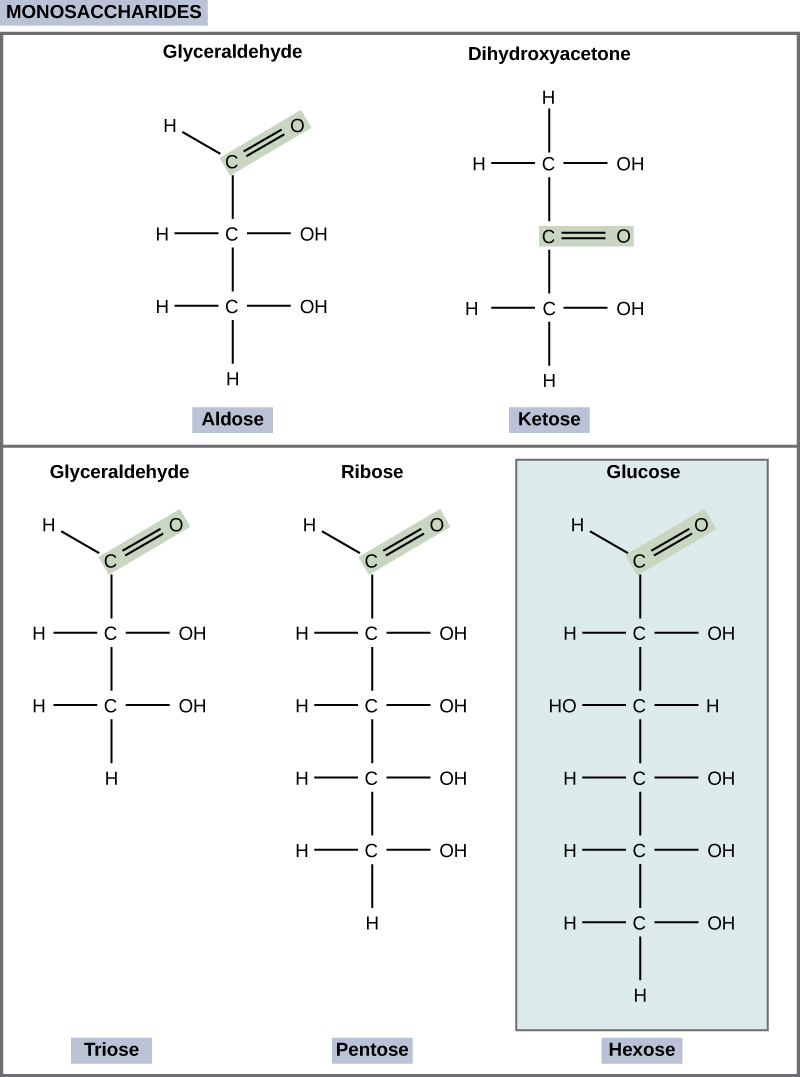
Figure 3.4図 3.4
Scientists classify monosaccharides based on the position of their carbonyl group and the number of carbons in the backbone. Aldoses have a carbonyl group (indicated in green) at the end of the carbon chain, and ketoses have a carbonyl group in the middle of the carbon chain. Trioses, pentoses, and hexoses have three-, five-, and six- carbon backbones, respectively.
単糖は、カルボニル基の位置と骨格の炭素数に基づいて分類される。アルドースでは炭素鎖の末端にカルボニル基(緑色で表示)があり、ケトースでは炭素鎖の途中にある。三炭糖、五炭糖、六炭糖の骨格は、それぞれ炭素三つ、五つ、六つからなる。
The chemical formula for glucose is C6H12O6. In humans, glucose is an important source of energy. During cellular respiration, energy releases from glucose, and that energy helps make adenosine triphosphate (ATP). Plants synthesize glucose using carbon dioxide and water, and glucose in turn provides energy requirements for the plant. Humans and other animals that feed on plants often obtain glucose from catabolized (cell breakdown of larger molecules) starch.
英語のヒント
グルコースの化学式はC6H12O6である。ヒトにとってグルコースは重要なエネルギー源である。細胞呼吸の際にグルコースからエネルギーが放出され、そのエネルギーがアデノシン三リン酸(ATP)の生成に役立つ。植物は二酸化炭素と水を使ってグルコースを合成し、そのグルコースが植物に必要なエネルギーを供給する。ヒトや植物を食べるほかの動物は、デンプンの異化(細胞が大きな分子を分解すること)によってグルコースを得ることが多い。
Galactose (part of lactose, or milk sugar) and fructose (found in sucrose, in fruit) are other common monosaccharides. Although glucose, galactose, and fructose all have the same chemical formula (C6H12O6), they differ structurally and chemically (and are isomers) because of the different arrangement of functional groups around the asymmetric carbon. All these monosaccharides have more than one asymmetric carbon (Figure 3.5).
英語のヒント
ほかの一般的な単糖に、ガラクトース(ラクトース、すなわち乳糖の一部)とフルクトース(スクロースや果物に含まれる)がある。グルコース、ガラクトース、フルクトースはすべて同じ化学式(C6H12O6)を持つが、不斉炭素の周囲の官能基の並び方が異なるため、構造的にも化学的にも異なり、異性体である。これらの単糖はいずれも、複数の不斉炭素を持つ(図3.5)。
Glucose, galactose, and fructose are isomeric monosaccharides (hexoses), meaning they have the same chemical formula but have slightly different structures. Glucose and galactose are aldoses, and fructose is a ketose.
グルコース、ガラクトース、フルクトースは、互いに異性体である単糖(六炭糖)である。化学式は同じだが、構造がわずかに異なる。グルコースとガラクトースはアルドース、フルクトースはケトースである。
Monosaccharides can exist as a linear chain or as ring-shaped molecules. In aqueous solutions they are usually in ring forms (Figure 3.6). Glucose in a ring form can have two different hydroxyl group arrangements (OH) around the anomeric carbon (carbon 1 that becomes asymmetric in the ring formation process). If the hydroxyl group is below carbon number 1 in the sugar, it is in the alpha (α) position, and if it is above the plane, it is in the beta (β) position.
英語のヒント
単糖は、直鎖状でも環状でも存在できる。水溶液中では、通常は環状である(図3.6)。環状のグルコースでは、アノマー炭素(環ができる過程で不斉になる1番の炭素)の周囲のヒドロキシ基(OH)の配置が、二通りになりうる。ヒドロキシ基が糖の1番炭素の下側にある場合はアルファ(α)位置、平面の上側にある場合はベータ(β)位置である。
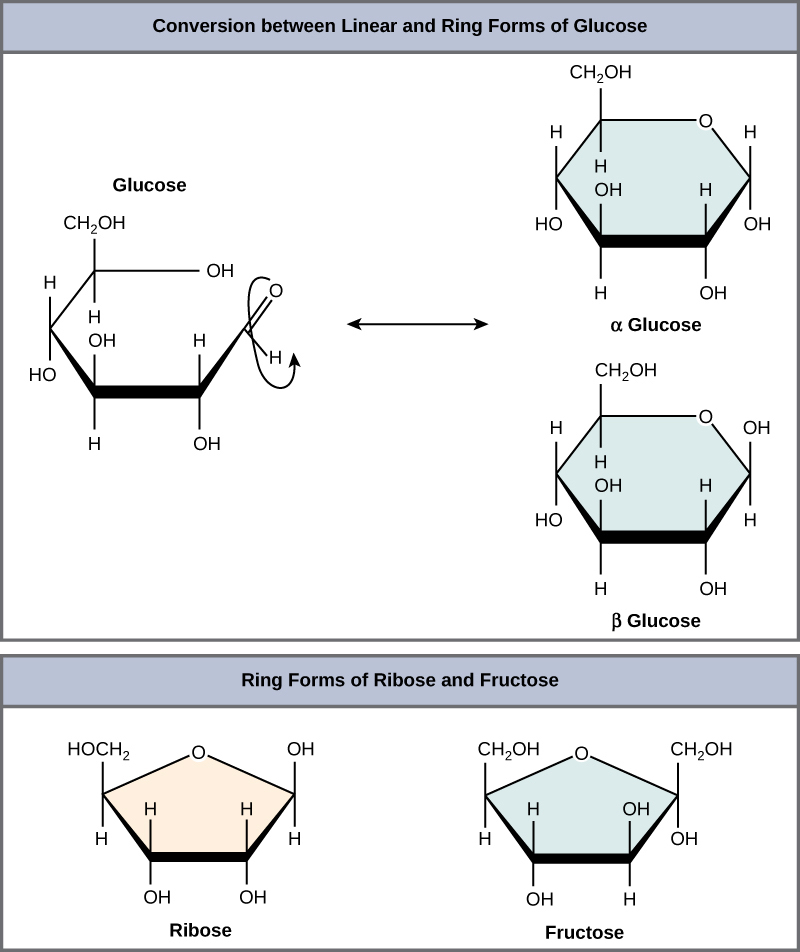


Figure 3.6図 3.6
Five and six carbon monosaccharides exist in equilibrium between linear and ring forms. When the ring forms, the side chain it closes on locks into an α or β position. Fructose and ribose also form rings, although they form five-membered rings as opposed to the six-membered ring of glucose.
炭素五つと六つの単糖は、直鎖状と環状の間で平衡状態にある。環が形成されると、閉環に関わる側鎖がα位置またはβ位置に固定される。フルクトースとリボースも環を形成するが、グルコースの六員環とは異なり、五員環となる。