第3章生体高分子
3.3 Lipids3.3 脂質
Learning Objectives学習目標
By the end of this section, you will be able to do the following:
この節を学び終えると、次のことができるようになる。
- Describe the four major types of lipids脂質の主な四種類を説明する。
- Explain the role of fats in storing energyエネルギーの貯蔵における脂肪の役割を説明する。
- Differentiate between saturated and unsaturated fatty acids飽和脂肪酸と不飽和脂肪酸を区別する。
- Describe phospholipids and their role in cellsリン脂質と、細胞内でのその役割を説明する。
- Define the basic structure of a steroid and some steroid functionsステロイドの基本構造と、その機能の例を示す。
- Explain how cholesterol helps maintain the plasma membrane's fluid natureコレステロールが細胞膜の流動性の維持を助ける仕組みを説明する。
Lipids include a diverse group of compounds that are largely nonpolar in nature. This is because they are hydrocarbons that include mostly nonpolar carbon–carbon or carbon–hydrogen bonds. Non-polar molecules are hydrophobic (“water fearing”), or insoluble in water. Lipids perform many different functions in a cell. Cells store energy for long-term use in the form of fats. Lipids also provide insulation from the environment for plants and animals (Figure 3.12). For example, they help keep aquatic birds and mammals dry when forming a protective layer over fur or feathers because of their water-repellent hydrophobic nature. Lipids are also the building blocks of many hormones and are an important constituent of all cellular membranes. Lipids include fats, oils, waxes, phospholipids, and steroids.
英語のヒント
脂質には、性質として大部分が無極性である、多様な化合物が含まれる。主に無極性の炭素–炭素結合や炭素–水素結合を含む炭化水素だからである。無極性分子は疎水性、つまり「水を嫌う」性質を持ち、水に溶けない。脂質は細胞内でさまざまな機能を果たす。細胞は、長期にわたって使うエネルギーを脂肪の形で蓄える。脂質は動植物を周囲の環境から断熱・隔離する役割も持つ(図3.12)。例えば、撥水性を持つ疎水的な脂質が毛や羽毛に保護層を作ると、水鳥や水生哺乳類の体をぬれにくくできる。脂質は多くのホルモンの材料であり、すべての細胞の膜の重要な構成成分でもある。脂肪、油、ろう、リン脂質、ステロイドなどが脂質に含まれる。
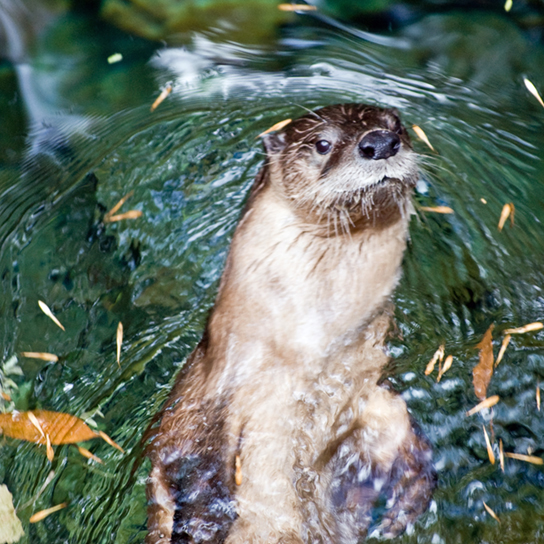
OpenStax, Rice University; Biology 2e. (credit: Ken Bosma) Embedded rights notice: Kervens Bosma · CC BY 4.0 · Source出典
Figure 3.12図 3.12
Hydrophobic lipids in aquatic mammals' fur, such as this river otter, protect them from the elements. (credit: Ken Bosma)
このカワウソのような水生哺乳類では、毛に含まれる疎水性の脂質が、風雨などの自然環境から体を守る。(出典:Ken Bosma)
Fats and Oils脂肪と油
A fat molecule consists of two main components—glycerol and fatty acids. Glycerol is an organic compound (alcohol) with three carbons, five hydrogens, and three hydroxyl (OH) groups. Fatty acids have a long chain of hydrocarbons to which a carboxyl group is attached, hence the name “fatty acid.” The number of carbons in the fatty acid may range from 4 to 36. The most common are those containing 12–18 carbons. In a fat molecule, the fatty acids attach to each of the glycerol molecule's three carbons with an ester bond through an oxygen atom (Figure 3.13).
英語のヒント
脂肪分子の主な構成成分は、グリセロールと脂肪酸の二つである。グリセロールは、炭素三つ、水素五つ、ヒドロキシ基(OH)三つを持つ有機化合物(アルコール)である。脂肪酸は、カルボキシ基が付いた長い炭化水素鎖を持つ。これが「脂肪酸」という名の由来である。脂肪酸の炭素数は4〜36で、最も一般的なのは12〜18個の炭素を含むものである。脂肪分子では、グリセロール分子の三つの炭素それぞれに、酸素原子を介したエステル結合で脂肪酸が付いている(図3.13)。
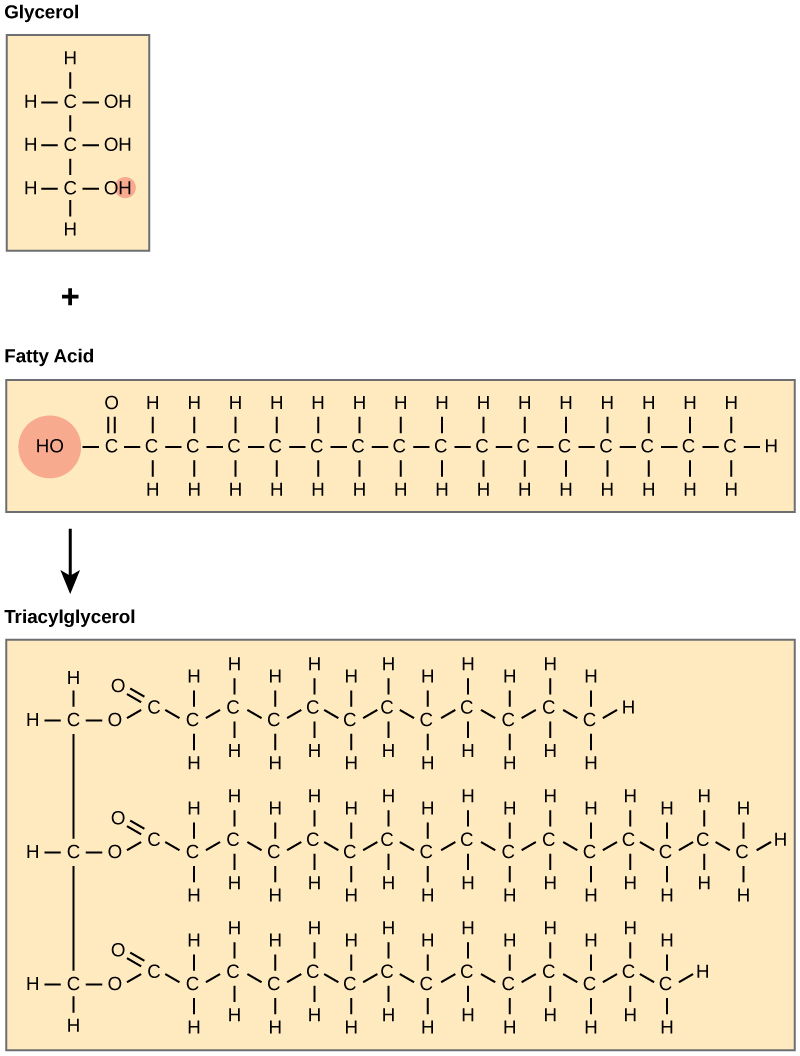
Figure 3.13図 3.13
Joining three fatty acids to a glycerol backbone in a dehydration reaction forms triacylglycerol. Three water molecules release in the process.
脱水反応によって三つの脂肪酸をグリセロール骨格につなぐと、トリアシルグリセロールができる。この過程で水分子が三つ放出される。
During this ester bond formation, three water molecules are released. The three fatty acids in the triacylglycerol may be similar or dissimilar. We also call fats triacylglycerols or triglycerides because of their chemical structure. Some fatty acids have common names that specify their origin. For example, palmitic acid, a saturated fatty acid, is derived from the palm tree. Arachidic acid is derived from Arachis hypogea, the scientific name for groundnuts or peanuts.
英語のヒント
このエステル結合の形成時には、水分子が三つ放出される。トリアシルグリセロールに含まれる三つの脂肪酸は、似ている場合も異なる場合もある。脂肪はその化学構造から、トリアシルグリセロールまたはトリグリセリドとも呼ばれる。一部の脂肪酸には、由来を示す慣用名がある。例えば、飽和脂肪酸のパルミチン酸はヤシの木に由来する。アラキジン酸は、ラッカセイ、すなわちピーナッツの学名Arachis hypogeaに由来する。
Fatty acids may be saturated or unsaturated. In a fatty acid chain, if there are only single bonds between neighboring carbons in the hydrocarbon chain, the fatty acid is saturated. Saturated fatty acids are saturated with hydrogen. In other words, the number of hydrogen atoms attached to the carbon skeleton is maximized. Stearic acid is an example of a saturated fatty acid (Figure 3.14).
英語のヒント
脂肪酸には飽和脂肪酸と不飽和脂肪酸がある。脂肪酸の炭化水素鎖で、隣り合う炭素の間がすべて単結合であれば、その脂肪酸は飽和している。飽和脂肪酸は水素で飽和しているのである。言い換えると、炭素骨格に結合した水素原子の数が最大になっている。ステアリン酸は飽和脂肪酸の一例である(図3.14)。

Figure 3.14図 3.14
Stearic acid is a common saturated fatty acid.
ステアリン酸は、一般的な飽和脂肪酸である。
When the hydrocarbon chain contains a double bond, the fatty acid is unsaturated. Oleic acid is an example of an unsaturated fatty acid (Figure 3.15).
英語のヒント
炭化水素鎖に二重結合が含まれる場合、その脂肪酸は不飽和である。オレイン酸は不飽和脂肪酸の一例である(図3.15)。

Figure 3.15図 3.15
Oleic acid is a common unsaturated fatty acid.
オレイン酸は、一般的な不飽和脂肪酸である。
Most unsaturated fats are liquid at room temperature. We call these oils. If there is one double bond in the molecule, then it is a monounsaturated fat (e.g., olive oil), and if there is more than one double bond, then it is a polyunsaturated fat (e.g., canola oil).
英語のヒント
不飽和脂肪の大部分は室温で液体であり、油と呼ばれる。分子内に二重結合が一つある場合は一価不飽和脂肪(例えばオリーブ油)、二つ以上ある場合は多価不飽和脂肪(例えばキャノーラ油)である。
When a fatty acid has no double bonds, it is a saturated fatty acid because it is not possible to add more hydrogen to the chain's carbon atoms. A fat may contain similar or different fatty acids attached to glycerol. Long straight fatty acids with single bonds generally pack tightly and are solid at room temperature. Animal fats with stearic acid and palmitic acid (common in meat) and the fat with butyric acid (common in butter) are examples of saturated fats. Mammals store fats in specialized cells, or adipocytes, where fat globules occupy most of the cell’s volume. Plants store fat or oil in many seeds and use them as a source of energy during seedling development. Unsaturated fats or oils are usually of plant origin and contain cis unsaturated fatty acids. Cis and trans indicate the configuration of the molecule around the double bond. If hydrogens are present in the same plane, it is a cis fat. If the hydrogen atoms are on two different planes, it is a trans fat. The cis double bond causes a bend or a “kink” that prevents the fatty acids from packing tightly, keeping them liquid at room temperature (Figure 3.16). Olive oil, corn oil, canola oil, and cod liver oil are examples of unsaturated fats. Unsaturated fats help to lower blood cholesterol levels; whereas, saturated fats might contribute to plaque formation in the arteries.
英語のヒント
二重結合のない脂肪酸は、鎖の炭素にそれ以上の水素を加えられないため、飽和脂肪酸である。脂肪には、同じような脂肪酸がグリセロールに付いている場合も、異なる脂肪酸が付いている場合もある。単結合からなる長くまっすぐな脂肪酸は、一般に密に詰まり、室温では固体となる。肉によく含まれるステアリン酸やパルミチン酸を持つ動物性脂肪、バターによく含まれる酪酸を持つ脂肪は、飽和脂肪の例である。哺乳類は、脂肪細胞という特殊な細胞に脂肪を蓄える。この細胞では、脂肪滴が体積の大部分を占める。植物は多くの種子に脂肪や油を蓄え、実生の発達時にエネルギー源として利用する。不飽和脂肪、すなわち油は、通常は植物由来で、シス型の不飽和脂肪酸を含む。シスとトランスは、二重結合の周囲の分子配置を示す。水素が同じ平面にある場合はシス脂肪、二つの異なる平面にある場合はトランス脂肪である。シス二重結合は曲がり、すなわち「折れ曲がり」を作り、脂肪酸が密に詰まるのを妨げるため、室温でも液体に保たれる(図3.16)。オリーブ油、コーン油、キャノーラ油、タラの肝油は不飽和脂肪の例である。不飽和脂肪は血中コレステロール値を下げるのに役立つ一方、飽和脂肪は動脈でのプラーク形成に寄与する可能性がある。
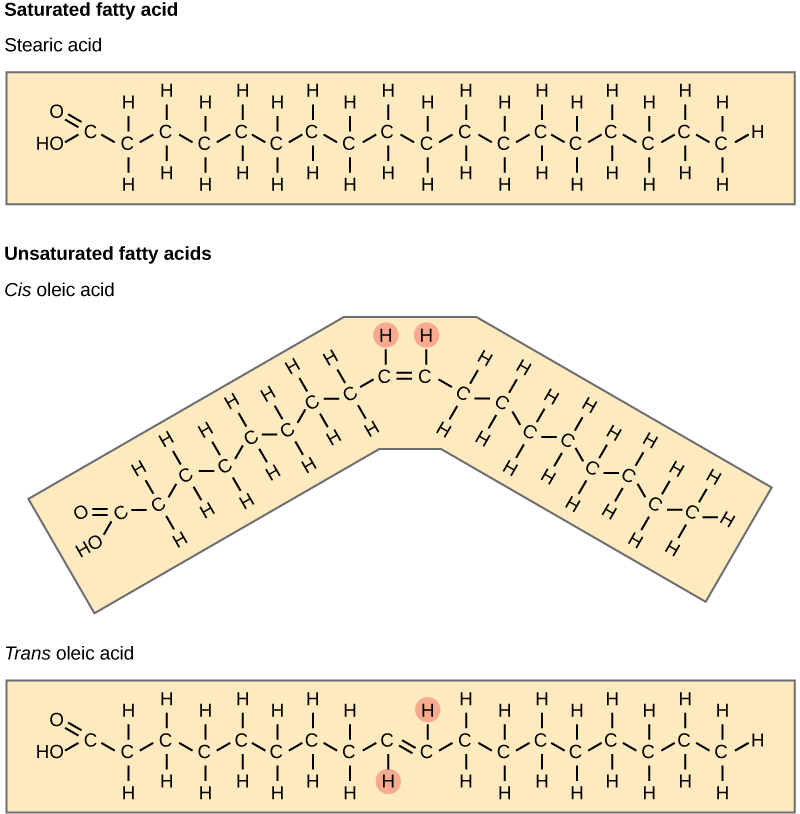


Figure 3.16図 3.16
Saturated fatty acids have hydrocarbon chains connected by single bonds only. Unsaturated fatty acids have one or more double bonds. Each double bond may be in a cis or trans configuration. In the cis configuration, both hydrogens are on the same side of the hydrocarbon chain. In the trans configuration, the hydrogens are on opposite sides. A cis double bond causes a kink in the chain.
飽和脂肪酸の炭化水素鎖は、単結合だけでつながっている。不飽和脂肪酸には一つ以上の二重結合がある。各二重結合はシス配置またはトランス配置を取る。シス配置では二つの水素が炭化水素鎖の同じ側にあり、トランス配置では反対側にある。シス二重結合は鎖に折れ曲がりを作る。