第3章生体高分子
3.4 Proteins3.4 タンパク質
Learning Objectives学習目標
By the end of this section, you will be able to do the following:
この節を学び終えると、次のことができるようになる。
- Describe the functions proteins perform in the cell and in tissues細胞や組織でタンパク質が果たす機能を説明する。
- Discuss the relationship between amino acids and proteinsアミノ酸とタンパク質の関係を論じる。
- Explain the four levels of protein organizationタンパク質の四段階の構造を説明する。
- Describe the ways in which protein shape and function are linkedタンパク質の形と機能がどのように結び付いているか説明する。
Proteins are one of the most abundant organic molecules in living systems and have the most diverse range of functions of all macromolecules. Proteins may be structural, regulatory, contractile, or protective. They may serve in transport, storage, or membranes; or they may be toxins or enzymes. Each cell in a living system may contain thousands of proteins, each with a unique function. Their structures, like their functions, vary greatly. They are all, however, amino acid polymers arranged in a linear sequence.
英語のヒント
タンパク質は、生物の中で最も豊富な有機分子の一つであり、すべての高分子の中で最も多様な機能を持つ。構造を作るもの、調節するもの、収縮するもの、保護するものがある。輸送、貯蔵、膜の中で働くものもあれば、毒素や酵素となるものもある。生体内の一つの細胞には、それぞれ固有の機能を持つ数千種類のタンパク質が含まれることがある。構造も、機能と同じように大きく異なる。しかし、いずれもアミノ酸が直線状に並んだ重合体である。
Types and Functions of Proteinsタンパク質の種類と機能
Enzymes, which living cells produce, are catalysts in biochemical reactions (like digestion) and are usually complex or conjugated proteins. Each enzyme is specific for the substrate (a reactant that binds to an enzyme) upon which it acts. The enzyme may help in breakdown, rearrangement, or synthesis reactions. We call enzymes that break down their substrates catabolic enzymes. Those that build more complex molecules from their substrates are anabolic enzymes, and enzymes that affect the rate of reaction are catalytic enzymes. Note that all enzymes increase the reaction rate and, therefore, are organic catalysts. An example of an enzyme is salivary amylase, which hydrolyzes its substrate amylose, a component of starch.
英語のヒント
生きた細胞が作る酵素は、消化のような生化学反応の触媒であり、通常は複雑なタンパク質または複合タンパク質である。各酵素は、自身が作用する基質(酵素に結合する反応物)に対して特異性を持つ。酵素は、分解、組み替え、合成の反応を助ける。基質を分解する酵素を異化酵素という。基質からより複雑な分子を作るものは同化酵素であり、反応速度に影響するものは触媒酵素である。すべての酵素は反応速度を上げるため、有機触媒であることに注意しよう。酵素の一例は唾液アミラーゼで、デンプンの成分である基質アミロースを加水分解する。
Hormones are chemical-signaling molecules, usually small proteins or steroids, secreted by endocrine cells that act to control or regulate specific physiological processes, including growth, development, metabolism, and reproduction. For example, insulin is a protein hormone that helps regulate the blood glucose level. Table 3.1 lists the primary types and functions of proteins.
英語のヒント
ホルモンは、通常は小さなタンパク質またはステロイドである、化学的なシグナル分子である。内分泌細胞から分泌され、成長、発生、代謝、生殖など、特定の生理過程を制御・調節する。例えばインスリンは、血糖値の調節を助けるタンパク質ホルモンである。表3.1に、タンパク質の主な種類と機能をまとめる。
Protein Types and Functions タンパク質の種類と機能 |
||
|---|---|---|
Type 種類 |
Examples 例 |
Functions 機能 |
Digestive Enzymes 消化酵素 |
Amylase, lipase, pepsin, trypsin アミラーゼ、リパーゼ、ペプシン、トリプシン |
Help in food by catabolizing nutrients into monomeric units 栄養素を単量体の単位へ異化し、食物の処理を助ける。 |
Transport 輸送 |
Hemoglobin, albumin ヘモグロビン、アルブミン |
Carry substances in the blood or lymph throughout the body 血液やリンパの中で、物質を全身へ運ぶ。 |
Structural 構造 |
Actin, tubulin, keratin アクチン、チューブリン、ケラチン |
Construct different structures, like the cytoskeleton 細胞骨格など、さまざまな構造を作る。 |
Hormones ホルモン |
Insulin, thyroxine インスリン、チロキシン |
Coordinate different body systems' activity 体の異なる系の活動を協調させる。 |
Defense 防御 |
Immunoglobulins 免疫グロブリン |
Protect the body from foreign pathogens 外来の病原体から体を守る。 |
Contractile 収縮 |
Actin, myosin アクチン、ミオシン |
Effect muscle contraction 筋収縮を起こす。 |
Storage 貯蔵 |
Legume storage proteins, egg white (albumin) マメ科植物の貯蔵タンパク質、卵白(アルブミン) |
Provide nourishment in early embryo development and the seedling 胚発生の初期や実生に栄養を与える。 |
Proteins have different shapes and molecular weights. Some proteins are globular in shape; whereas, others are fibrous in nature. For example, hemoglobin is a globular protein, but collagen, located in our skin, is a fibrous protein. Protein shape is critical to its function, and many different types of chemical bonds maintain this shape. Changes in temperature, pH, and exposure to chemicals may lead to permanent changes in the protein's shape, leading to loss of function, or denaturation. Different arrangements of the same 20 types of amino acids comprise all proteins. Two rare new amino acids were discovered recently (selenocysteine and pyrrolysine), and additional new discoveries may be added to the list.
英語のヒント
タンパク質は、形も分子量もさまざまである。球状のものもあれば、繊維状のものもある。例えばヘモグロビンは球状タンパク質であり、皮膚にあるコラーゲンは繊維状タンパク質である。タンパク質の形は機能にとって決定的に重要で、さまざまな種類の化学結合がその形を保つ。温度やpHの変化、化学物質への接触によって、タンパク質の形が恒久的に変化し、機能が失われる、すなわち変性が起こる場合がある。すべてのタンパク質は、同じ20種類のアミノ酸の異なる配列からなる。最近、まれな二つの新しいアミノ酸、セレノシステインとピロリシンが発見されており、今後も新発見がこの一覧に加わるかもしれない。
Amino Acidsアミノ酸
Amino acids are the monomers that comprise proteins. Each amino acid has the same fundamental structure, which consists of a central carbon atom, or the alpha (α) carbon, bonded to an amino group (NH2), a carboxyl group (COOH), and to a hydrogen atom. Every amino acid also has another atom or group of atoms bonded to the central atom known as the R group (Figure 3.22).
英語のヒント
アミノ酸は、タンパク質を構成する単量体である。どのアミノ酸も同じ基本構造を持つ。中心の炭素原子、すなわちα炭素に、アミノ基(NH2)、カルボキシ基(COOH)、水素原子が結合している。さらに、どのアミノ酸でも中心の原子に別の原子または原子団が結び付いており、これをR基という(図3.22)。
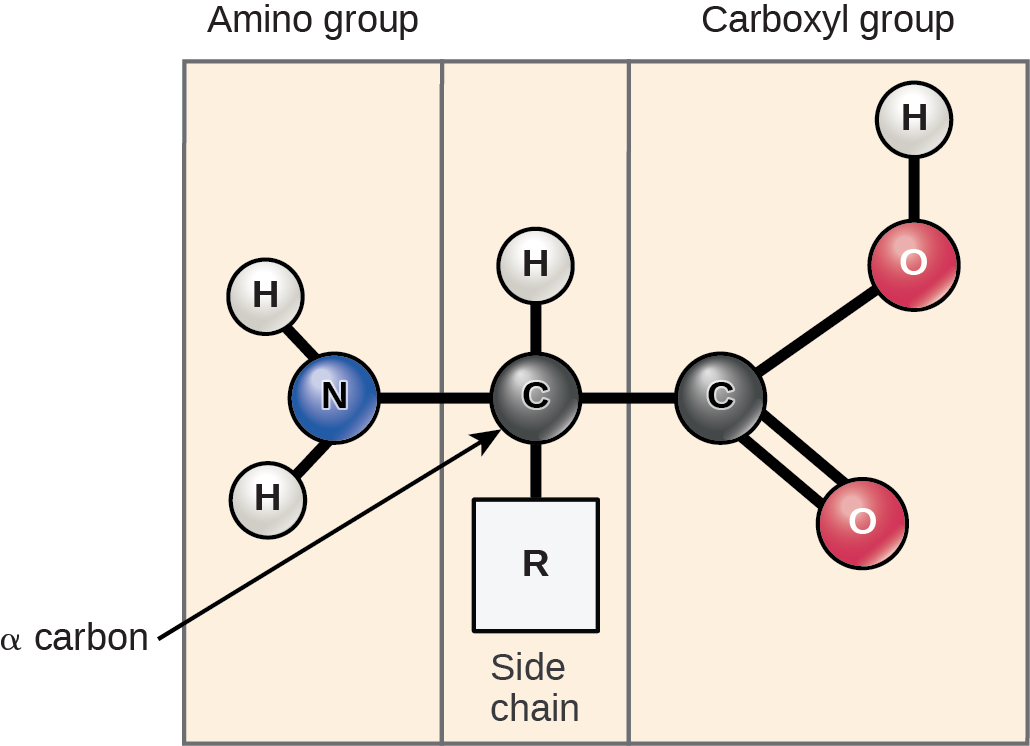
Figure 3.22図 3.22
Amino acids have a central asymmetric carbon to which an amino group, a carboxyl group, a hydrogen atom, and a side chain (R group) are attached.
アミノ酸は中心に不斉炭素を持ち、そこにアミノ基、カルボキシ基、水素原子、側鎖(R基)が結合している。
Scientists use the name "amino acid" because these acids contain both amino group and carboxyl-acid-group in their basic structure. As we mentioned, there are 20 common amino acids present in proteins. Nine of these are essential amino acids in humans because the human body cannot produce them and we obtain them from our diet. For each amino acid, the R group (or side chain) is different (Figure 3.23).
英語のヒント
「アミノ酸」という名が使われるのは、基本構造にアミノ基とカルボン酸の基をともに含むからである。先に述べたように、タンパク質には一般的に20種類のアミノ酸が含まれる。このうち九つは、ヒトの体内では作れず食事から得るため、ヒトの必須アミノ酸である。R基(側鎖)は、アミノ酸の種類ごとに異なる(図3.23)。
The chemical nature of the side chain determines the amino acid's nature (that is, whether it is acidic, basic, polar, or nonpolar). For example, the amino acid glycine has a hydrogen atom as the R group. Amino acids such as valine, methionine, and alanine are nonpolar or hydrophobic in nature, while amino acids such as serine, threonine, and cysteine are polar and have hydrophilic side chains. The side chains of lysine and arginine are positively charged, and therefore these amino acids are also basic amino acids. Proline has an R group that is linked to the amino group, forming a ring-like structure. Proline is an exception to the amino acid's standard structure since its amino group is not separate from the side chain (Figure 3.23).
英語のヒント
側鎖の化学的性質によって、アミノ酸の性質、すなわち酸性、塩基性、極性、無極性のいずれであるかが決まる。例えばグリシンのR基は水素原子である。バリン、メチオニン、アラニンなどは無極性、つまり疎水性である。一方、セリン、トレオニン、システインなどは極性を持ち、側鎖は親水性である。リシンとアルギニンの側鎖は正に帯電しているため、これらは塩基性アミノ酸でもある。プロリンではR基がアミノ基につながり、環のような構造を作る。アミノ基が側鎖から独立していないため、プロリンはアミノ酸の標準的な構造の例外である(図3.23)。
A single upper case letter or a three-letter abbreviation represents amino acids. For example, the letter V or the three-letter symbol val represent valine. Just as some fatty acids are essential to a diet, some amino acids also are necessary. These essential amino acids in humans include isoleucine, leucine, and cysteine. Essential amino acids refer to those necessary to build proteins in the body, but not those that the body produces. Which amino acids are essential varies from organism to organism.
英語のヒント
アミノ酸は、大文字一文字または三文字の略号で表す。例えば、Vまたは三文字のvalはバリンを表す。一部の脂肪酸が食事に必須であるのと同様に、一部のアミノ酸も食事から摂る必要がある。ヒトでは、イソロイシン、ロイシン、システインなどがこうした必須アミノ酸に含まれる。必須アミノ酸とは、体内でタンパク質を作るために必要だが、体内では作られないアミノ酸を指す。どのアミノ酸が必須かは、生物によって異なる。
The sequence and the number of amino acids ultimately determine the protein's shape, size, and function. A covalent bond, or peptide bond, attaches to each amino acid, which a dehydration reaction forms. One amino acid's carboxyl group and the incoming amino acid's amino group combine, releasing a water molecule. The resulting bond is the peptide bond (Figure 3.24).
英語のヒント
アミノ酸の配列と数が、最終的にタンパク質の形、大きさ、機能を決める。各アミノ酸は、脱水反応で作られる共有結合、すなわちペプチド結合でつながる。一方のアミノ酸のカルボキシ基と、新たに加わるアミノ酸のアミノ基が結び付き、水分子を放出する。こうしてできる結合がペプチド結合である(図3.24)。
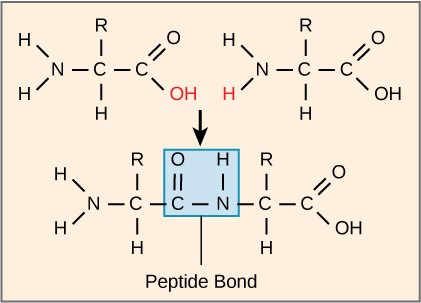


Figure 3.24図 3.24
Peptide bond formation is a dehydration synthesis reaction. The carboxyl group of one amino acid is linked to the incoming amino acid's amino group. In the process, it releases a water molecule.
ペプチド結合の形成は脱水合成反応である。一方のアミノ酸のカルボキシ基が、新たに加わるアミノ酸のアミノ基につながる。この過程で水分子が放出される。
The products that such linkages form are peptides. As more amino acids join to this growing chain, the resulting chain is a polypeptide. Each polypeptide has a free amino group at one end. This end is called the N terminal, or the amino terminal, and the other end has a free carboxyl group, also called the C or carboxyl terminal. While the terms polypeptide and protein are sometimes used interchangeably, a polypeptide is technically a polymer of amino acids, whereas the term protein is used for a polypeptide or polypeptides that have combined together, often have bound non-peptide prosthetic groups, have a distinct shape, and have a unique function. After protein synthesis (translation), most proteins are modified. These are known as post-translational modifications. They may undergo cleavage, phosphorylation, or may require adding other chemical groups. Only after these modifications is the protein completely functional.
英語のヒント
このような結合によってできる生成物がペプチドである。伸びていく鎖にさらにアミノ酸が加わると、ポリペプチドになる。各ポリペプチドの一方の端には遊離のアミノ基があり、この端をN末端またはアミノ末端という。もう一方の端には遊離のカルボキシ基があり、C末端またはカルボキシ末端という。ポリペプチドとタンパク質は同じ意味で使われることもあるが、厳密にはポリペプチドはアミノ酸の重合体を指す。一方、タンパク質という語は、一つまたは複数のポリペプチドが組み合わさり、しばしば非ペプチド性の補欠分子族も結合し、明確な形と固有の機能を持つものに使われる。タンパク質の多くは、合成(翻訳)の後に修飾される。これを翻訳後修飾という。切断やリン酸化を受けたり、ほかの化学基の付加が必要だったりする場合がある。こうした修飾を経て初めて、タンパク質は完全に機能するようになる。