第3章生体高分子
Benefits of Carbohydrates炭水化物の利点
Are carbohydrates good for you? Some people believe that carbohydrates are bad and they should avoid them. Some diets completely forbid carbohydrate consumption, claiming that a low-carbohydrate diet helps people to lose weight faster. However, carbohydrates have been an important part of the human diet for thousands of years. Artifacts from ancient civilizations show the presence of wheat, rice, and corn in our ancestors’ storage areas.
英語のヒント
炭水化物は体によいのだろうか。炭水化物は悪いもので、避けるべきだと考える人もいる。低炭水化物の食事は体重をより速く減らせると主張し、炭水化物の摂取を完全に禁じる食事法もある。しかし、炭水化物は何千年もの間、人間の食事の重要な一部だった。古代文明の遺物は、私たちの祖先の貯蔵場所に小麦、米、トウモロコシがあったことを示している。
As part of a well balanced diet, we should supplement carbohydrates with proteins, vitamins, and fats. Calorie-wise, a gram of carbohydrate provides 4.3 Kcal. For comparison, fats provide 9 Kcal/g, a less desirable ratio. Carbohydrates contain soluble and insoluble elements. The insoluble part, fiber, is mostly cellulose. Fiber has many uses. It promotes regular bowel movement by adding bulk, and it regulates the blood glucose consumption rate. Fiber also helps to remove excess cholesterol from the body. Fiber binds to the cholesterol in the small intestine, then attaches to the cholesterol and prevents the cholesterol particles from entering the bloodstream. Cholesterol then exits the body via the feces. Fiber-rich diets also have a protective role in reducing the occurrence of colon cancer. In addition, a meal containing whole grains and vegetables gives a feeling of fullness. As an immediate source of energy, glucose breaks down during the cellular respiration process, which produces ATP, the cell's energy currency. Without consuming carbohydrates, we reduce the availability of “instant energy”. Eliminating carbohydrates from the diet may be necessary for some people, but such a step may not be healthy for everyone.
英語のヒント
バランスのよい食事の一環として、炭水化物に加えてタンパク質、ビタミン、脂肪も摂るべきである。熱量の点では、炭水化物1グラムは4.3 kcalを供給する。比較すると、脂肪は1グラム当たり9 kcalを供給し、望ましさの点で劣る比率となる。炭水化物には、水に溶ける部分と溶けない部分がある。不溶性の部分である食物繊維は、主にセルロースからなる。食物繊維にはさまざまな働きがある。便のかさを増やして規則的な排便を促し、血中グルコースの消費速度を調節する。また、過剰なコレステロールを体外へ除くのにも役立つ。小腸でコレステロールに結び付き、その粒子が血流に入るのを防ぐ。その後、コレステロールは便とともに体外へ出る。食物繊維の多い食事には、結腸がんの発生を減らす防御的な役割もある。また、全粒穀物や野菜を含む食事は満腹感を与える。グルコースは、すぐに使えるエネルギー源として細胞呼吸の過程で分解され、細胞のエネルギー通貨であるATPを生み出す。炭水化物を摂らないと、「即座に使えるエネルギー」を得にくくなる。炭水化物を食事から除く必要がある人もいるかもしれないが、そうすることが誰にとっても健康的とは限らない。
Section Summaryこの節のまとめ
Carbohydrates are a group of macromolecules that are a vital energy source for the cell and provide structural support to plant cells, fungi, and all of the arthropods that include lobsters, crabs, shrimp, insects, and spiders. Scientists classify carbohydrates as monosaccharides, disaccharides, and polysaccharides depending on the number of monomers in the molecule. Monosaccharides are linked by glycosidic bonds that form as a result of dehydration reactions, forming disaccharides and polysaccharides with eliminating a water molecule for each bond formed. Glucose, galactose, and fructose are common monosaccharides; whereas, common disaccharides include lactose, maltose, and sucrose. Starch and glycogen, examples of polysaccharides, are the storage forms of glucose in plants and animals, respectively. The long polysaccharide chains may be branched or unbranched. Cellulose is an example of an unbranched polysaccharide; whereas, amylopectin, a constituent of starch, is a highly branched molecule. Glucose storage, in the form of polymers like starch of glycogen, makes it slightly less accessible for metabolism; however, this prevents it from leaking out of the cell or creating a high osmotic pressure that could cause the cell to uptake excessive water.
英語のヒント
炭水化物は、細胞に不可欠なエネルギー源である高分子の一群である。また、植物細胞、菌類、そしてロブスター、カニ、エビ、昆虫、クモを含むすべての節足動物を構造的に支える。炭水化物は、分子内の単量体の数によって単糖、二糖、多糖に分類される。単糖は脱水反応でできるグリコシド結合によってつながり、二糖や多糖を作る。結合一つを作るたびに、水分子一つが除かれる。一般的な単糖にはグルコース、ガラクトース、フルクトースがあり、一般的な二糖にはラクトース、マルトース、スクロースがある。多糖の例であるデンプンとグリコーゲンは、それぞれ植物と動物におけるグルコースの貯蔵形態である。長い多糖鎖には、枝分かれがあるものとないものがある。セルロースは枝分かれのない多糖の例であり、デンプンの構成成分であるアミロペクチンは枝分かれの多い分子である。グルコースをデンプンやグリコーゲンのような重合体の形で蓄えると、代謝にはやや利用しにくくなる。しかし、細胞から漏れ出すことや、高い浸透圧を生んで細胞に過剰な水を取り込ませることを防げる。
Visual Connection Questions図を使った問題
Exercises 7練習問題 7
Exercise 7問題 7
Figure 3.5 What kind of sugars are these, aldose or ketose?
図3.5 これらの糖は、アルドースとケトースのどちらか。
Solution解き方
Figure 3.5 Glucose and galactose are aldoses. Fructose is a ketose.
図3.5 グルコースとガラクトースはアルドース、フルクトースはケトースである。
Review Questions確認問題
Exercises 8–12練習問題 8–12
Exercise 8問題 8
An example of a monosaccharide is ________.
単糖の例は________である。
- fructoseフルクトース
- glucoseグルコース
- galactoseガラクトース
- all of the above上記のすべて
Solution解き方
D
D
Exercise 9問題 9
Cellulose and starch are examples of:
セルロースとデンプンは、次のどれの例か。
- monosaccharides単糖
- disaccharides二糖
- lipids脂質
- polysaccharides多糖
Solution解き方
D
D
Exercise 10問題 10
Plant cell walls contain which of the following in abundance?
植物の細胞壁には、次のどれが豊富に含まれるか。
- starchデンプン
- celluloseセルロース
- glycogenグリコーゲン
- lactoseラクトース
Solution解き方
B
B
Exercise 11問題 11
Lactose is a disaccharide formed by the formation of a ________ bond between glucose and ________.
ラクトースは、グルコースともう一つの糖の間に________結合ができて形成される二糖である。そのもう一つの糖は________である。
- glycosidic; lactoseグリコシド;ラクトース
- glycosidic; galactoseグリコシド;ガラクトース
- hydrogen; sucrose水素;スクロース
- hydrogen; fructose水素;フルクトース
Solution解き方
B
B
Exercise 12問題 12
Which of the following is not an extracellular matrix role of carbohydrates?
次のうち、細胞外マトリックスにおける炭水化物の役割ではないものはどれか。
- protect an insect’s internal organs from external trauma昆虫の内臓を外部からの損傷から守る。
- prevent plant cells from lysing after the plant is watered植物に水を与えた後、植物細胞が破裂するのを防ぐ。
- maintain the shape of a fungal spore菌類の胞子の形を保つ。
- provide energy for muscle movement筋肉の運動にエネルギーを供給する。
Solution解き方
D
D
Critical Thinking Questions考察問題
Exercises 13–15練習問題 13–15
Exercise 13問題 13
Describe the similarities and differences between glycogen and starch.
グリコーゲンとデンプンの共通点と相違点を説明しなさい。
Solution解き方
Glycogen and starch are polysaccharides. They are the storage form of glucose. Glycogen is stored in animals in the liver and in muscle cells, whereas starch is stored in the roots, seeds, and leaves of plants. Starch has two different forms, one unbranched (amylose) and one branched (amylopectin), whereas glycogen is a single type of a highly branched molecule.
グリコーゲンとデンプンは多糖であり、グルコースの貯蔵形態である。グリコーゲンは動物の肝細胞や筋細胞に蓄えられ、デンプンは植物の根、種子、葉に蓄えられる。デンプンには、枝分かれのないアミロースと枝分かれのあるアミロペクチンという二つの形がある。一方、グリコーゲンは枝分かれが非常に多い、一種類の分子である。
Exercise 14問題 14
Why is it impossible for humans to digest food that contains cellulose?
ヒトがセルロースを含む食物を消化できないのはなぜか。
Solution解き方
The β 1-4 glycosidic linkage in cellulose cannot be broken down by human digestive enzymes. Herbivores such as cows, koalas, and buffalos are able to digest grass that is rich in cellulose and use it as a food source because bacteria and protists in their digestive systems, especially in the rumen, secrete the enzyme cellulase. Cellulases can break down cellulose into glucose monomers that can be used as an energy source by the animal.
セルロースのβ1–4グリコシド結合は、ヒトの消化酵素では切れない。ウシ、コアラ、バッファローなどの草食動物は、セルロースの多い草を消化し、食料にできる。これは、消化器系、特にルーメンにいる細菌や原生生物が、セルラーゼという酵素を分泌するためである。セルラーゼはセルロースをグルコース単量体に分解でき、動物はそれをエネルギー源として利用できる。
Exercise 15問題 15
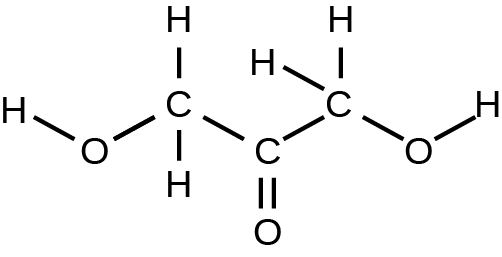
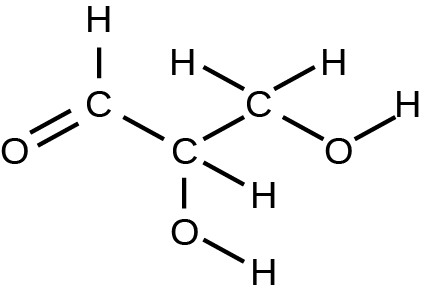
Draw the ketose and aldose forms of a monosaccharide with the chemical formula C3H6O3. How is the structure of the monosaccharide changed from one form to the other in the human body?
化学式C3H6O3の単糖について、ケトース型とアルドース型の構造を描きなさい。ヒトの体内では、単糖の構造がどのように一方の型からもう一方へ変わるか。
Solution解き方
The human body switches carbohydrates between their aldose and ketose forms using a family of enzymes called isomerases. The ketose triose is called dihydroxyacetone, and has the oxygen double-bonded to the center carbon:
ヒトの体では、イソメラーゼと呼ばれる酵素群を使って、炭水化物をアルドース型とケトース型の間で変換する。ケトース型の三炭糖はジヒドロキシアセトンといい、中央の炭素に酸素が二重結合している。
The aldose is called glyceraldehyde, and can have the oxygen double-bonded to the first or third carbon of the molecule:
アルドース型はグリセルアルデヒドといい、分子の1番目または3番目の炭素に酸素が二重結合できる。


carbohydrate
炭水化物
biological macromolecule in which the ratio of carbon to hydrogen and to oxygen is 1:2:1; carbohydrates serve as energy sources and structural support in cells and form arthropods' cellular exoskeleton
炭素・水素・酸素の比が1:2:1である生体高分子。細胞のエネルギー源や構造の支持に用いられ、節足動物の細胞性の外骨格を形成する。
cellulose
セルロース
polysaccharide that comprises the plants' cell wall; provides structural support to the cell
植物の細胞壁を構成する多糖。細胞を構造的に支える。
chitin
キチン
type of carbohydrate that forms the outer skeleton of all arthropods that include crustaceans and insects; it also forms fungi cell walls
甲殻類や昆虫など、すべての節足動物の外骨格を作る炭水化物の一種。菌類の細胞壁も作る。
disaccharide
二糖
two sugar monomers that a glycosidic bond links
グリコシド結合でつながった二つの糖単量体。
glycogen
グリコーゲン
storage carbohydrate in animals
動物の貯蔵炭水化物。
glycosidic bond
グリコシド結合
bond formed by a dehydration reaction between two monosaccharides with eliminating a water molecule
二つの単糖間の脱水反応で、水分子一つが除かれることによって形成される結合。
monosaccharide
単糖
single unit or monomer of carbohydrates
炭水化物を構成する単一の単位、すなわち単量体。
polysaccharide
多糖
long chain of monosaccharides; may be branched or unbranched
単糖の長い鎖。枝分かれのあるものと、ないものがある。
starch
デンプン
storage carbohydrate in plants
植物の貯蔵炭水化物。