第3章生体高分子
Disaccharides二糖
Disaccharides (di- = “two”) form when two monosaccharides undergo a dehydration reaction (or a condensation reaction or dehydration synthesis). During this process, one monosaccharide's hydroxyl group combines with another monosaccharide's hydrogen, releasing a water molecule and forming a covalent bond. A covalent bond forms between a carbohydrate molecule and another molecule (in this case, between two monosaccharides). Scientists call this a glycosidic bond (Figure 3.7). Glycosidic bonds (or glycosidic linkages) can be an alpha or beta type. An alpha bond is formed when the OH group on the carbon-1 of the first glucose is below the ring plane, and a beta bond is formed when the OH group on the carbon-1 is above the ring plane.
英語のヒント
二糖(disaccharideのdi-は「二つ」)は、二つの単糖が脱水反応(縮合反応または脱水合成ともいう)を起こすことで形成される。この過程では、一方の単糖のヒドロキシ基が、もう一方の単糖の水素と結び付き、水分子を放出して共有結合を作る。こうして炭水化物分子と別の分子(この場合は二つの単糖の間)に形成される共有結合を、グリコシド結合という(図3.7)。グリコシド結合にはα型とβ型がある。最初のグルコースの1番炭素のOH基が環の平面より下にあるときにはα結合、上にあるときにはβ結合ができる。
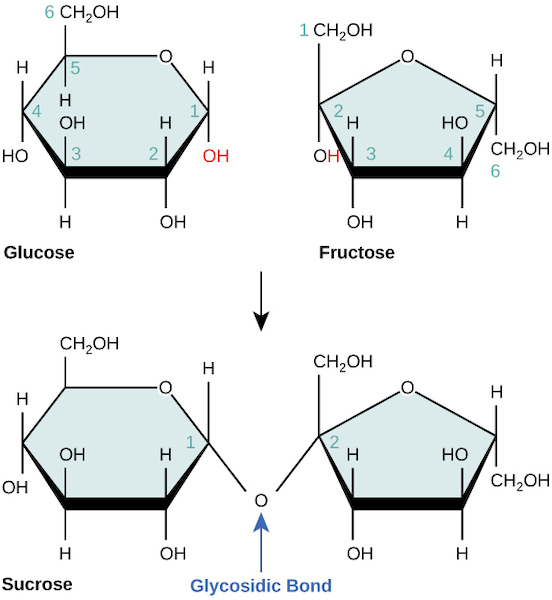
Figure 3.7図 3.7
Sucrose forms when a glucose monomer and a fructose monomer join in a dehydration reaction to form a glycosidic bond. In the process, a water molecule is lost. By convention, the carbon atoms in a monosaccharide are numbered from the terminal carbon closest to the carbonyl group. In sucrose, a glycosidic linkage forms between carbon 1 in glucose and carbon 2 in fructose.
グルコース単量体とフルクトース単量体が脱水反応によってグリコシド結合でつながると、スクロースができる。この過程で水分子一つが失われる。単糖の炭素原子には、慣例により、カルボニル基に最も近い末端の炭素から番号を付ける。スクロースでは、グルコースの1番炭素とフルクトースの2番炭素の間にグリコシド結合ができる。
Common disaccharides include lactose, maltose, and sucrose (Figure 3.8). Lactose is a disaccharide consisting of the monomers glucose and galactose. It is naturally in milk. Maltose, or malt sugar, is a disaccharide formed by a dehydration reaction between two glucose molecules. The most common disaccharide is sucrose, or table sugar, which is comprised of glucose and fructose monomers.
英語のヒント
一般的な二糖には、ラクトース、マルトース、スクロースがある(図3.8)。ラクトースは、グルコースとガラクトースを単量体とする二糖で、乳に天然に含まれる。マルトース、すなわち麦芽糖は、グルコース分子二つの脱水反応でできる二糖である。最も一般的な二糖はスクロース、すなわち砂糖で、グルコースとフルクトースの単量体からできている。
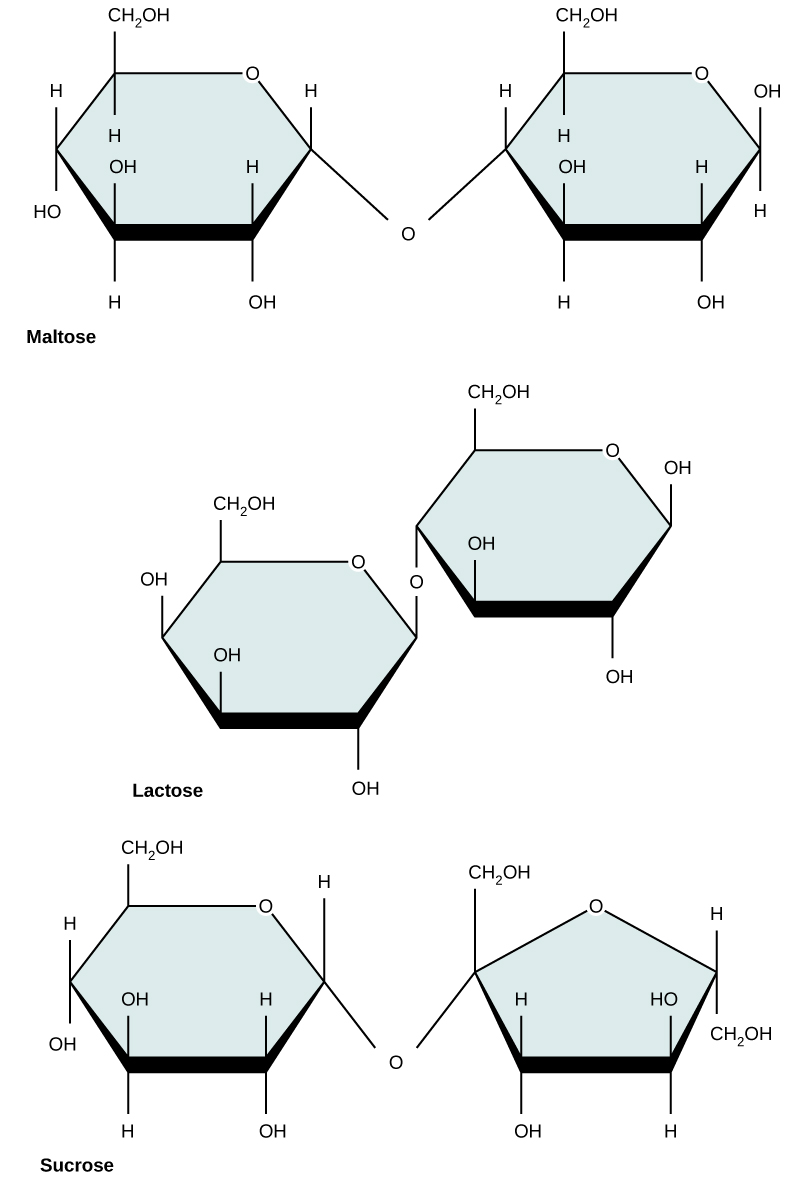
Figure 3.8図 3.8
Common disaccharides include maltose (grain sugar), lactose (milk sugar), and sucrose (table sugar).
一般的な二糖には、マルトース(穀物由来の糖)、ラクトース(乳糖)、スクロース(砂糖)がある。
Polysaccharides多糖
A long chain of monosaccharides linked by glycosidic bonds is a polysaccharide (poly- = “many”). The chain may be branched or unbranched, and it may contain different types of monosaccharides. The molecular weight may be 100,000 daltons or more depending on the number of joined monomers. Starch, glycogen, cellulose, and chitin are primary examples of polysaccharides.
英語のヒント
単糖がグリコシド結合でつながった長い鎖が多糖である(polysaccharideのpoly-は「多くの」の意味)。鎖には枝分かれがある場合とない場合があり、異なる種類の単糖を含むこともある。結合した単量体の数によっては、分子量が10万ダルトン以上になる。デンプン、グリコーゲン、セルロース、キチンは、多糖の主な例である。
Plants store sugars in the form of starch. In plants, an amylose and amylopectin mixture (both glucose polymers) comprise these sugars. Plants are able to synthesize glucose, and they store the excess glucose, beyond their immediate energy needs, as starch in different plant parts, including roots and seeds. The starch in the seeds provides food for the embryo as it germinates and can also act as a food source for humans and animals. Enzymes break down the starch that humans consume. For example, an amylase present in saliva catalyzes, or breaks down this starch into smaller molecules, such as maltose and glucose. The cells can then absorb the glucose.
英語のヒント
植物は糖をデンプンの形で蓄える。植物では、どちらもグルコースの重合体であるアミロースとアミロペクチンの混合物が、こうした糖を構成する。植物はグルコースを合成でき、すぐに使うエネルギーの必要量を超えた余分なグルコースを、根や種子など各部位にデンプンとして蓄える。種子のデンプンは、発芽時に胚の栄養となり、ヒトや動物の食料にもなる。ヒトが摂取したデンプンは酵素によって分解される。例えば、唾液中のアミラーゼは、デンプンをマルトースやグルコースなどの小さな分子に分解する反応を触媒する。その後、細胞がグルコースを吸収できる。
Glucose starch comprises monomers that are joined by α 1-4 or α 1-6 glycosidic bonds. The numbers 1-4 and 1-6 refer to the carbon number of the two residues that have joined to form the bond. As Figure 3.9 illustrates, unbranched glucose monomer chains (only α 1-4 linkages) form the starch; whereas, amylopectin is a branched polysaccharide (α 1-6 linkages at the branch points).
英語のヒント
グルコースからなるデンプンは、α1–4またはα1–6グリコシド結合でつながった単量体を含む。1–4と1–6という数字は、結合を作る二つの残基の炭素番号を表す。図3.9に示すように、グルコース単量体が枝分かれせずにつながった鎖(α1–4結合のみ)がデンプンを形成する。一方、アミロペクチンは枝分かれした多糖で、分岐点にα1–6結合がある。
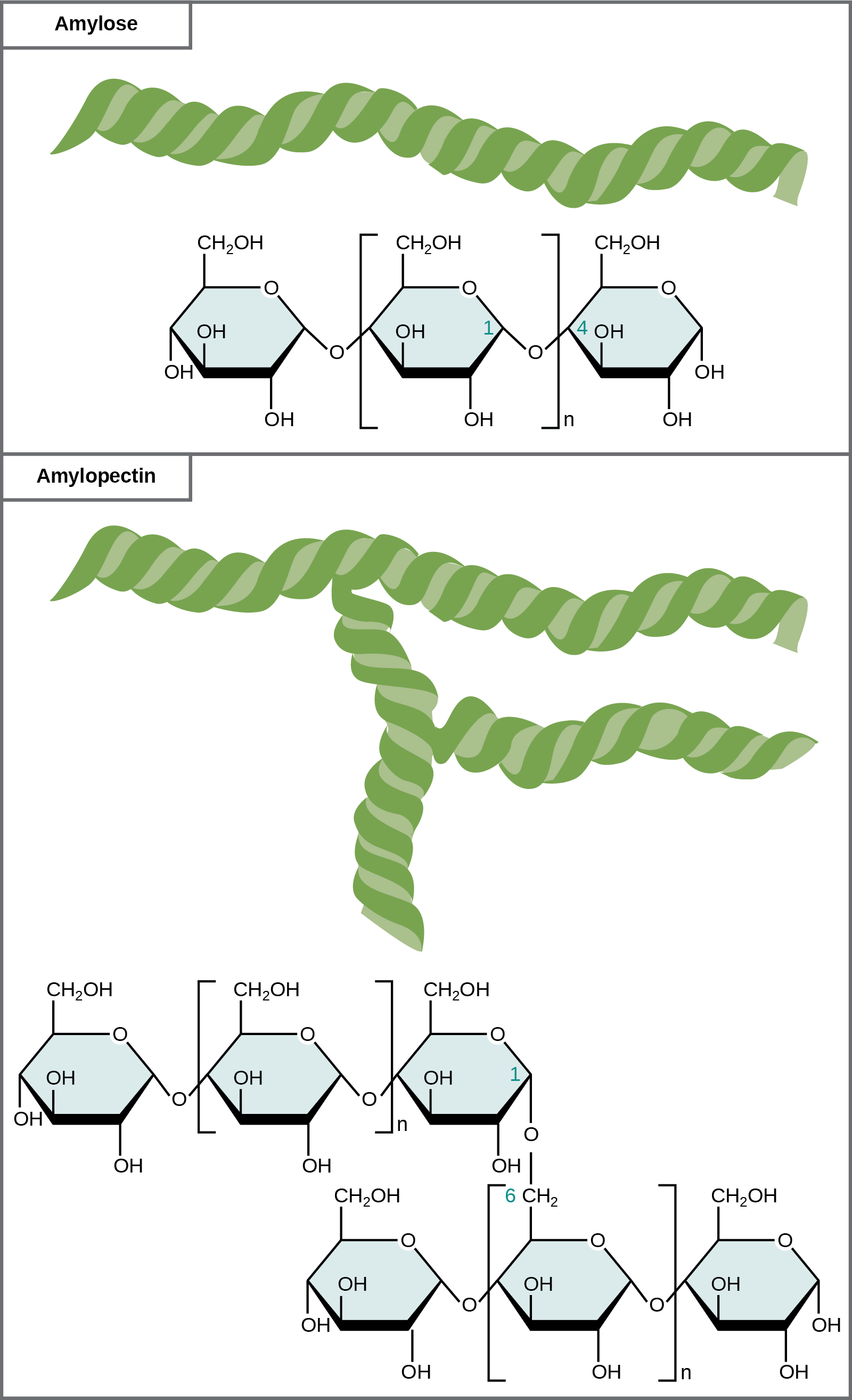
Figure 3.9図 3.9
Amylose and amylopectin are two different starch forms. Unbranched glucose monomer chains comprise amylose by α 1-4 glycosidic linkages. Branched glucose monomer chains comprise amylopectin by α 1-4 and α 1-6 glycosidic linkages. Because of the way the subunits are joined, the glucose chains have a helical structure. Glycogen (not shown) is similar in structure to amylopectin but more highly branched.
アミロースとアミロペクチンは、異なる二つのデンプンの形である。アミロースは、グルコース単量体がα1–4グリコシド結合でつながった、枝分かれのない鎖からなる。アミロペクチンは、α1–4およびα1–6グリコシド結合でつながった、枝分かれのあるグルコース単量体の鎖からなる。構成単位のつながり方によって、グルコース鎖はらせん構造を持つ。グリコーゲン(図には示していない)は、アミロペクチンと似た構造だが、より多くの枝分かれがある。
Glycogen is the storage form of glucose in humans and other vertebrates and is comprised of monomers of glucose. Glycogen is the animal equivalent of starch and is a highly branched molecule usually stored in liver and muscle cells. Whenever blood glucose levels decrease, glycogen breaks down to release glucose in a process scientists call glycogenolysis.
英語のヒント
グリコーゲンは、ヒトやほかの脊椎動物におけるグルコースの貯蔵形態であり、グルコース単量体からできている。動物においてデンプンに相当する物質で、枝分かれが非常に多く、通常は肝細胞や筋細胞に蓄えられる。血糖値が下がるたびに、グリコーゲン分解と呼ばれる過程でグリコーゲンが分解され、グルコースが放出される。
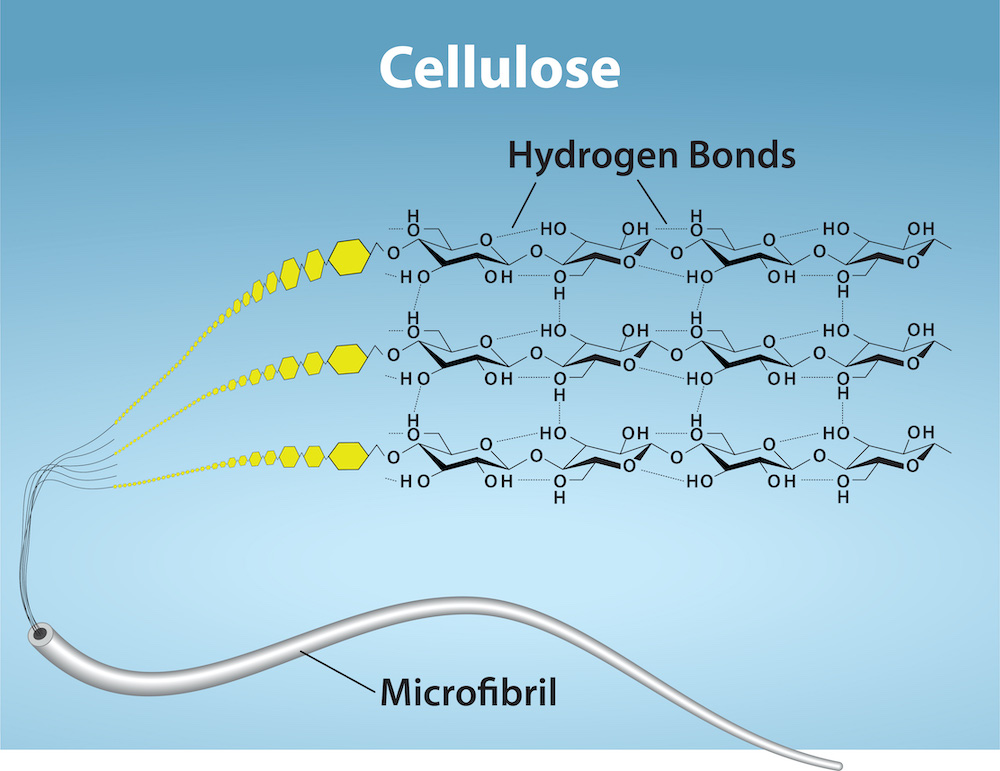
Cellulose is the most abundant natural biopolymer. Cellulose mostly comprises a plant's cell wall. This provides the cell structural support. Wood and paper are mostly cellulosic in nature. Glucose monomers comprise cellulose that β 1-4 glycosidic bonds link (Figure 3.10).
英語のヒント
セルロースは、自然界で最も豊富な生体高分子である。植物の細胞壁の大部分を構成し、細胞を構造的に支えている。木材や紙も、主としてセルロースからなる。セルロースは、グルコース単量体がβ1–4グリコシド結合でつながったものである(図3.10)。
OpenStax, Rice University; Biology 2e. Credit: Ryan, K. Rao, A. and Hawkins, A. Department of Biology, Texas A&M University. · CC BY 4.0 · Source出典
Figure 3.10図 3.10
Cellulose is an organic compound composed of linear chains of hundreds to thousands of linked glucose molecules. The glucose monomers form hydrogen bonds, holding the chains firmly together side-by-side and form strong microfibrils. This rigidity is an important structural component of the cell walls found in plants. Credit: Ryan, K. Rao, A. and Hawkins, A. Department of Biology, Texas A&M University.
セルロースは、数百〜数千のグルコース分子がつながった直鎖からなる有機化合物である。グルコース単量体は水素結合を作り、並んだ鎖をしっかりと結び付け、強い微繊維を形成する。この剛性は、植物の細胞壁を構造的に支える重要な要素である。出典:Ryan, K., Rao, A. and Hawkins, A.(テキサスA&M大学生物学部)
As Figure 3.10 shows, every other glucose monomer in cellulose is flipped over, and the monomers are packed tightly as extended long chains. This gives cellulose its rigidity and high tensile strength—which is so important to plant cells. While human digestive enzymes cannot break down the β 1-4 linkage, herbivores such as cows, koalas, and buffalos are able, with the help of the specialized flora in their stomach, to digest plant material that is rich in cellulose and use it as a food source. In some of these animals, certain species of bacteria and protists reside in the rumen (part of the herbivore's digestive system) and secrete the enzyme cellulase. The appendix of grazing animals also contains bacteria that digest cellulose, giving it an important role in ruminants' digestive systems. Cellulases can break down cellulose into glucose monomers that animals use as an energy source. Termites are also able to break down cellulose because of the presence of other organisms in their bodies that secrete cellulases.
英語のヒント
図3.10に示すように、セルロースではグルコース単量体が一つおきに反転し、伸びた長い鎖として密に詰まっている。このことがセルロースに剛性と高い引張強度を与え、植物細胞にとって非常に重要となる。ヒトの消化酵素はβ1–4結合を切れない。しかし、ウシ、コアラ、バッファローなどの草食動物は、胃にすむ特殊な微生物叢の助けを借りて、セルロースを豊富に含む植物を消化し、食料として利用できる。こうした動物の一部では、特定の細菌や原生生物がルーメン(草食動物の消化器系の一部)に生息し、セルラーゼという酵素を分泌する。草を食べる動物の虫垂にもセルロースを消化する細菌があり、反芻動物の消化器系で重要な役割を担っている。セルラーゼはセルロースをグルコース単量体に分解でき、動物はそれをエネルギー源として使う。シロアリも、体内にセルラーゼを分泌するほかの生物がいるため、セルロースを分解できる。
Carbohydrates serve various functions in different animals. Arthropods (insects, crustaceans, and others) have an outer skeleton, the exoskeleton, which protects their internal body parts (as we see in the bee in Figure 3.11). This exoskeleton is made of the biological macromolecule chitin, which is a nitrogen-containing polysaccharide. It is made of repeating N-acetyl-β-d-glucosamine units, which are a modified sugar. Chitin is also a major component of fungal cell walls. Fungi are neither animals nor plants and form a kingdom of their own in the domain Eukarya.
英語のヒント
炭水化物は、さまざまな動物で多様な機能を果たす。節足動物(昆虫、甲殻類など)は、外骨格という外側の骨格を持ち、体の内部を保護している(図3.11のハチを参照)。この外骨格は、生体高分子のキチンからできている。キチンは窒素を含む多糖で、修飾された糖であるN-アセチル-β-D-グルコサミン単位が繰り返し並んだものである。キチンは菌類の細胞壁の主要成分でもある。菌類は動物でも植物でもなく、真核生物ドメインの中で独自の界を形成している。
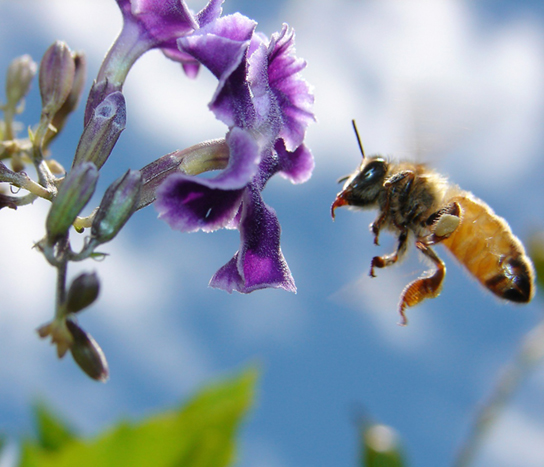


Figure 3.11図 3.11
Insects have a hard outer exoskeleton made of chitin, a type of polysaccharide. (credit: Louise Docker)
昆虫は、多糖の一種であるキチンからできた硬い外骨格を持つ。(出典:Louise Docker)