第32章植物の生殖
32.3 Asexual Reproduction32.3 無性生殖
Learning Objectives学習目標
By the end of this section, you will be able to do the following:
この節を学ぶと、次のことができるようになる。
- Compare the mechanisms and methods of natural and artificial asexual reproduction自然の無性生殖と人工的な無性生殖の仕組みや方法を比較する。
- Describe the advantages and disadvantages of natural and artificial asexual reproduction自然の無性生殖と人工的な無性生殖の利点と欠点を説明する。
- Discuss plant life spans植物の寿命について論じる。
Many plants are able to propagate themselves using asexual reproduction. This method does not require the investment required to produce a flower, attract pollinators, or find a means of seed dispersal. Asexual reproduction produces plants that are genetically identical to the parent plant because no mixing of male and female gametes takes place. Traditionally, these plants survive well under stable environmental conditions when compared with plants produced from sexual reproduction because they carry genes identical to those of their parents.
英語のヒント
多くの植物は、無性生殖によって増殖できる。この方法では、花を作る、送粉者を引き寄せる、種子の散布方法を確保するといったことに資源を費やす必要がない。雄と雌の配偶子が混ざり合わないため、無性生殖で生じる植物は親植物と遺伝的に同一である。これらの植物は親と同じ遺伝子をもつため、安定した環境条件のもとでは、有性生殖で生じた植物よりも一般によく生き残る。
Many different types of roots exhibit asexual reproduction (Figure 32.24). The corm is used by gladiolus and garlic. Bulbs, such as a scaly bulb in lilies and a tunicate bulb in daffodils, are other common examples. A potato is a stem tuber, while parsnip propagates from a taproot. Ginger and iris produce rhizomes, while ivy uses an adventitious root (a root arising from a plant part other than the main or primary root), and the strawberry plant has a stolon, which is also called a runner.
さまざまな種類の根で無性生殖が見られる(図32.24)。グラジオラスやニンニクは球茎を使う。ユリの無皮鱗茎やスイセンの有皮鱗茎なども、よく見られる例である。ジャガイモは茎の塊茎であり、パースニップは主根から増殖する。ショウガやアヤメ類は根茎を作り、ツタは不定根、すなわち主根以外の植物の部分から生じる根を使う。イチゴには、ランナーとも呼ばれる匍匐茎がある。
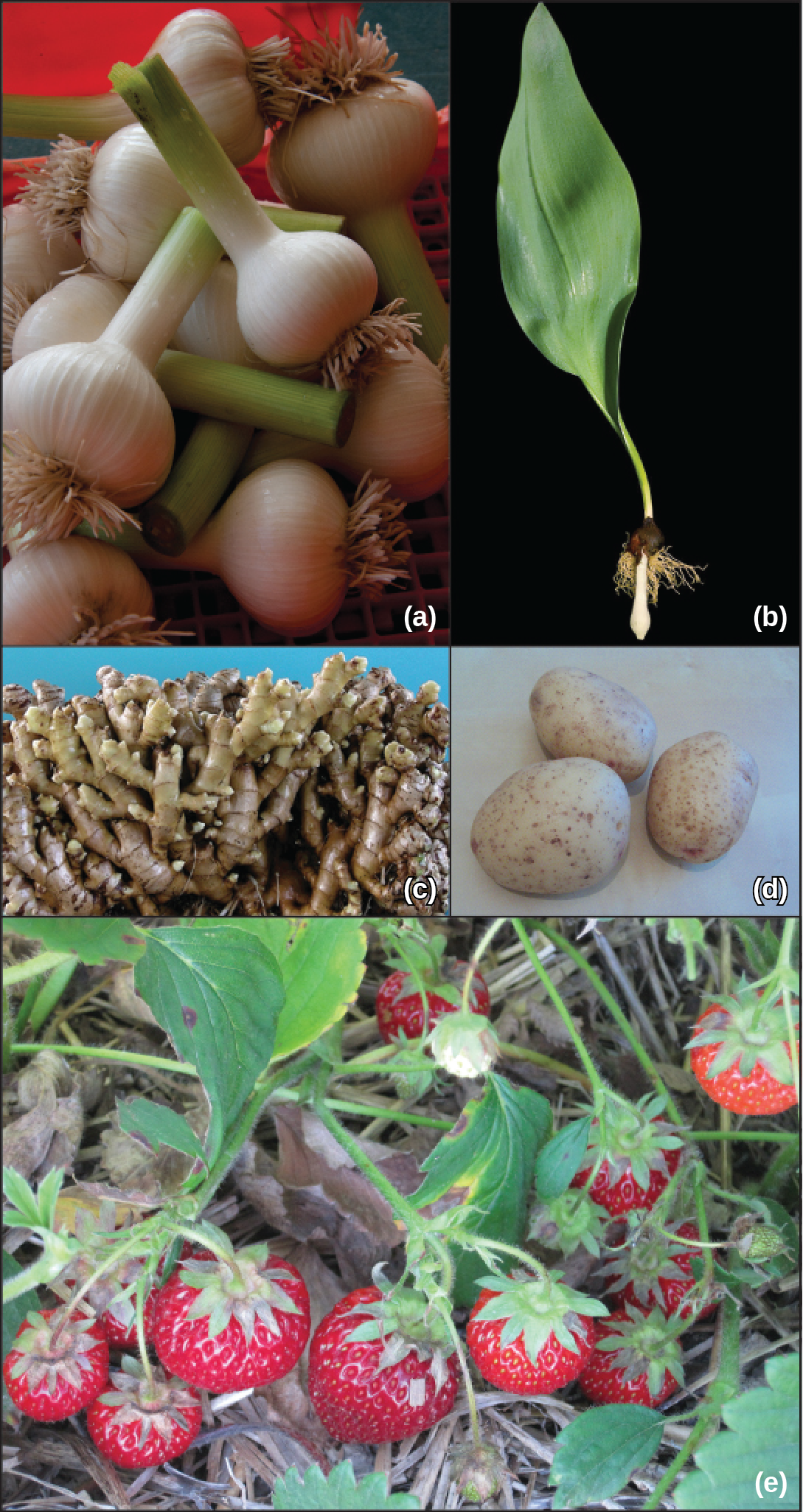
OpenStax, Rice University; Biology 2e. (credit a: modification of work by Dwight Sipler; credit c: modification of work by Albert Cahalan, USDA ARS; credit d: modification of work by Richard North; credit e: modification of work by Julie Magro) · CC BY 4.0 · Source出典
Figure 32.24図 32.24
Different types of stems allow for asexual reproduction. (a) The corm of a garlic plant looks similar to (b) a tulip bulb, but the corm is solid tissue, while the bulb consists of layers of modified leaves that surround an underground stem. Both corms and bulbs can self-propagate, giving rise to new plants. (c) Ginger forms masses of stems called rhizomes that can give rise to multiple plants. (d) Potato plants form fleshy stem tubers. Each eye in the stem tuber can give rise to a new plant. (e) Strawberry plants form stolons: stems that grow at the soil surface or just below ground and can give rise to new plants. (credit a: modification of work by Dwight Sipler; credit c: modification of work by Albert Cahalan, USDA ARS; credit d: modification of work by Richard North; credit e: modification of work by Julie Magro)
さまざまな型の茎によって、無性生殖が可能になる。(a)ニンニクの球茎は(b)チューリップの鱗茎に似て見えるが、球茎は中身の詰まった組織である。一方、鱗茎は地下の茎を囲む、変形した葉の層からなる。どちらも自ら増殖して新しい植物を生じる。(c)ショウガは根茎という茎の集まりを作り、そこから複数の植物が生じる。(d)ジャガイモは肉質の塊茎を作り、その芽の一つ一つから新しい植物が育つ。(e)イチゴは、地表や地面のすぐ下を伸び、新しい植物を作れる茎である匍匐茎を形成する。(クレジットa:Dwight Siplerの作品を改変;c:Albert Cahalan, USDA ARSの作品を改変;d:Richard Northの作品を改変;e:Julie Magroの作品を改変)
Some plants can produce seeds without fertilization. Either the ovule or part of the ovary, which is diploid in nature, gives rise to a new seed. This method of reproduction is known as apomixis.
受精せずに種子を作れる植物もある。二倍体の胚珠または子房の一部から、新しい種子が生じる。この生殖方法をアポミクシスという。
An advantage of asexual reproduction is that the resulting plant will reach maturity faster. Since the new plant is arising from an adult plant or plant parts, it will also be sturdier than a seedling. Asexual reproduction can take place by natural or artificial (assisted by humans) means.
無性生殖の利点は、生じた植物がより早く成熟することである。新しい植物は成体やその一部から生じるため、実生よりも丈夫になる。無性生殖は、自然の方法でも、人間が手助けする人工的な方法でも起こる。
Natural Methods of Asexual Reproduction自然の無性生殖の方法
Natural methods of asexual reproduction include strategies that plants have developed to self-propagate. Many plants—like ginger, onion, gladioli, and dahlia—continue to grow from buds that are present on the surface of the stem. In some plants, such as the sweet potato, adventitious roots or runners can give rise to new plants (Figure 32.25). In Bryophyllum and kalanchoe, the leaves have small buds on their margins. When these are detached from the plant, they grow into independent plants; or, they may start growing into independent plants if the leaf touches the soil. Some plants can be propagated through cuttings alone.
自然の無性生殖には、植物が自ら増殖するために発達させた戦略が含まれる。ショウガ、タマネギ、グラジオラス、ダリアなど、多くの植物は茎の表面にある芽から成長を続ける。サツマイモなどの一部の植物では、不定根やランナーから新しい植物が生じる(図32.25)。セイロンベンケイ属やカランコエ属では、葉の縁に小さな芽がある。これらが親植物から離れると独立した植物へ育つ。また、葉が土に触れたときに、独立した植物として成長を始めることもある。挿し木だけで増やせる植物もある。
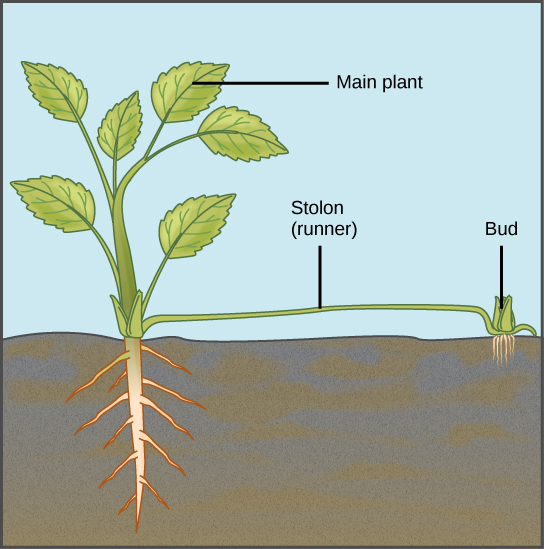
Figure 32.25図 32.25
A stolon, or runner, is a stem that runs along the ground. At the nodes, it forms adventitious roots and buds that grow into a new plant.
匍匐茎、すなわちランナーは、地面に沿って伸びる茎である。節に不定根と芽を作り、それらが新しい植物へ育つ。
Artificial Methods of Asexual Reproduction人工的な無性生殖の方法
These methods are frequently employed to give rise to new, and sometimes novel, plants. They include grafting, cutting, layering, and micropropagation.
これらの方法は、新しい個体、ときには新しい性質をもつ植物を作るためによく使われる。接ぎ木、挿し木、取り木、微細繁殖などがある。
Grafting接ぎ木
Grafting has long been used to produce novel varieties of roses, citrus species, and other plants. In grafting, two plant species are used; part of the stem of the desirable plant is grafted onto a rooted plant called the stock. The part that is grafted or attached is called the scion. Both are cut at an oblique angle (any angle other than a right angle), placed in close contact with each other, and are then held together (Figure 32.26). Matching up these two surfaces as closely as possible is extremely important because these will be holding the plant together. The vascular systems of the two plants grow and fuse, forming a graft. After a period of time, the scion starts producing shoots, and eventually starts bearing flowers and fruits. Grafting is widely used in viticulture (grape growing) and the citrus industry. Scions capable of producing a particular fruit variety are grafted onto root stock with specific resistance to disease.
英語のヒント
接ぎ木は、バラ、柑橘類、その他の植物の新しい品種を作るために、古くから使われてきた。接ぎ木には2種類の植物を使い、望ましい植物の茎の一部を、台木という根のある植物へ接ぐ。接がれる部分を穂木という。両方を斜め、つまり直角以外の角度に切り、切り口を密着させて固定する(図32.26)。二つの面が植物をつなぎとめることになるため、できるだけぴったり合わせることが非常に重要である。両方の植物の維管束系が成長して融合し、接ぎ木が成立する。しばらくすると穂木からシュートが伸び、やがて花や実をつけ始める。接ぎ木はブドウ栽培や柑橘産業で広く使われる。特定の果実品種を生産できる穂木を、特定の病気への抵抗性をもつ台木に接ぐ。
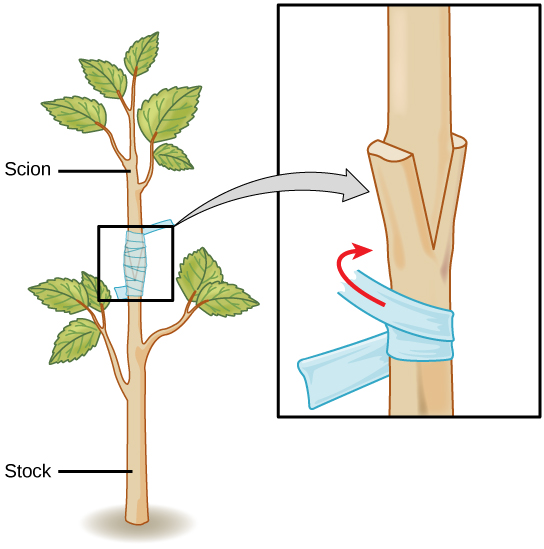


Figure 32.26図 32.26
Grafting is an artificial method of asexual reproduction used to produce plants combining favorable stem characteristics with favorable root characteristics. The stem of the plant to be grafted is known as the scion, and the root is called the stock.
接ぎ木は、茎の好ましい特徴と根の好ましい特徴を組み合わせた植物を作る、人工的な無性生殖の方法である。接がれる植物の茎を穂木、根をもつ側を台木という。