第32章植物の生殖
Seed Germination種子の発芽
Many mature seeds enter a period of inactivity, or extremely low metabolic activity: a process known as dormancy, which may last for months, years, or even centuries. Dormancy helps keep seeds viable during unfavorable conditions. Upon a return to favorable conditions, seed germination takes place. Favorable conditions could be as diverse as moisture, light, cold, fire, or chemical treatments. After heavy rains, many new seedlings emerge. Forest fires also lead to the emergence of new seedlings. Some seeds require vernalization (cold treatment) before they can germinate. This guarantees that seeds produced by plants in temperate climates will not germinate until the spring. Plants growing in hot climates may have seeds that need a heat treatment in order to germinate, to avoid germination in the hot, dry summers. In many seeds, the presence of a thick seed coat retards the ability to germinate. Scarification, which includes mechanical or chemical processes to soften the seed coat, is often employed before germination. Presoaking in hot water, or passing through an acid environment, such as an animal’s digestive tract, may also be employed.
英語のヒント
多くの成熟種子は、活動しないか、代謝活動がきわめて低い時期に入る。これを休眠といい、数か月、数年、ときには数世紀も続く。休眠によって、種子は不利な条件の間も生存能力を保てる。好適な条件が戻ると発芽が起こる。その条件は、水分、光、低温、火、化学処理など実に多様である。大雨の後には多くの新しい実生が現れ、森林火災も新たな実生の出現をもたらす。発芽前に春化、すなわち低温処理を必要とする種子もある。これにより、温帯の植物が作った種子は、春になるまで発芽しないことが保証される。暑い気候で育つ植物には、暑く乾いた夏の発芽を避けるため、発芽に熱処理を必要とする種子をもつものもある。多くの種子では、厚い種皮が発芽を遅らせる。そのため発芽前には、機械的・化学的な過程で種皮を軟らかくする傷つけ処理がよく行われる。あらかじめ温水に浸したり、動物の消化管のような酸性環境を通したりすることもある。
Depending on seed size, the time taken for a seedling to emerge may vary. Species with large seeds have enough food reserves to germinate deep below ground, and still extend their epicotyl all the way to the soil surface. Seeds of small-seeded species usually require light as a germination cue. This ensures the seeds only germinate at or near the soil surface (where the light is greatest). If they were to germinate too far underneath the surface, the developing seedling would not have enough food reserves to reach the sunlight.
英語のヒント
実生が地上に現れるまでの時間は、種子の大きさによって異なることがある。大きな種子をもつ種には十分な貯蔵養分があり、地中深くで発芽しても、上胚軸を地表まで伸ばせる。小さな種子をもつ種は、通常、発芽の手掛かりとして光を必要とする。これにより、光がもっとも多い地表またはその近くでのみ発芽するようになる。もし地表から深すぎる場所で発芽すれば、発達する実生には、日光の届く場所まで達するための養分が足りなくなる。
Development of Fruit and Fruit Types果実の発達と種類
After fertilization, the ovary of the flower usually develops into the fruit. Fruits are usually associated with having a sweet taste; however, not all fruits are sweet. Botanically, the term “fruit” is used for a ripened ovary. In most cases, flowers in which fertilization has taken place will develop into fruits, and flowers in which fertilization has not taken place will not. Some fruits develop from the ovary and are known as true fruits, whereas others develop from other parts of the female gametophyte and are known as accessory fruits. The fruit encloses the seeds and the developing embryo, thereby providing it with protection. Fruits are of many types, depending on their origin and texture. The sweet tissue of the blackberry, the red flesh of the tomato, the shell of the peanut, and the hull of corn (the tough, thin part that gets stuck in your teeth when you eat popcorn) are all fruits. As the fruit matures, the seeds also mature.
受精後、花の子房は通常、果実へ発達する。果実といえば甘味を連想しがちだが、すべての果実が甘いわけではない。植物学では、「果実」は成熟した子房を指す。多くの場合、受精した花は果実へ発達し、受精しなかった花は発達しない。子房から発達する果実は真果と呼ばれる。一方、雌性配偶体のほかの部分から発達するものは付属果という。果実は種子と発達中の胚を包み、保護する。起源や質感によって、果実には多くの種類がある。ブラックベリーの甘い組織、トマトの赤い果肉、ラッカセイの殻、トウモロコシの外皮(ポップコーンを食べると歯に挟まる、硬く薄い部分)は、すべて果実である。果実が成熟すると、種子も成熟する。
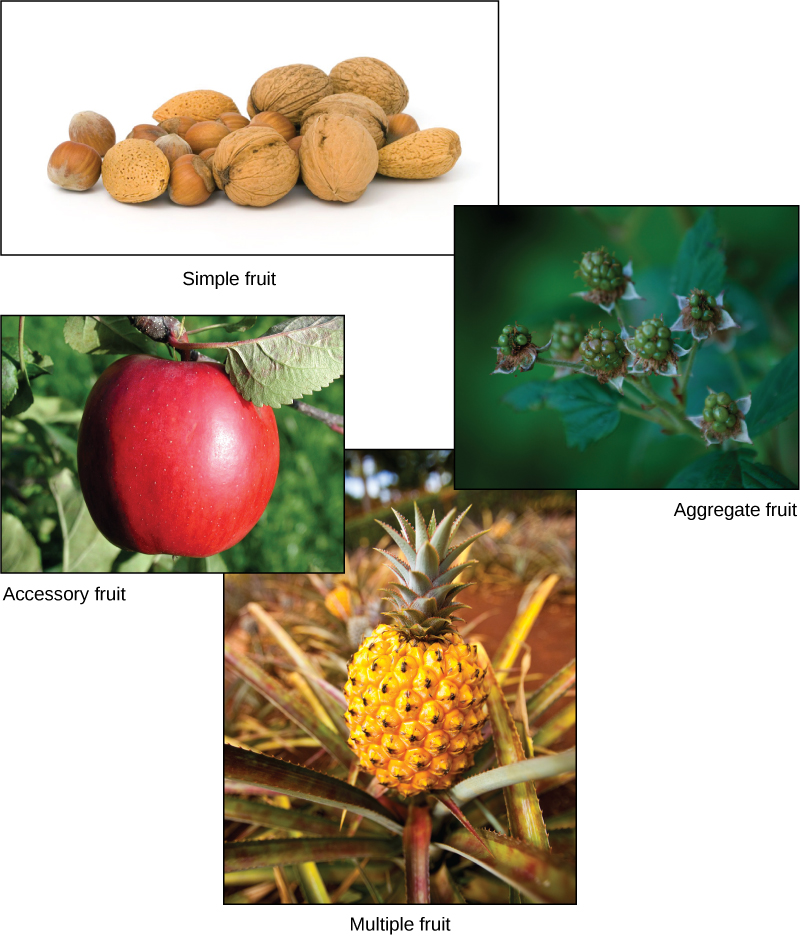
Fruits may be classified as simple, aggregate, multiple, or accessory, depending on their origin (Figure 32.22). If the fruit develops from a single carpel or fused carpels of a single ovary, it is known as a simple fruit, as seen in nuts and beans. An aggregate fruit is one that develops from more than one carpel, but all are in the same flower: the mature carpels fuse together to form the entire fruit, as seen in the raspberry. Multiple fruit develops from an inflorescence or a cluster of flowers. An example is the pineapple, where the flowers fuse together to form the fruit. Accessory fruits (sometimes called false fruits) are not derived from the ovary, but from another part of the flower, such as the receptacle (strawberry) or the hypanthium (apples and pears). In general, the accessory fruit is a combination of the ovary and several floral components.
果実は、その起源に応じて、単果、集合果、複合果、付属果に分類できる(図32.22)。一つの心皮、または一つの子房を作る融合した心皮から発達するものを単果といい、堅果やマメの果実がその例である。集合果は、一つの花にある複数の心皮から発達する。成熟した心皮が合わさって果実全体を作り、ラズベリーに見られる。複合果は、花序、すなわち花の集まりから発達する。パイナップルがその例で、花が融合して果実を作る。付属果は偽果とも呼ばれ、子房ではなく、イチゴの花床やリンゴ・ナシの花托筒など、花のほかの部分に由来する。一般に、付属果は子房といくつかの花の構成要素が組み合わさったものである。
OpenStax, Rice University; Biology 2e. (credit "nuts": modification of work by Petr Kratochvil; credit "raspberries": modification of work by Cory Zanker; credit "pineapple": modification of work by Howie Le; credit "apple": modification of work by Paolo Neo) · CC BY 4.0 · Source出典

Figure 32.22図 32.22
There are four main types of fruits. Simple fruits, such as these nuts, are derived from a single ovary. Aggregate fruits, like raspberries, form from many carpels that fuse together. Multiple fruits, such as pineapple, form from a cluster of flowers called an inflorescence. Accessory fruit, like the apple, are formed from a part of the plant other than the ovary. (credit "nuts": modification of work by Petr Kratochvil; credit "raspberries": modification of work by Cory Zanker; credit "pineapple": modification of work by Howie Le; credit "apple": modification of work by Paolo Neo)
果実には四つの主要な型がある。これらの堅果のような単果は、一つの子房に由来する。ラズベリーのような集合果は、多数の心皮が合わさってできる。パイナップルのような複合果は、花序という花の集まりからできる。リンゴのような付属果は、子房以外の植物の部分から形成される。(堅果のクレジット:Petr Kratochvilの作品を改変;ラズベリー:Cory Zankerの作品を改変;パイナップル:Howie Leの作品を改変;リンゴ:Paolo Neoの作品を改変)
Fruits generally have three parts: the exocarp (the outermost skin or covering), the mesocarp (middle part of the fruit), and the endocarp (the inner part of the fruit). Together, all three are known as the pericarp. The mesocarp is usually the fleshy, edible part of the fruit; however, in some fruits, such as the almond, the endocarp is the edible part. In many fruits, two or all three of the layers are fused, and are indistinguishable at maturity. Fruits can be dry or fleshy. Furthermore, fruits can be divided into dehiscent or indehiscent types. Dehiscent fruits, such as peas, readily release their seeds, while indehiscent fruits, like peaches, rely on decay to release their seeds.
英語のヒント
果実には一般に、外果皮(もっとも外側の皮や覆い)、中果皮(果実の中間部分)、内果皮(内側の部分)の三つがある。三つを合わせて果皮という。中果皮は通常、肉質の食用部分になるが、アーモンドなど一部の果実では内果皮が食用部分となる。多くの果実では、二層または三層すべてが融合し、成熟時には見分けられなくなる。果実には乾燥したものと肉質のものがある。さらに、裂開性と非裂開性にも分けられる。エンドウなどの裂開果は種子を容易に放出するが、モモのような非裂開果は、腐敗によって種子を放出する。