第32章植物の生殖
Fruit and Seed Dispersal果実と種子の散布
The fruit has a single purpose: seed dispersal. Seeds contained within fruits need to be dispersed far from the mother plant, so they may find favorable and less competitive conditions in which to germinate and grow.
英語のヒント
果実の目的は一つ、種子の散布である。果実の中の種子は、母植物から遠くへ散布される必要がある。そうすることで、競争が少なく、発芽と成長に適した条件を見つけられる。
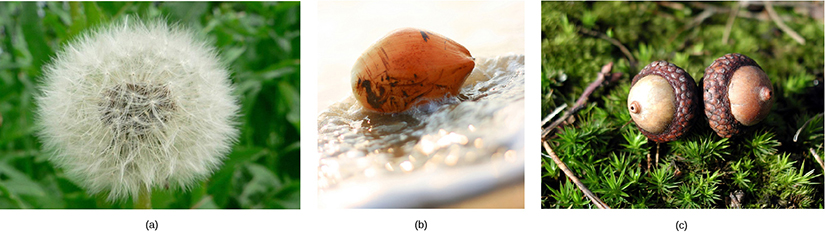
Some fruit have built-in mechanisms so they can disperse by themselves, whereas others require the help of agents like wind, water, and animals (Figure 32.23). Modifications in seed structure, composition, and size help in dispersal. Wind-dispersed fruit are lightweight and may have wing-like appendages that allow them to be carried by the wind. Some have a parachute-like structure to keep them afloat. Some fruits—for example, the dandelion—have hairy, weightless structures that are suited to dispersal by wind.
自力で散布できる仕組みを内蔵する果実もあるが、風、水、動物などの助けを必要とするものもある(図32.23)。種子の構造、組成、大きさの変化は、散布に役立つ。風で散布される果実は軽く、風に運ばれるための翼状の付属物をもつことがある。空中に浮かぶためのパラシュート状の構造をもつものもある。タンポポなどの果実には、風による散布に適した、ほとんど重さのない毛状構造がある。
Seeds dispersed by water are contained in light and buoyant fruit, giving them the ability to float. Coconuts are well known for their ability to float on water to reach land where they can germinate. Similarly, willow and silver birches produce lightweight fruit that can float on water.
水で散布される種子は、軽く浮力のある果実に包まれているため、水に浮くことができる。ココヤシは、水に浮かんで発芽できる陸地へ到達することでよく知られる。同様に、ヤナギやシラカバ類も水に浮く軽い果実を作る。
Animals and birds eat fruits, and the seeds that are not digested are excreted in their droppings some distance away. Some animals, like squirrels, bury seed-containing fruits for later use; if the squirrel does not find its stash of fruit, and if conditions are favorable, the seeds germinate. Some fruits, like the cocklebur, have hooks or sticky structures that stick to an animal's coat and are then transported to another place. Humans also play a big role in dispersing seeds when they carry fruits to new places and throw away the inedible part that contains the seeds.
英語のヒント
動物や鳥は果実を食べ、消化されなかった種子を、離れた場所で糞とともに排出する。リスなどの動物は、後で使うため種子を含む果実を埋める。リスがその蓄えを見つけられず、条件がよければ、種子は発芽する。オナモミのように、動物の毛に付着する鉤や粘着性の構造をもち、別の場所へ運ばれる果実もある。人間も果実を新しい場所へ運び、種子を含む食べられない部分を捨てることで、種子散布に大きな役割を果たす。
All of the above mechanisms allow for seeds to be dispersed through space, much like an animal’s offspring can move to a new location. Seed dormancy, which was described earlier, allows plants to disperse their progeny through time: something animals cannot do. Dormant seeds can wait months, years, or even decades for the proper conditions for germination and propagation of the species.
英語のヒント
以上の仕組みはすべて、動物の子が新しい場所へ移動できるのと同じように、種子を空間的に散布する。前述した種子の休眠によって、植物は子孫を時間的にも分散させられる。これは動物にはできないことである。休眠種子は、発芽と種の繁殖に適した条件が整うまで、数か月、数年、さらには数十年も待つことができる。
OpenStax, Rice University; Biology 2e. (credit a: modification of work by "Rosendahl"/Flickr; credit b: modification of work by Shine Oa; credit c: modification of work by Paolo Neo) · CC BY 4.0 · Source出典

Figure 32.23図 32.23
Fruits and seeds are dispersed by various means. (a) Dandelion seeds are dispersed by wind, the (b) coconut seed is dispersed by water, and the (c) acorn is dispersed by animals that cache and then forget it. (credit a: modification of work by "Rosendahl"/Flickr; credit b: modification of work by Shine Oa; credit c: modification of work by Paolo Neo)
果実と種子は、さまざまな方法で散布される。(a)タンポポの種子は風によって、(b)ココヤシの種子は水によって散布される。(c)ドングリは、蓄えてから忘れてしまう動物によって散布される。(クレジットa:"Rosendahl"/Flickrの作品を改変;b:Shine Oaの作品を改変;c:Paolo Neoの作品を改変)
Section Summaryこの節のまとめ
For fertilization to occur in angiosperms, pollen has to be transferred to the stigma of a flower: a process known as pollination. Gymnosperm pollination involves the transfer of pollen from a male cone to a female cone. When the pollen of the flower is transferred to the stigma of the same or another flower on the same plant, it is called self-pollination. Cross-pollination occurs when pollen is transferred from one flower to another flower of another plant. Cross-pollination requires pollinating agents such as water, wind, or animals, and increases genetic diversity. After the pollen lands on the stigma, the tube cell gives rise to the pollen tube, through which the generative nucleus migrates. The pollen tube gains entry through the micropyle on the ovule sac. The generative cell divides to form two sperm cells: one fuses with the egg to form the diploid zygote, and the other fuses with the polar nuclei to form the endosperm, which is triploid in nature. This is known as double fertilization. After fertilization, the zygote divides to form the embryo and the fertilized ovule forms the seed. The walls of the ovary form the fruit in which the seeds develop. The seed, when mature, will germinate under favorable conditions and give rise to the diploid sporophyte.
英語のヒント
被子植物で受精が起こるには、花粉が花の柱頭へ移されなければならない。この過程を受粉という。裸子植物の受粉では、雄性球果から雌性球果へ花粉が移る。花粉が同じ花、または同じ個体の別の花の柱頭へ移る場合は、自家受粉という。他家受粉は、ある花から別個体の花へ花粉が移るときに起こる。水、風、動物などの媒介者が必要であり、遺伝的多様性を増やす。花粉が柱頭につくと、花粉管細胞が花粉管を作り、その中を雄原核が移動する。花粉管は珠孔を通って胚嚢へ入る。雄原細胞は分裂して2個の精細胞となる。一つは卵と融合して二倍体の接合子を作り、もう一つは極核と融合して三倍体の胚乳を作る。これを重複受精という。受精後、接合子は分裂して胚となり、受精した胚珠は種子となる。子房の壁は、種子が発達する果実を作る。成熟した種子は、好適な条件下で発芽し、二倍体の胞子体を生じる。
Visual Connection Questions図を使った問題
Exercises 11練習問題 11
Exercise 11問題 11
Figure 32.20 What is the function of the cotyledon?
図32.20 子葉の機能は何か。
- It develops into the root.根へ発達する。
- It provides nutrition for the embryo.胚に栄養を供給する。
- It forms the embryo.胚を形成する。
- It protects the embryo.胚を保護する。
Solution解き方
Review Questions確認問題
Exercises 12–15練習問題 12–15
Exercise 12問題 12
After double fertilization, a zygote and ________ form.
重複受精の後には、接合子と________が形成される。
- an ovule胚珠
- endosperm胚乳
- a cotyledon子葉
- a suspensor胚柄
Solution解き方
B
B
Exercise 13問題 13
The fertilized ovule gives rise to the ________.
受精した胚珠は、________を生じる。
- fruit果実
- seed種子
- endosperm胚乳
- embryo胚
Solution解き方
B
B
Exercise 14問題 14
What is the term for a fruit that develops from tissues other than the ovary?
子房以外の組織から発達する果実を、何というか。
- simple fruit単果
- aggregate fruit集合果
- multiple fruit複合果
- accessory fruit付属果
Solution解き方
D
D
Exercise 15問題 15
The ________ is the outermost covering of a fruit.
________は、果実のもっとも外側の覆いである。
- endocarp内果皮
- pericarp果皮
- exocarp外果皮
- mesocarp中果皮
Solution解き方
C
C