第32章植物の生殖
Sexual Reproduction in Gymnosperms裸子植物の有性生殖
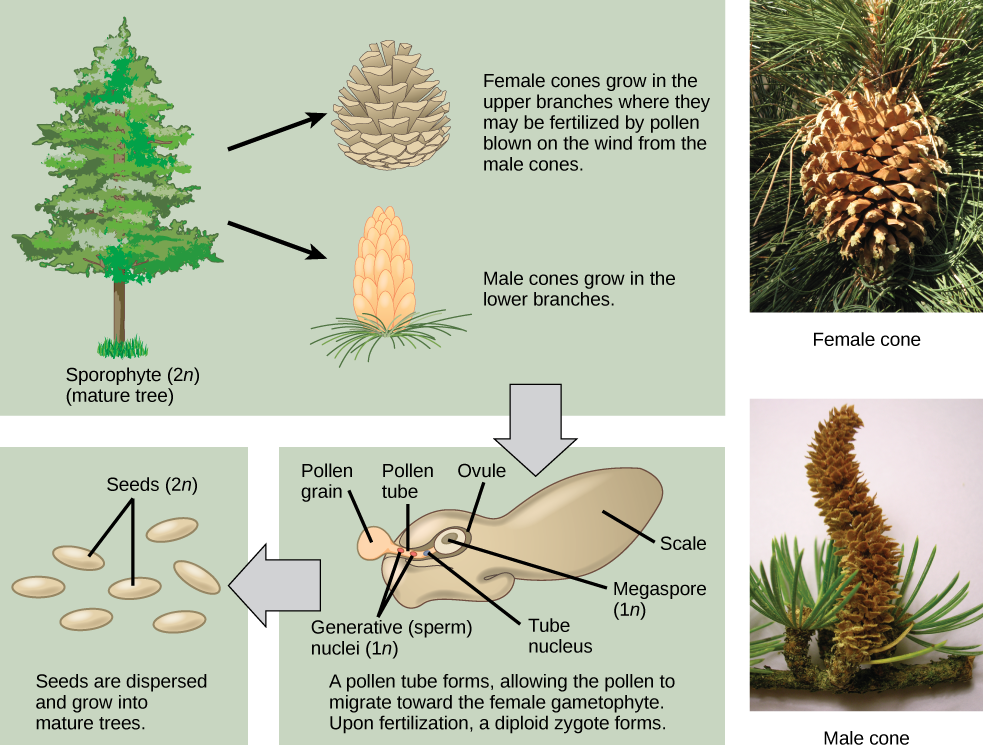
As with angiosperms, the lifecycle of a gymnosperm is also characterized by alternation of generations. In conifers such as pines, the green leafy part of the plant is the sporophyte, and the cones contain the male and female gametophytes (Figure 32.9). The female cones are larger than the male cones and are positioned towards the top of the tree; the small, male cones are located in the lower region of the tree. Because the pollen is shed and blown by the wind, this arrangement makes it difficult for a gymnosperm to self-pollinate.
英語のヒント
被子植物と同様、裸子植物の生活環も世代交代によって特徴づけられる。マツのような針葉樹では、緑色で葉をつけた植物体が胞子体であり、球果には雄性配偶体と雌性配偶体が含まれる(図32.9)。雌性球果は雄性球果より大きく、木の上のほうにつく。小さい雄性球果は木の下部につく。花粉は放出されて風で運ばれるため、この配置によって裸子植物は自家受粉しにくくなる。
OpenStax, Rice University; Biology 2e. (credit “female”: modification of work by “Geographer”/Wikimedia Commons; credit “male”: modification of work by Roger Griffith) · CC BY 4.0 · Source出典

Figure 32.9図 32.9
This image shows the lifecycle of a conifer. Pollen from male cones blows up into upper branches, where it fertilizes female cones. Examples are shown of female and male cones. (credit “female”: modification of work by “Geographer”/Wikimedia Commons; credit “male”: modification of work by Roger Griffith)
針葉樹の生活環を示す図。雄性球果からの花粉は上の枝へ吹き上げられ、そこで雌性球果を受精させる。雌性球果と雄性球果の例も示す。(雌性球果のクレジット:"Geographer"/Wikimedia Commonsの作品を改変;雄性球果:Roger Griffithの作品を改変)
Male Gametophyte雄性配偶体
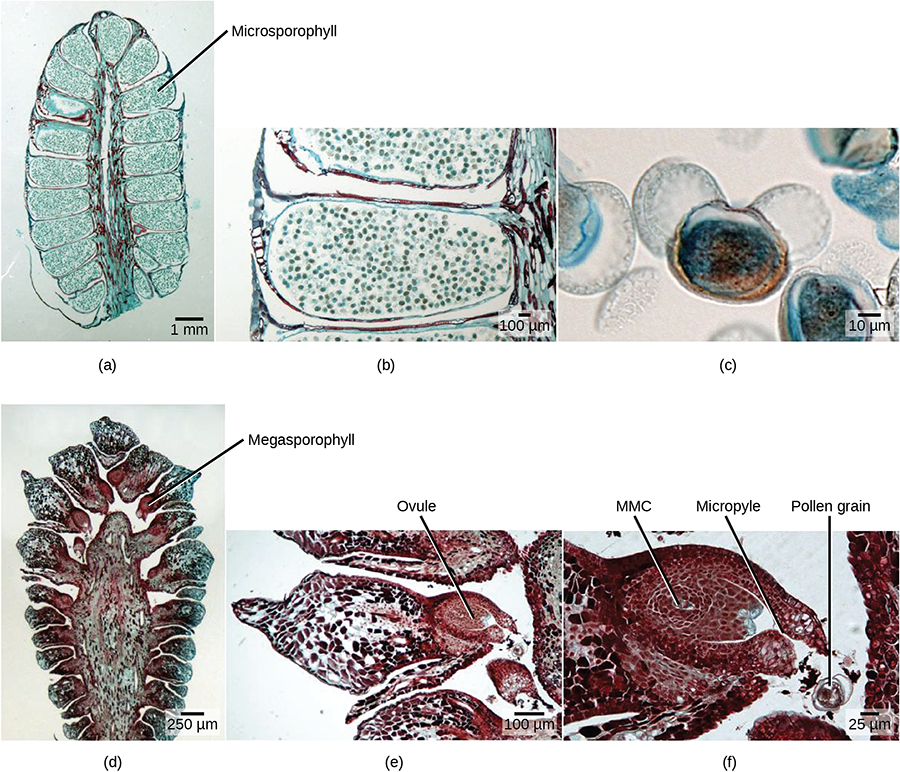
A male cone has a central axis on which bracts, a type of modified leaf, are attached. The bracts are known as microsporophylls (Figure 32.10) and are the sites where microspores will develop. The microspores develop inside the microsporangium. Within the microsporangium, cells known as microsporocytes divide by meiosis to produce four haploid microspores. Further mitosis of the microspore produces two nuclei: the generative nucleus, and the tube nucleus. Upon maturity, the male gametophyte (pollen) is released from the male cones and is carried by the wind to land on the female cone.
英語のヒント
雄性球果には中心軸があり、そこに変形した葉の一種である苞がつく。苞は小胞子葉と呼ばれ(図32.10)、小胞子が発達する場所である。小胞子は小胞子嚢の中で発達する。小胞子嚢では、小胞子母細胞という細胞が減数分裂し、4個の半数体の小胞子を作る。小胞子がさらに有糸分裂すると、雄原核と花粉管核という二つの核が生じる。成熟した雄性配偶体、すなわち花粉は雄性球果から放出され、風に運ばれて雌性球果につく。
Female Gametophyte雌性配偶体
The female cone also has a central axis on which bracts known as megasporophylls (Figure 32.10) are present. In the female cone, megaspore mother cells are present in the megasporangium. The megaspore mother cell divides by meiosis to produce four haploid megaspores. One of the megaspores divides to form the multicellular female gametophyte, while the others divide to form the rest of the structure. The female gametophyte is contained within a structure called the archegonium.
英語のヒント
雌性球果にも中心軸があり、大胞子葉と呼ばれる苞がついている(図32.10)。雌性球果の大胞子嚢内には、大胞子母細胞がある。大胞子母細胞は減数分裂し、4個の半数体の大胞子を作る。そのうち1個が分裂して多細胞の雌性配偶体となり、残りも分裂して構造のほかの部分を作る。雌性配偶体は、造卵器と呼ばれる構造の中にある。
OpenStax, Rice University; Biology 2e. (credit: modification of work by Robert R. Wise; scale-bar data from Matt Russell) · CC BY 4.0 · Source出典

Figure 32.10図 32.10
This series of micrographs shows male and female gymnosperm gametophytes. (a) This male cone, shown in cross section, has approximately 20 microsporophylls, each of which produces hundreds of male gametophytes (pollen grains). (b) Pollen grains are visible in this single microsporophyll. (c) This micrograph shows an individual pollen grain. (d) This cross section of a female cone shows portions of about 15 megasporophylls. (e) The ovule can be seen in this single megasporophyll. (f) Within this single ovule are the megaspore mother cell (MMC), micropyle, and a pollen grain. (credit: modification of work by Robert R. Wise; scale-bar data from Matt Russell)
裸子植物の雄性配偶体と雌性配偶体を示す一連の顕微鏡写真。(a)横断面で示されたこの雄性球果には約20枚の小胞子葉があり、それぞれが数百個の雄性配偶体(花粉粒)を作る。(b)1枚の小胞子葉の中に花粉粒が見える。(c)花粉粒1個の顕微鏡写真。(d)雌性球果の横断面には、約15枚の大胞子葉の一部が見える。(e)1枚の大胞子葉に胚珠が見える。(f)1個の胚珠内にある大胞子母細胞(MMC)、珠孔、花粉粒。(クレジット:Robert R. Wiseの作品を改変;スケールバーのデータ:Matt Russell)
Reproductive Process生殖の過程
Upon landing on the female cone, the tube cell of the pollen forms the pollen tube, through which the generative cell migrates towards the female gametophyte through the micropyle. It takes approximately one year for the pollen tube to grow and migrate towards the female gametophyte. The male gametophyte containing the generative cell splits into two sperm nuclei, one of which fuses with the egg, while the other degenerates. After fertilization of the egg, the diploid zygote is formed, which divides by mitosis to form the embryo. The scales of the cones are closed during development of the seed. The seed is covered by a seed coat, which is derived from the female sporophyte. Seed development takes another one to two years. Once the seed is ready to be dispersed, the bracts of the female cones open to allow the dispersal of seed; no fruit formation takes place because gymnosperm seeds have no covering.
英語のヒント
花粉が雌性球果につくと、花粉管細胞が花粉管を作る。その中を雄原細胞が移動し、珠孔を通って雌性配偶体へ向かう。花粉管が成長して雌性配偶体へ到達するには、約1年かかる。雄原細胞を含む雄性配偶体は二つの精核に分かれ、そのうち一つが卵と融合し、もう一つは退化する。卵が受精すると二倍体の接合子ができ、有糸分裂を繰り返して胚となる。種子の発達中、球果の鱗片は閉じている。種子は雌の胞子体に由来する種皮に覆われる。種子の発達には、さらに1~2年かかる。散布の準備が整うと雌性球果の苞が開き、種子が散布される。裸子植物の種子には覆いがないため、果実は形成されない。
Angiosperms versus Gymnosperms被子植物と裸子植物の比較
Gymnosperm reproduction differs from that of angiosperms in several ways (Figure 32.11). In angiosperms, the female gametophyte exists in an enclosed structure—the ovule—which is within the ovary; in gymnosperms, the female gametophyte is present on exposed bracts of the female cone. Double fertilization is a key event in the lifecycle of angiosperms, but is completely absent in gymnosperms. The male and female gametophyte structures are present on separate male and female cones in gymnosperms, whereas in angiosperms, they are a part of the flower. Lastly, wind plays an important role in pollination in gymnosperms because pollen is blown by the wind to land on the female cones. Although many angiosperms are also wind-pollinated, animal pollination is more common.
英語のヒント
裸子植物の生殖は、いくつかの点で被子植物の生殖と異なる(図32.11)。被子植物では、雌性配偶体は子房内にある胚珠という閉じた構造の中にある。裸子植物では、雌性配偶体は雌性球果の露出した苞の上にある。重複受精は被子植物の生活環における重要な出来事だが、裸子植物にはまったく見られない。裸子植物では、雄性配偶体と雌性配偶体の構造が別々の雄性球果と雌性球果に存在する。一方、被子植物ではそれらが花の一部となる。最後に、裸子植物では花粉が風で運ばれて雌性球果につくため、風が送粉に重要な役割を果たす。風媒の被子植物も多いが、動物による送粉のほうが一般的である。
OpenStax, Rice University; Biology 2e. (credit a: modification of work by Wendy Cutler; credit b: modification of work by Lews Castle UHI) · CC BY 4.0 · Source出典

Figure 32.11図 32.11
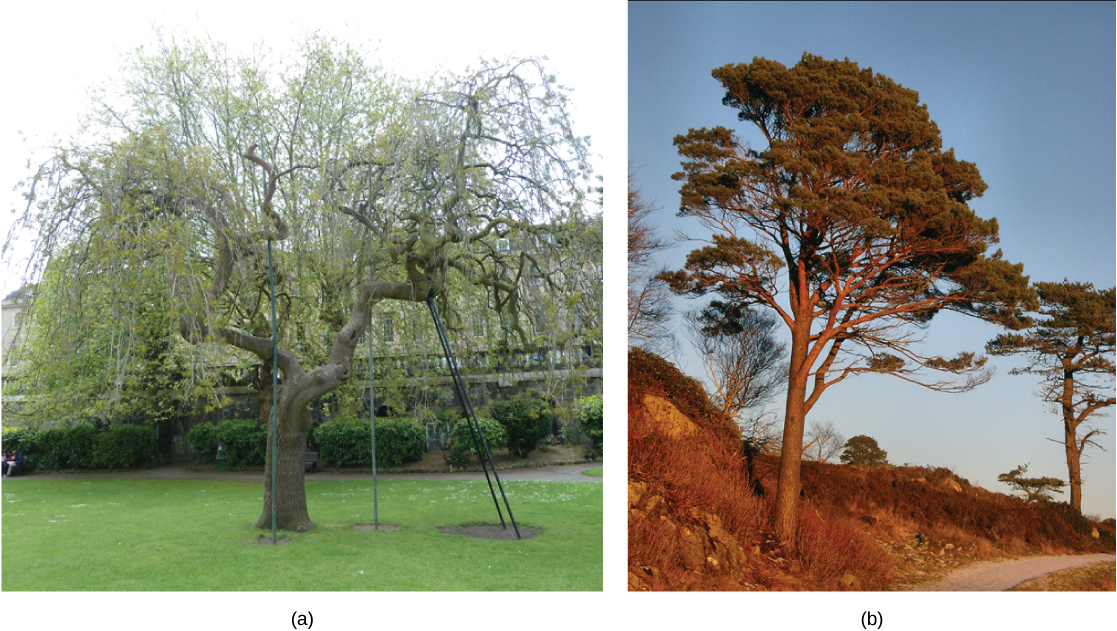
(a) Angiosperms are flowering plants, and include grasses, herbs, shrubs and most deciduous trees, while (b) gymnosperms are conifers. Both produce seeds but have different reproductive strategies. (credit a: modification of work by Wendy Cutler; credit b: modification of work by Lews Castle UHI)
(a)被子植物は花をつける植物で、イネ科植物、草本、低木、大部分の落葉樹が含まれる。一方、(b)裸子植物は針葉樹である。どちらも種子を作るが、生殖戦略は異なる。(クレジットa:Wendy Cutlerの作品を改変;b:Lews Castle UHIの作品を改変)