第32章植物の生殖
Pollination by Wind風による送粉
Most species of conifers, and many angiosperms, such as grasses, maples and oaks, are pollinated by wind. Pine cones are brown and unscented, while the flowers of wind-pollinated angiosperm species are usually green, small, may have small or no petals, and produce large amounts of pollen. Unlike the typical insect-pollinated flowers, flowers adapted to pollination by wind do not produce nectar or scent. In wind-pollinated species, the microsporangia hang out of the flower, and, as the wind blows, the lightweight pollen is carried with it (Figure 32.15). The flowers usually emerge early in the spring, before the leaves, so that the leaves do not block the movement of the wind. The pollen is deposited on the exposed feathery stigma of the flower (Figure 32.16).
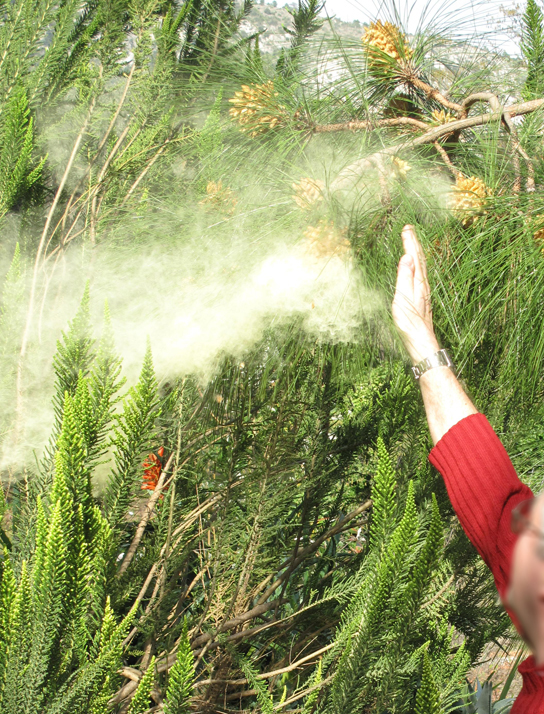
Figure 32.15図 32.15
A person knocks pollen from a pine tree.
マツを揺すって花粉を落とす人。
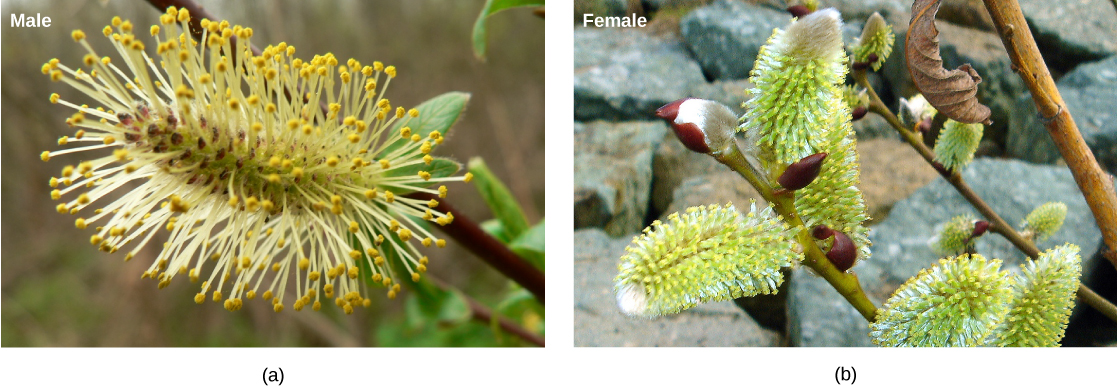
Figure 32.16図 32.16
These male (a) and female (b) catkins are from the goat willow tree (Salix caprea). Note how both structures are light and feathery to better disperse and catch the wind-blown pollen.
バッコヤナギの近縁種ゴートウィロー(Salix caprea)の、(a)雄の尾状花序と(b)雌の尾状花序。風で運ばれる花粉をうまく散布・捕捉できるよう、どちらも軽く羽毛状であることに注目しよう。
Pollination by Water水による送粉
Some weeds, such as Australian sea grass and pond weeds, are pollinated by water. The pollen floats on water, and when it comes into contact with the flower, it is deposited inside the flower.
オーストラリアの海草やヒルムシロ類など、一部の水草は水によって受粉する。花粉は水に浮かび、花に触れると、その中に付着する。
Double Fertilization重複受精
After pollen is deposited on the stigma, it must germinate and grow through the style to reach the ovule. The microspores, or the pollen, contain two cells: the pollen tube cell and the generative cell. The pollen tube cell grows into a pollen tube through which the generative cell travels. The germination of the pollen tube requires water, oxygen, and certain chemical signals. As it travels through the style to reach the embryo sac, the pollen tube’s growth is supported by the tissues of the style. In the meantime, if the generative cell has not already split into two cells, it now divides to form two sperm cells. The pollen tube is guided by the chemicals secreted by the synergids present in the embryo sac, and it enters the ovule sac through the micropyle. Of the two sperm cells, one sperm fertilizes the egg cell, forming a diploid zygote; the other sperm fuses with the two polar nuclei, forming a triploid cell that develops into the endosperm. Together, these two fertilization events in angiosperms are known as double fertilization (Figure 32.18). After fertilization is complete, no other sperm can enter. The fertilized ovule forms the seed, whereas the tissues of the ovary become the fruit, usually enveloping the seed.
柱頭についた花粉は、発芽して花柱を通って伸び、胚珠へ到達しなければならない。小胞子、すなわち花粉には、花粉管細胞と雄原細胞の二つの細胞が含まれる。花粉管細胞が花粉管へ成長し、その中を雄原細胞が移動する。花粉管の発芽には、水、酸素、特定の化学信号が必要である。花柱を通って胚嚢へ向かう間、花粉管の成長は花柱の組織に支えられる。その間に、雄原細胞がまだ二つに分かれていなければ、分裂して2個の精細胞を作る。花粉管は胚嚢内の助細胞が分泌する化学物質に導かれ、珠孔から胚嚢へ入る。2個の精細胞のうち、一つは卵細胞を受精させ、二倍体の接合子を作る。もう一つは二つの極核と融合し、胚乳へ発達する三倍体の細胞を作る。被子植物で起こるこの二つの受精を合わせて、重複受精という(図32.18)。受精が完了すると、ほかの精細胞は入れなくなる。受精した胚珠は種子となり、子房の組織は果実となって、通常は種子を包む。
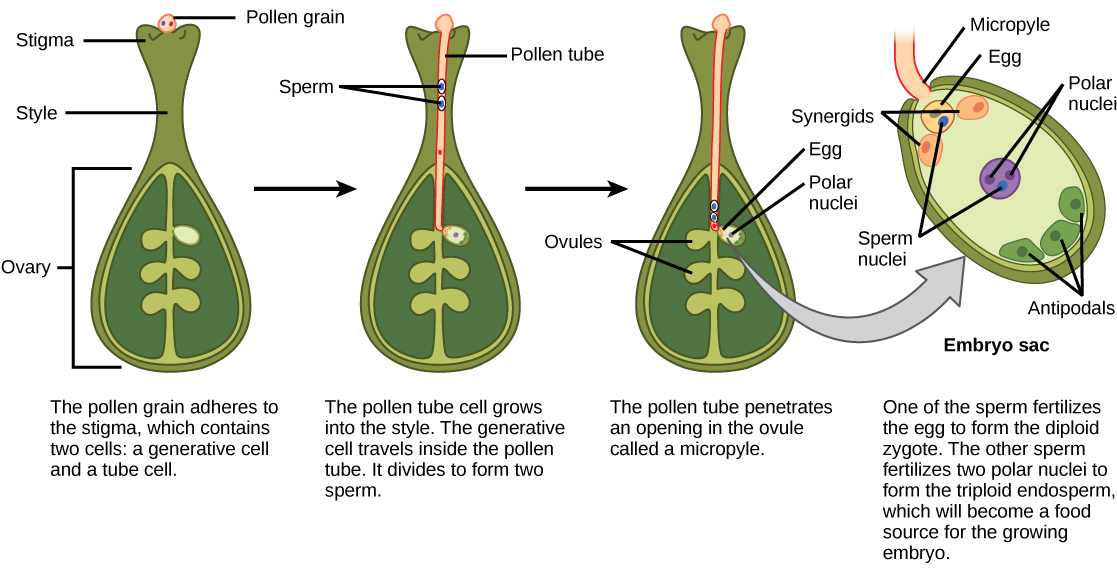


Figure 32.18図 32.18
In angiosperms, one sperm fertilizes the egg to form the 2n zygote, and the other sperm fertilizes the central cell to form the 3n endosperm. This is called a double fertilization.
被子植物では、一つの精細胞が卵を受精させて2nの接合子を作り、もう一つが中央細胞を受精させて3nの胚乳を作る。これを重複受精という。
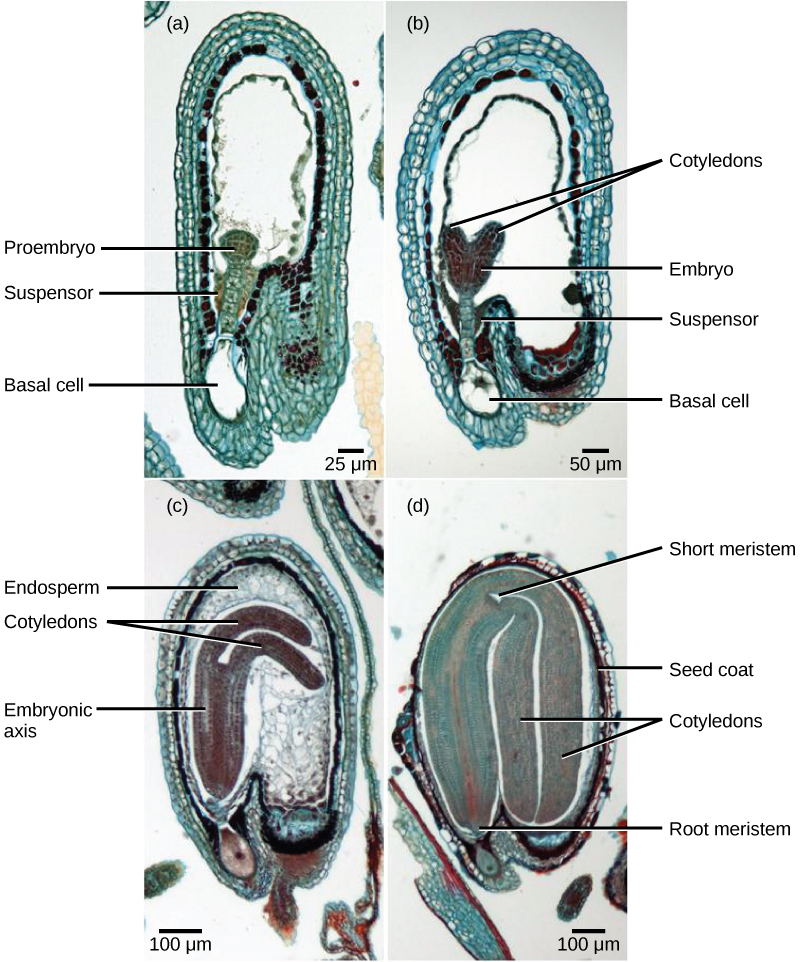
After fertilization, the zygote divides to form two cells: the upper cell, or terminal cell, and the lower, or basal, cell. The division of the basal cell gives rise to the suspensor, which eventually makes connection with the maternal tissue. The suspensor provides a route for nutrition to be transported from the mother plant to the growing embryo. The terminal cell also divides, giving rise to a globular-shaped proembryo (Figure 32.19a). In dicots (eudicots), the developing embryo has a heart shape, due to the presence of the two rudimentary cotyledons (Figure 32.19b). In non-endospermic dicots, such as Capsella bursa, the endosperm develops initially, but is then digested, and the food reserves are moved into the two cotyledons. As the embryo and cotyledons enlarge, they run out of room inside the developing seed, and are forced to bend (Figure 32.19c). Ultimately, the embryo and cotyledons fill the seed (Figure 32.19d), and the seed is ready for dispersal. Embryonic development is suspended after some time, and growth is resumed only when the seed germinates. The developing seedling will rely on the food reserves stored in the cotyledons until the first set of leaves begin photosynthesis.
英語のヒント
受精後、接合子は分裂し、上側の頂端細胞と下側の基部細胞という二つの細胞になる。基部細胞の分裂によって胚柄が生じ、やがて母体組織とつながる。胚柄は、母植物から成長中の胚へ栄養分を運ぶ経路となる。頂端細胞も分裂し、球状の前胚を生じる(図32.19a)。双子葉植物(真正双子葉植物)では、二つの未発達な子葉が現れるため、発達中の胚はハート形になる(図32.19b)。ナズナ(Capsella bursa)のような無胚乳の双子葉植物では、胚乳は最初に発達するものの、その後に消化され、貯蔵養分は二つの子葉へ移される。胚と子葉が大きくなると、発達中の種子の中で場所が足りなくなり、曲がらざるを得なくなる(図32.19c)。最終的に胚と子葉が種子の中を満たし(図32.19d)、種子は散布の準備が整う。胚発生はしばらくすると中断され、種子が発芽したときにだけ成長が再開する。発達する実生は、最初の葉が光合成を始めるまで、子葉に蓄えられた養分に頼る。
OpenStax, Rice University; Biology 2e. (credit: modification of work by Robert R. Wise; scale-bar data from Matt Russell) · CC BY 4.0 · Source出典

Figure 32.19図 32.19
Shown are the stages of embryo development in the ovule of a shepherd’s purse (Capsella bursa). After fertilization, the zygote divides to form an upper terminal cell and a lower basal cell. (a) In the first stage of development, the terminal cell divides, forming a globular pro-embryo. The basal cell also divides, giving rise to the suspensor. (b) In the second stage, the developing embryo has a heart shape due to the presence of cotyledons. (c) In the third stage, the growing embryo runs out of room and starts to bend. (d) Eventually, it completely fills the seed. (credit: modification of work by Robert R. Wise; scale-bar data from Matt Russell)
ナズナ(Capsella bursa)の胚珠内における胚発生の各段階。受精後、接合子は分裂し、上側の頂端細胞と下側の基部細胞になる。(a)第1段階では、頂端細胞が分裂して球状の前胚を作る。基部細胞も分裂して胚柄を作る。(b)第2段階では、子葉が現れるため、胚がハート形になる。(c)第3段階では、成長する胚の場所が足りなくなり、曲がり始める。(d)最終的に、胚が種子の中を完全に満たす。(クレジット:Robert R. Wiseの作品を改変;スケールバーのデータ:Matt Russell)