第32章植物の生殖
Development of the Seed種子の発達
The mature ovule develops into the seed. A typical seed contains a seed coat, cotyledons, endosperm, and a single embryo (Figure 32.20).
成熟した胚珠は種子へ発達する。典型的な種子には、種皮、子葉、胚乳、一つの胚が含まれる(図32.20)。
The storage of food reserves in angiosperm seeds differs between monocots and dicots. In monocots, such as corn and wheat, the single cotyledon is called a scutellum; the scutellum is connected directly to the embryo via vascular tissue (xylem and phloem). Food reserves are stored in the large endosperm. Upon germination, enzymes are secreted by the aleurone, a single layer of cells just inside the seed coat that surrounds the endosperm and embryo. The enzymes degrade the stored carbohydrates, proteins and lipids, the products of which are absorbed by the scutellum and transported via a vasculature strand to the developing embryo. Therefore, the scutellum can be seen to be an absorptive organ, not a storage organ.
英語のヒント
被子植物の種子における養分の貯蔵方法は、単子葉植物と双子葉植物で異なる。トウモロコシやコムギのような単子葉植物では、一つの子葉を胚盤といい、維管束組織(木部と師部)を介して胚に直接つながっている。養分は大きな胚乳に蓄えられる。発芽すると、種皮のすぐ内側で胚乳と胚を囲む単層の細胞層、アリューロン層から酵素が分泌される。酵素は蓄えられた炭水化物、タンパク質、脂質を分解し、その生成物は胚盤に吸収され、維管束を通って発達中の胚へ運ばれる。したがって胚盤は、貯蔵器官ではなく吸収器官だと分かる。
The two cotyledons in the dicot seed also have vascular connections to the embryo. In endospermic dicots, the food reserves are stored in the endosperm. During germination, the two cotyledons therefore act as absorptive organs to take up the enzymatically released food reserves, much like in monocots (monocots, by definition, also have endospermic seeds). Tobacco (Nicotiana tabaccum), tomato (Solanum lycopersicum), and pepper (Capsicum annuum) are examples of endospermic dicots. In non-endospermic dicots, the triploid endosperm develops normally following double fertilization, but the endosperm food reserves are quickly remobilized and moved into the developing cotyledon for storage. The two halves of a peanut seed (Arachis hypogaea) and the split peas (Pisum sativum) of split pea soup are individual cotyledons loaded with food reserves.
双子葉植物の種子の二つの子葉も、維管束によって胚につながっている。有胚乳の双子葉植物では、養分は胚乳に蓄えられる。そのため発芽時には、単子葉植物と同じように、二つの子葉が吸収器官として働き、酵素によって放出された貯蔵養分を取り込む。なお、単子葉植物も定義上、有胚乳種子をもつ。タバコ(Nicotiana tabaccum)、トマト(Solanum lycopersicum)、トウガラシ(Capsicum annuum)は、有胚乳の双子葉植物の例である。無胚乳の双子葉植物では、重複受精後に三倍体の胚乳が正常に発達するが、その貯蔵養分はすぐに再動員され、発達中の子葉へ移って蓄えられる。ラッカセイ(Arachis hypogaea)の種子の二つの半分や、スプリットピー・スープに使う半割りのエンドウ(Pisum sativum)は、それぞれ貯蔵養分をたっぷり含む子葉である。
The seed, along with the ovule, is protected by a seed coat that is formed from the integuments of the ovule sac. In dicots, the seed coat is further divided into an outer coat known as the testa and inner coat known as the tegmen.
種子は胚珠とともに、胚嚢の珠皮から形成される種皮によって保護される。双子葉植物では、種皮はさらに、外種皮という外側の層と、内種皮という内側の層に分かれる。
The embryonic axis consists of three parts: the plumule, the radicle, and the hypocotyl. The portion of the embryo between the cotyledon attachment point and the radicle is known as the hypocotyl (hypocotyl means “below the cotyledons”). The embryonic axis terminates in a radicle (the embryonic root), which is the region from which the root will develop. In dicots, the hypocotyls extend above ground, giving rise to the stem of the plant. In monocots, the hypocotyl does not show above ground because monocots do not exhibit stem elongation. The part of the embryonic axis that projects above the cotyledons is known as the epicotyl. The plumule is composed of the epicotyl, young leaves, and the shoot apical meristem.
胚軸は、幼芽、幼根、下胚軸の三つの部分からなる。子葉の付着点と幼根の間にある胚の部分を、下胚軸という。hypocotylは「子葉の下」を意味する。胚軸の先端は、胚の根である幼根となり、そこから根が発達する。双子葉植物では、下胚軸が地上へ伸びて植物の茎となる。単子葉植物では茎の伸長が起こらないため、下胚軸は地上に現れない。胚軸のうち、子葉より上へ突き出した部分を上胚軸という。幼芽は、上胚軸、若い葉、シュート頂端分裂組織からなる。
Upon germination in dicot seeds, the epicotyl is shaped like a hook with the plumule pointing downwards. This shape is called the plumule hook, and it persists as long as germination proceeds in the dark. Therefore, as the epicotyl pushes through the tough and abrasive soil, the plumule is protected from damage. Upon exposure to light, the hypocotyl hook straightens out, the young foliage leaves face the sun and expand, and the epicotyl continues to elongate. During this time, the radicle is also growing and producing the primary root. As it grows downward to form the tap root, lateral roots branch off to all sides, producing the typical dicot tap root system.
双子葉植物の種子が発芽すると、上胚軸は鉤形になり、幼芽は下を向く。この形を幼芽フックといい、暗所で発芽が進む間は維持される。そのため、上胚軸が硬くこすれやすい土を押し分ける際にも、幼芽は損傷から守られる。光を受けると下胚軸のフックがまっすぐになり、若い普通葉は太陽のほうを向いて広がり、上胚軸はさらに伸長する。この間、幼根も成長して主根を作る。下向きに伸びて直根となるにつれ、側根が四方へ枝分かれし、双子葉植物に典型的な主根系ができる。
In monocot seeds (Figure 32.21), the testa and tegmen of the seed coat are fused. As the seed germinates, the primary root emerges, protected by the root-tip covering: the coleorhiza. Next, the primary shoot emerges, protected by the coleoptile: the covering of the shoot tip. Upon exposure to light (i.e., when the plumule has exited the soil and the protective coleoptile is no longer needed), elongation of the coleoptile ceases and the leaves expand and unfold. At the other end of the embryonic axis, the primary root soon dies, while other, adventitious roots (roots that do not arise from the usual place – i.e., the root) emerge from the base of the stem. This gives the monocot a fibrous root system.
単子葉植物の種子(図32.21)では、外種皮と内種皮が融合している。種子が発芽すると、まず根端を覆う根鞘に保護された主根が現れる。次に、シュートの先端を覆う子葉鞘に保護された最初のシュートが現れる。光を受けると、つまり幼芽が土から出て保護用の子葉鞘が不要になると、子葉鞘の伸長が止まり、葉が大きくなって開く。胚軸の反対側では主根がほどなく枯れ、茎の基部から別の不定根が現れる。不定根とは、通常の場所、つまり根から生じるのではない根のことである。こうして単子葉植物のひげ根系ができる。
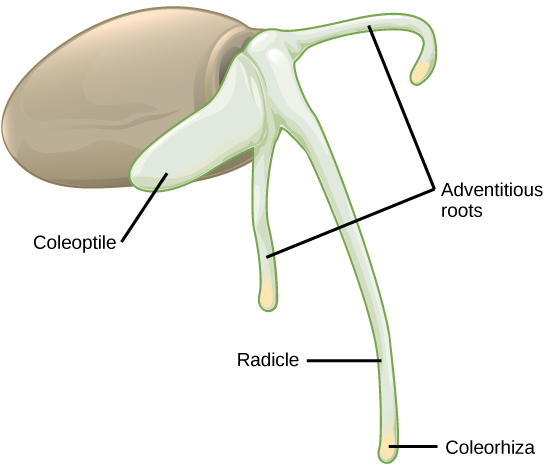

Figure 32.21図 32.21
As this monocot grass seed germinates, the primary root, or radicle, emerges first, followed by the primary shoot, or coleoptile, and the adventitious roots.
単子葉植物であるこのイネ科植物の種子が発芽すると、まず主根、すなわち幼根が現れ、続いて最初のシュート、すなわち子葉鞘と、不定根が現れる。