第32章植物の生殖
32.1 Reproductive Development and Structure32.1 生殖に関わる発生と構造
Learning Objectives学習目標
By the end of this section, you will be able to do the following:
この節を学ぶと、次のことができるようになる。
- Describe the two stages of a plant’s lifecycle植物の生活環の二つの段階を説明する。
- Compare and contrast male and female gametophytes and explain how they form in angiosperms雄性配偶体と雌性配偶体の共通点と相違点を比較し、被子植物でそれぞれが形成される仕組みを説明する。
- Describe the reproductive structures of a plant植物の生殖構造を説明する。
- Describe the components of a complete flower完全花の構成要素を説明する。
- Describe the development of microsporangium and megasporangium in gymnosperms裸子植物における小胞子嚢と大胞子嚢の発達を説明する。
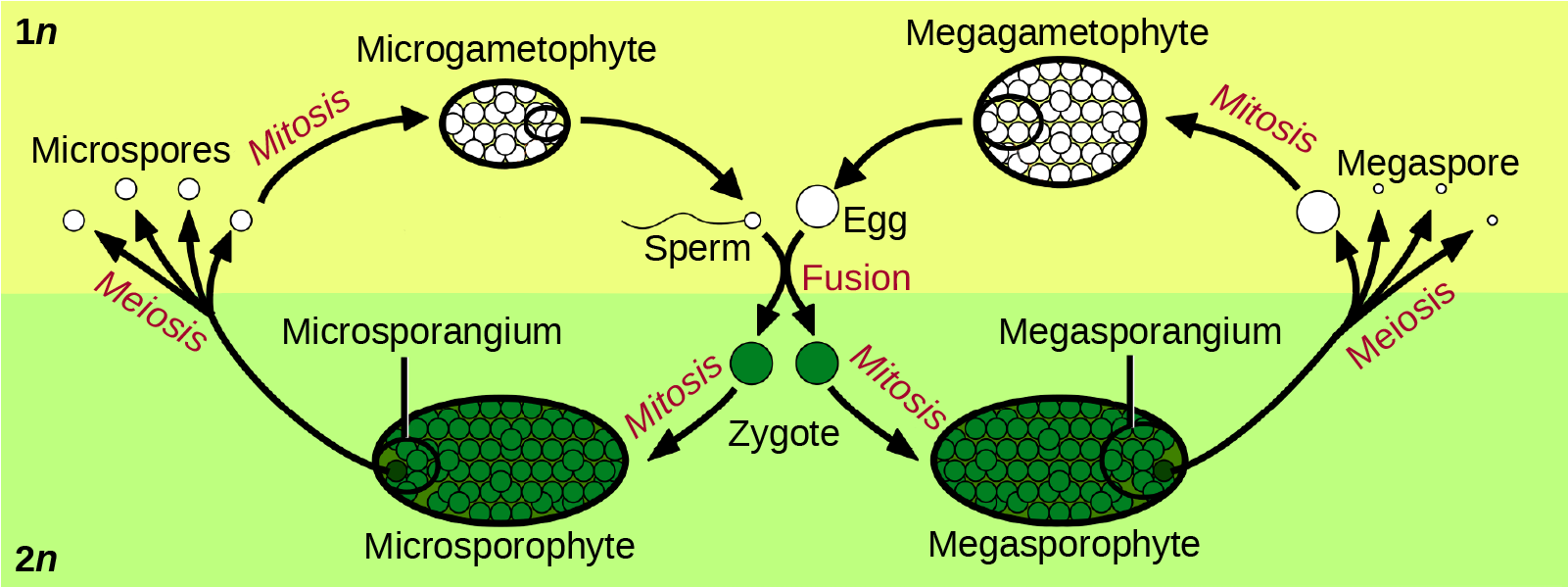
Sexual reproduction takes place with slight variations in different groups of plants. Plants have two distinct stages in their lifecycle: the gametophyte stage and the sporophyte stage. The haploid gametophyte produces the male and female gametes by mitosis in distinct multicellular structures. Fusion of the male and females gametes forms the diploid zygote, which develops into the sporophyte. After reaching maturity, the diploid sporophyte produces spores by meiosis, which in turn divide by mitosis to produce the haploid gametophyte. The new gametophyte produces gametes, and the cycle continues. This is the alternation of generations, and is typical of plant reproduction (Figure 32.2).
英語のヒント
有性生殖のあり方は、植物の群によって少しずつ異なる。植物の生活環には、配偶体世代と胞子体世代という二つの明瞭な段階がある。半数体の配偶体は、別々の多細胞構造の中で、有糸分裂によって雄と雌の配偶子を作る。雄と雌の配偶子が融合すると二倍体の接合子ができ、これが胞子体へ発達する。成熟した二倍体の胞子体は、減数分裂によって胞子を作る。胞子は今度は有糸分裂で分裂し、半数体の配偶体を作る。新しい配偶体が配偶子を作り、この周期が続く。これが世代交代であり、植物の生殖に典型的な特徴である(図32.2)。
OpenStax, Rice University; Biology 2e. (credit: modification of work by Peter Coxhead) · CC BY 4.0 · Source出典
Figure 32.2図 32.2
The alternation of generations in angiosperms is depicted in this diagram. (credit: modification of work by Peter Coxhead)
被子植物の世代交代を示した図。(クレジット:Peter Coxheadの作品を改変)
The life cycle of higher plants is dominated by the sporophyte stage, with the gametophyte borne on the sporophyte. In ferns, the gametophyte is free-living and very distinct in structure from the diploid sporophyte. In bryophytes, such as mosses, the haploid gametophyte is more developed than the sporophyte.
高等植物の生活環では胞子体世代が優勢であり、配偶体は胞子体上に形成される。シダ植物では配偶体が独立して生活し、二倍体の胞子体とは構造が大きく異なる。蘚類などのコケ植物では、半数体の配偶体のほうが胞子体よりよく発達している。
During the vegetative phase of growth, plants increase in size and produce a shoot system and a root system. As they enter the reproductive phase, some of the branches start to bear flowers. Many flowers are borne singly, whereas some are borne in clusters. The flower is borne on a stalk known as a receptacle. Flower shape, color, and size are unique to each species, and are often used by taxonomists to classify plants.
英語のヒント
栄養成長期には、植物は大きくなり、シュート系と根系を作る。生殖成長期に入ると、一部の枝が花をつけ始める。多くの花は単独でつくが、集まってつくものもある。花は花床と呼ばれる柄の上につく。花の形、色、大きさは種ごとに特徴があり、分類学者が植物を分類する際によく用いられる。
Sexual Reproduction in Angiosperms被子植物の有性生殖
The lifecycle of angiosperms follows the alternation of generations explained previously. The haploid gametophyte alternates with the diploid sporophyte during the sexual reproduction process of angiosperms. Flowers contain the plant’s reproductive structures.
被子植物の生活環は、前述した世代交代に従う。有性生殖の過程では、半数体の配偶体と二倍体の胞子体が交互に現れる。植物の生殖構造は花に含まれる。
Flower Structure花の構造
A typical flower has four main parts—or whorls—known as the calyx, corolla, androecium, and gynoecium (Figure 32.3). The outermost whorl of the flower has green, leafy structures known as sepals. The sepals, collectively called the calyx, help to protect the unopened bud. The second whorl is comprised of petals—usually, brightly colored—collectively called the corolla. The number of sepals and petals varies depending on whether the plant is a monocot or dicot. In monocots, petals usually number three or multiples of three; in dicots, the number of petals is four or five, or multiples of four and five. Together, the calyx and corolla are known as the perianth. The third whorl contains the male reproductive structures and is known as the androecium. The androecium has stamens with anthers that contain the microsporangia. The innermost group of structures in the flower is the gynoecium, or the female reproductive component(s). The carpel is the individual unit of the gynoecium and has a stigma, style, and ovary. A flower may have one or multiple carpels.
英語のヒント
典型的な花には、萼、花冠、雄ずい群、雌ずい群という四つの主要な部分、すなわち輪生する器官群がある(図32.3)。いちばん外側の器官群には、萼片と呼ばれる緑色の葉状構造がある。萼片をまとめて萼と呼び、開く前のつぼみを保護する。2番目の器官群は、通常は鮮やかな色をした花弁からなり、それらをまとめて花冠という。萼片と花弁の数は、単子葉植物か双子葉植物かによって異なる。単子葉植物では、花弁は通常3枚か3の倍数であり、双子葉植物では4枚か5枚、または4や5の倍数になる。萼と花冠を合わせて花被という。3番目の器官群には雄の生殖構造が含まれ、雄ずい群と呼ばれる。雄ずい群を構成する雄しべには葯があり、その中に小胞子嚢がある。もっとも内側の器官群は、雌の生殖構造である雌ずい群である。心皮は雌ずい群を構成する一つ一つの単位であり、柱頭、花柱、子房をもつ。一つの花に、心皮が一つの場合も複数の場合もある。
If all four whorls (the calyx, corolla, androecium, and gynoecium) are present, the flower is described as complete. If any of the four parts is missing, the flower is known as incomplete. Flowers that contain both an androecium and a gynoecium are called perfect, androgynous or hermaphrodites. There are two types of incomplete flowers: staminate flowers contain only an androecium, and carpellate flowers have only a gynoecium (Figure 32.4).
四つの器官群(萼、花冠、雄ずい群、雌ずい群)がすべてそろった花を完全花という。四つの部分のどれかが欠けていれば、不完全花という。雄ずい群と雌ずい群の両方を含む花は、両性花、雌雄性の花、または雌雄同体の花と呼ばれる。不完全花には二つの型がある。雄花は雄ずい群だけをもち、雌花は雌ずい群だけをもつ(図32.4)。
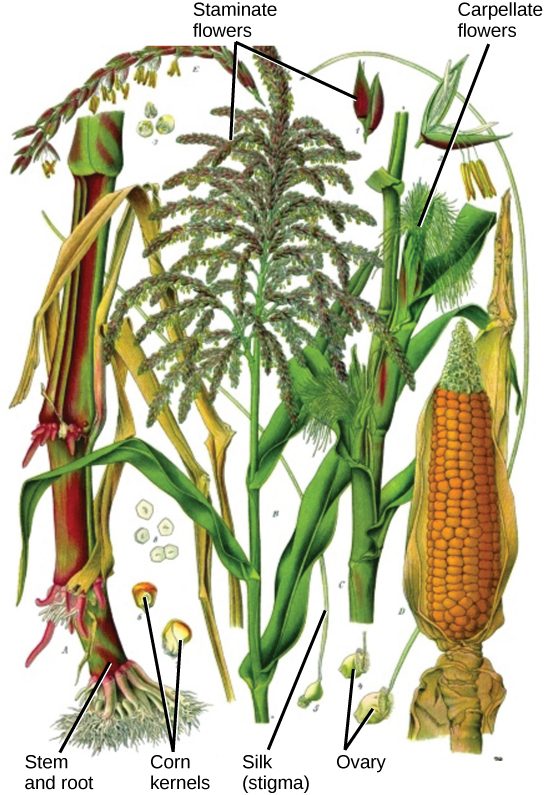


Figure 32.4図 32.4
The corn plant has both staminate (male) and carpellate (female) flowers. Staminate flowers, which are clustered in the tassel at the tip of the stem, produce pollen grains. Carpellate flowers are clustered in the immature ears. Each strand of silk is a stigma. The corn kernels are seeds that develop on the ear after fertilization. Also shown is the lower stem and root.
トウモロコシには、雄花と雌花の両方がある。茎の先の雄穂に集まる雄花は、花粉粒を作る。雌花は未成熟な雌穂に集まっている。ひげの一本一本が柱頭である。トウモロコシの粒は、受精後に穂の上で発達する種子である。茎の下部と根も示している。
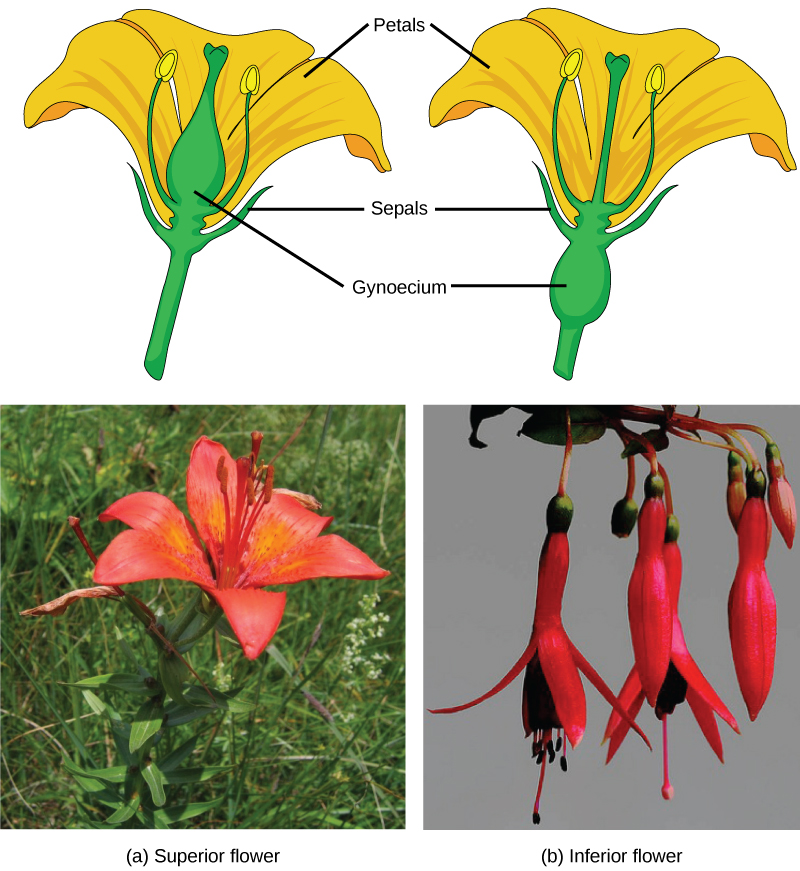
If both male and female flowers are borne on the same plant, the species is called monoecious (meaning “one home”): examples are corn and pea. Species with male and female flowers borne on separate plants are termed dioecious, or “two homes,” examples of which are C. papaya and Cannabis. The ovary, which may contain one or multiple ovules, may be placed above other flower parts, which is referred to as superior; or, it may be placed below the other flower parts, referred to as inferior (Figure 32.5).
英語のヒント
雄花と雌花が同じ個体につく種を雌雄同株という。英語の monoecious は「一つの家」を意味し、トウモロコシやエンドウがその例である。雄花と雌花が別々の個体につく種は雌雄異株と呼ばれる。dioecious は「二つの家」を意味し、パパイア(C. papaya)やアサが例として挙げられる。一つ以上の胚珠を含む子房は、ほかの花の部分より上に位置することがあり、これを子房上位という。下に位置する場合は子房下位という(図32.5)。
OpenStax, Rice University; Biology 2e. (credit a photo: modification of work by Benjamin Zwittnig; credit b photo: modification of work by "Koshy Koshy"/Flickr) · CC BY 4.0 · Source出典

Figure 32.5図 32.5
The (a) lily is a superior flower, which has the ovary above the other flower parts. (b) Fuchsia is an inferior flower, which has the ovary beneath other flower parts. (credit a photo: modification of work by Benjamin Zwittnig; credit b photo: modification of work by "Koshy Koshy"/Flickr)
(a)ユリは子房上位の花で、子房がほかの花の部分より上にある。(b)フクシアは子房下位の花で、子房がほかの部分より下にある。(写真クレジットa:Benjamin Zwittnigの作品を改変;b:"Koshy Koshy"/Flickrの作品を改変)