第2章生命の化学的基盤
2.3 Carbon2.3 炭素
Learning Objectives学習目標
By the end of this section, you will be able to do the following:
この節を学び終えると、次のことができるようになる。
- Explain why carbon is important for life炭素が生命にとって重要な理由を説明する。
- Describe the role of functional groups in biological molecules生体分子における官能基の役割を説明する。
Many complex molecules called macromolecules, such as proteins, nucleic acids (RNA and DNA), carbohydrates, and lipids comprise cells. The macromolecules are a subset of organic molecules (any carbon-containing liquid, solid, or gas) that are especially important for life. The fundamental component for all of these macromolecules is carbon. The carbon atom has unique properties that allow it to form covalent bonds to as many as four different atoms, making this versatile element ideal to serve as the basic structural component, or “backbone,” of the macromolecules.
英語のヒント
細胞は、高分子と呼ばれる多くの複雑な分子からできている。例えば、タンパク質、核酸(RNAとDNA)、炭水化物、脂質などである。高分子は有機分子(炭素を含む液体、固体、気体)の一部であり、生命にとって特に重要である。これらすべての高分子の基本となる構成元素は炭素である。炭素原子は、最大で四つの異なる原子と共有結合を作れるという独特の性質を持つ。この多様な働きができる元素は、高分子の基本的な構造をなす成分、すなわち「骨格」として理想的である。
Individual carbon atoms have an incomplete outermost electron shell. With an atomic number of 6 (six electrons and six protons), the first two electrons fill the inner shell, leaving four in the second shell. Therefore, carbon atoms can form up to four covalent bonds with other atoms to satisfy the octet rule. The methane molecule provides an example: it has the chemical formula CH4. Each of its four hydrogen atoms forms a single covalent bond with the carbon atom by sharing a pair of electrons. This results in a filled outermost shell.
英語のヒント
単独の炭素原子では、最外電子殻が満たされていない。原子番号は6で、電子六つと陽子六つを持つ。初めの二つの電子が内側の殻を満たし、残る四つが第2殻に入る。したがって、炭素原子はオクテット則を満たすために、ほかの原子と最大四つの共有結合を作れる。例として、化学式CH4で表されるメタン分子がある。四つの水素原子は、それぞれ電子対を共有することで、炭素原子と一つの共有単結合を形成する。この結果、最外殻が満たされる。
Hydrocarbons炭化水素
Hydrocarbons are organic molecules consisting entirely of carbon and hydrogen, such as methane (CH4) described above. We often use hydrocarbons in our daily lives as fuels—like the propane in a gas grill or the butane in a lighter. The many covalent bonds between the atoms in hydrocarbons store a great amount of energy, which releases when these molecules burn (oxidize). Methane, an excellent fuel, is the simplest hydrocarbon molecule, with a central carbon atom bonded to four different hydrogen atoms, as Figure 2.21 illustrates. The shape of its electron orbitals determines the shape of the methane molecule's geometry, where the atoms reside in three dimensions. The carbons and the four hydrogen atoms form a tetrahedron, with four triangular faces. For this reason, we describe methane as having tetrahedral geometry.
英語のヒント
炭化水素とは、上に述べたメタン(CH4)のように、炭素と水素だけでできた有機分子である。私たちは日常生活で、ガスグリルのプロパンやライターのブタンのように、炭化水素を燃料としてよく使う。炭化水素中の原子間にある多数の共有結合は、多量のエネルギーを蓄えており、分子が燃焼(酸化)するときにそれを放出する。優れた燃料であるメタンは最も単純な炭化水素分子で、図2.21に示すように、中心の炭素原子に四つの水素原子が結合している。電子軌道の形が、原子の三次元的な位置関係であるメタン分子の幾何学的な形を決める。炭素原子と四つの水素原子は、四つの三角形の面を持つ四面体を形作る。そのため、メタンは四面体形の分子構造を持つと表現する。
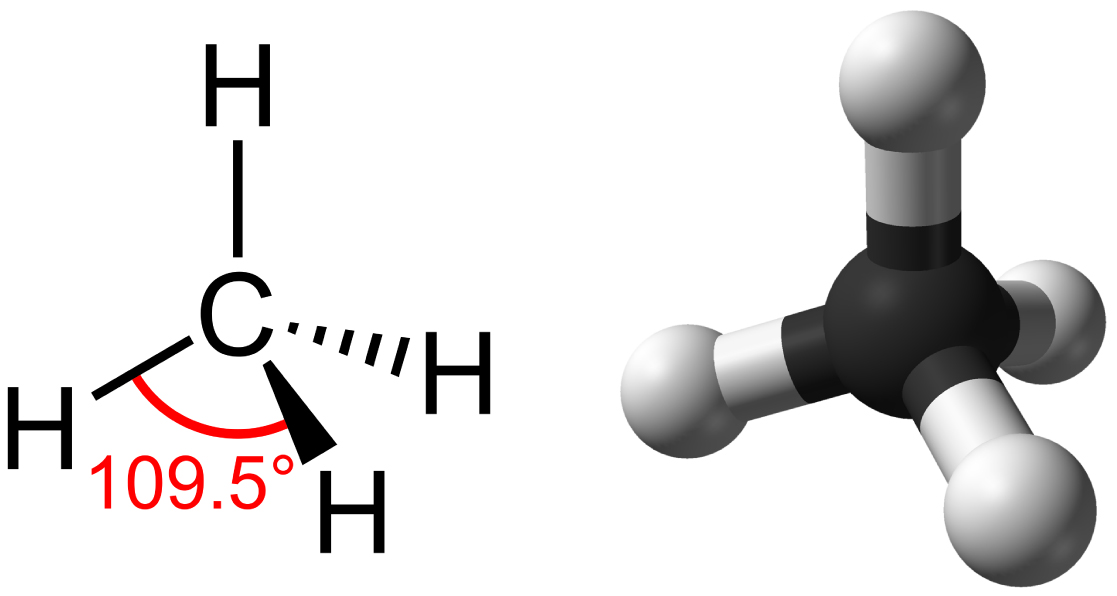
Figure 2.21図 2.21
Methane has a tetrahedral geometry, with each of the four hydrogen atoms spaced 109.5° apart.
メタンは四面体形の構造を持ち、四つの水素原子は互いに109.5°の角度を隔てて位置する。
As the backbone of the large molecules of living things, hydrocarbons may exist as linear carbon chains, carbon rings, or combinations of both. Furthermore, individual carbon-to-carbon bonds may be single, double, or triple covalent bonds, and each type of bond affects the molecule's geometry in a specific way. This three-dimensional shape or conformation of the large molecules of life (macromolecules) is critical to how they function.
英語のヒント
生物の大きな分子の骨格となる炭化水素は、炭素が直鎖状に並んだ形、環状に並んだ形、またはその両方を組み合わせた形で存在する。さらに、個々の炭素間結合は共有単結合、二重結合、三重結合のいずれかであり、各結合は特有の仕方で分子の形に影響する。生命を構成する大きな分子、すなわち高分子のこうした三次元の形や立体配座は、その働き方にとって極めて重要である。
Hydrocarbon Chains炭化水素鎖
Successive bonds between carbon atoms form hydrocarbon chains. These may be branched or unbranched. Furthermore, a molecule's different geometries of single, double, and triple covalent bonds alter the overall molecule's geometry as Figure 2.22 illustrates. The hydrocarbons ethane, ethene, and ethyne serve as examples of how different carbon-to-carbon bonds affect the molecule's geometry. The names of all three molecules start with the prefix “eth-,” which is the prefix for two carbon hydrocarbons. The suffixes “-ane,” “-ene,” and “-yne” refer to the presence of single, double, or triple carbon-carbon bonds, respectively. Thus, propane, propene, and propyne follow the same pattern with three carbon molecules, butane, butene, and butyne for four carbon molecules, and so on. Double and triple bonds change the molecule's geometry: single bonds allow rotation along the bond's axis; whereas, double bonds lead to a planar configuration and triple bonds to a linear one. These geometries have a significant impact on the shape a particular molecule can assume.
英語のヒント
炭素原子が次々と結合して炭化水素鎖を作る。この鎖には、枝分かれしたものと枝分かれしていないものがある。また、図2.22に示すように、共有単結合、二重結合、三重結合の形の違いが、分子全体の形を変える。炭化水素であるエタン、エテン、エチンは、炭素間結合の違いが分子の形にどう影響するかを示す例である。この三つの英語名はいずれも、炭素二つの炭化水素を表す接頭辞「eth-」で始まる。接尾辞「-ane」「-ene」「-yne」は、それぞれ炭素間の単結合、二重結合、三重結合の存在を示す。炭素三つの分子であるpropane(プロパン)、propene(プロペン)、propyne(プロピン)も同じパターンであり、炭素四つならbutane(ブタン)、butene(ブテン)、butyne(ブチン)となる。二重結合と三重結合は分子の形を変える。単結合では結合軸の周りに回転できるが、二重結合は平面形、三重結合は直線形の配置をもたらす。このような結合の形は、それぞれの分子が取りうる形状に大きく影響する。
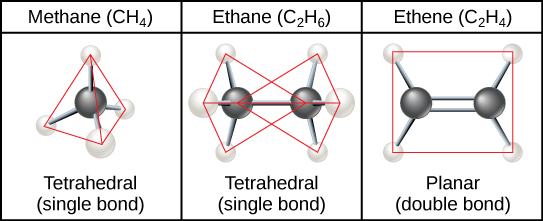
Figure 2.22図 2.22
When carbon forms single bonds with other atoms, the shape is tetrahedral. When two carbon atoms form a double bond, the shape is planar, or flat. Single bonds, like those in ethane, are able to rotate. Double bonds, like those in ethene, cannot rotate, so the atoms on either side are locked in place.
炭素がほかの原子と単結合を作る場合、その形は四面体形になる。二つの炭素原子が二重結合を作る場合、その形は平面形、つまり平らになる。エタンにあるような単結合は回転できる。エテンにあるような二重結合は回転できないので、その両側の原子は位置が固定される。
Hydrocarbon Rings炭化水素の環
So far, the hydrocarbons we have discussed have been aliphatic hydrocarbons, which consist of linear chains of carbon atoms, and sometimes they can form rings with all single bonds, as shown in Figure 2.23 in the examples of cyclopentane and cyclohexane. Another type of hydrocarbon, aromatic hydrocarbons, consists of closed rings of carbon atoms with alternating single and double bonds. We find ring structures in aliphatic hydrocarbons, containing only single bonds between carbons, like the cyclohexane's structure (aliphatic) compared to a ring structure of benzene (aromatic) with alternating single and double bonds in the ring in Figure 2.23. Examples of biological molecules that incorporate the benzene ring include some amino acids and cholesterol and its derivatives, including the hormones estrogen and testosterone. We also find the benzene ring in the herbicide 2,4-D. Benzene is a natural component of crude oil and has been classified as a carcinogen. Some hydrocarbons have both aliphatic and aromatic portions. Beta-carotene is an example of such a hydrocarbon.
英語のヒント
ここまで扱ったのは脂肪族炭化水素であり、炭素原子が直鎖状につながったものである。図2.23のシクロペンタンやシクロヘキサンの例のように、すべて単結合からなる環を形成することもある。別の種類である芳香族炭化水素は、単結合と二重結合が交互に並んだ、炭素原子の閉じた環からなる。脂肪族炭化水素にも環状構造が見られ、炭素間には単結合しかない。図2.23では、脂肪族のシクロヘキサンの構造と、環の中に単結合と二重結合が交互に並ぶ芳香族のベンゼンの構造を比較できる。ベンゼン環を含む生体分子の例には、一部のアミノ酸、コレステロール、およびエストロゲンやテストステロンといったホルモンを含むその誘導体がある。除草剤2,4-Dにもベンゼン環がある。ベンゼンは原油の天然成分であり、発がん性物質に分類されている。脂肪族の部分と芳香族の部分を両方持つ炭化水素もある。β-カロテンはその一例である。
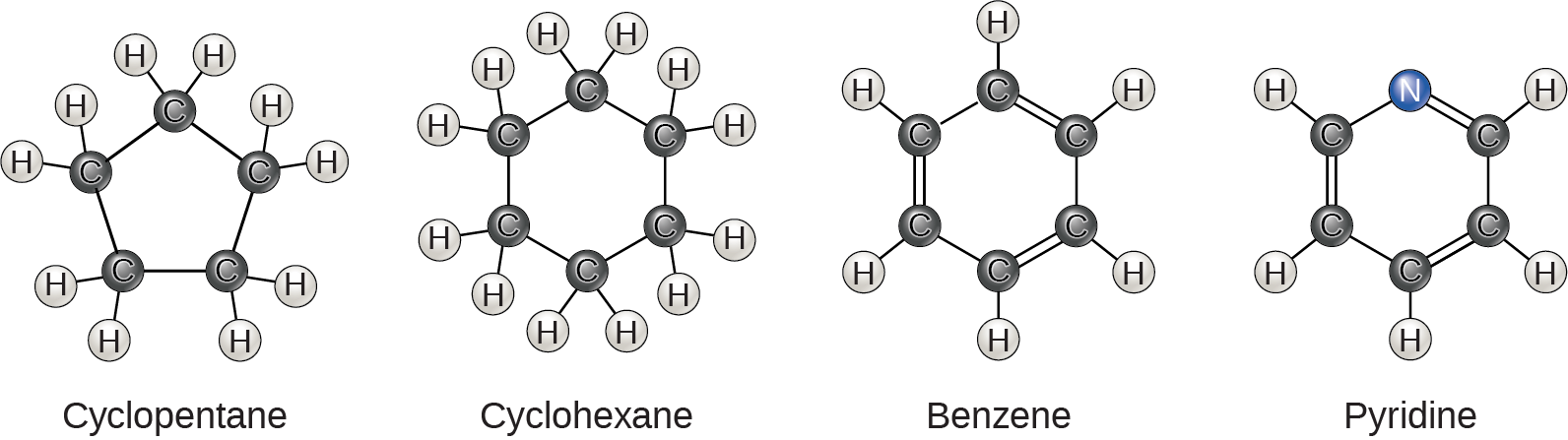


Figure 2.23図 2.23
Carbon can form five- and six-membered rings. Single or double bonds may connect the carbons in the ring, and nitrogen may be substituted for carbon.
炭素は五員環や六員環を形成できる。環の炭素同士は単結合または二重結合でつながり、炭素の代わりに窒素が入ることもある。