第2章生命の化学的基盤
Polar Covalent Bonds極性共有結合
There are two types of covalent bonds: polar and nonpolar. In a polar covalent bond, Figure 2.12 shows atoms unequally share the electrons as the electrons are attracted more to one nucleus than the other. Because of the unequal electron distribution between the atoms of different elements, a slightly positive (δ+) or slightly negative (δ–) charge develops. This partial charge is an important property of water and accounts for many of its characteristics.
英語のヒント
共有結合には、極性共有結合と無極性共有結合の二種類がある。図2.12に示すように、極性共有結合では電子が一方の原子核により強く引き付けられるため、原子同士は電子を不均等に共有する。異なる元素の原子間で電子分布が偏ることで、わずかな正の電荷(δ+)または負の電荷(δ−)が生じる。この部分電荷は水の重要な性質であり、水の多くの特徴の原因となっている。
Water is a polar molecule, with the hydrogen atoms acquiring a partial positive charge and the oxygen a partial negative charge. This occurs because the oxygen atom's nucleus is more attractive to the hydrogen atoms' electrons than the hydrogen nucleus is to the oxygen’s electrons. Thus, oxygen has a higher electronegativity than hydrogen and the shared electrons spend more time near the oxygen nucleus than the hydrogen atoms' nucleus, giving the oxygen and hydrogen atoms slightly negative and positive charges, respectively. Another way of stating this is that the probability of finding a shared electron near an oxygen nucleus is more likely than finding it near a hydrogen nucleus. Either way, the atom’s relative electronegativity contributes to developing partial charges whenever one element is significantly more electronegative than the other, and the charges that these polar bonds generate may then be used to form hydrogen bonds based on the attraction of opposite partial charges. (Hydrogen bonds, which we discuss in detail below, are weak bonds between slightly positively charged hydrogen atoms to slightly negatively charged atoms in other molecules.) Since macromolecules often have atoms within them that differ in electronegativity, polar bonds are often present in organic molecules.
英語のヒント
水は極性分子であり、水素原子は部分的に正の電荷を、酸素原子は部分的に負の電荷を帯びる。これは、酸素原子の原子核が水素原子の電子を引く力の方が、水素原子の原子核が酸素の電子を引く力よりも強いために起こる。したがって酸素は水素より電気陰性度が高く、共有された電子は水素の原子核の近くよりも酸素の原子核の近くで多くの時間を過ごす。その結果、酸素原子はわずかに負に、水素原子はわずかに正に帯電する。別の言い方をすると、共有電子が見つかる確率は、水素の原子核の近くより酸素の原子核の近くの方が高いということである。いずれの言い方でも、一方の元素の電気陰性度がもう一方よりかなり高いとき、原子間の電気陰性度の違いは部分電荷の発生に寄与する。こうした極性結合によって生じる電荷は、反対符号の部分電荷が引き合うことによって、水素結合を形成するために使われることがある。(水素結合については後で詳しく述べるが、これはわずかに正に帯電した水素原子と、別の分子に属するわずかに負に帯電した原子との間にできる弱い結合である。)高分子は、その内部に電気陰性度の異なる原子を含むことが多い。そのため、有機分子には極性結合がしばしば存在する。
Nonpolar Covalent Bonds無極性共有結合
Nonpolar covalent bonds form between two atoms of the same element or between different elements that share electrons equally. For example, molecular oxygen (O2) is nonpolar because the electrons distribute equally between the two oxygen atoms.
英語のヒント
無極性共有結合は、同じ元素の二つの原子間、または電子を均等に共有する異なる元素の原子間に形成される。例えば、酸素分子(O2)では電子が二つの酸素原子に均等に分布しているため、無極性である。
Figure 2.12 also shows another example of a nonpolar covalent bond—methane (CH4). Carbon has four electrons in its outermost shell and needs four more to fill it. It obtains these four from four hydrogen atoms, each atom providing one, making a stable outer shell of eight electrons. Carbon and hydrogen do not have the same electronegativity but are similar; thus, nonpolar bonds form. The hydrogen atoms each need one electron for their outermost shell, which is filled when it contains two electrons. These elements share the electrons equally among the carbons and the hydrogen atoms, creating a nonpolar covalent molecule.
英語のヒント
図2.12には、無極性共有結合の別の例としてメタン(CH4)も示されている。炭素の最外殻には四つの電子があり、この殻を満たすにはあと四つ必要である。炭素は四つの水素原子から一つずつ電子を得て、八つの電子からなる安定した最外殻を作る。炭素と水素の電気陰性度は同じではないが、よく似ているため、無極性結合が形成される。水素原子の最外殻は電子が二つになると満たされるので、それぞれあと一つの電子が必要である。これらの元素は炭素原子と水素原子の間で電子を均等に共有し、無極性の共有結合分子を作る。
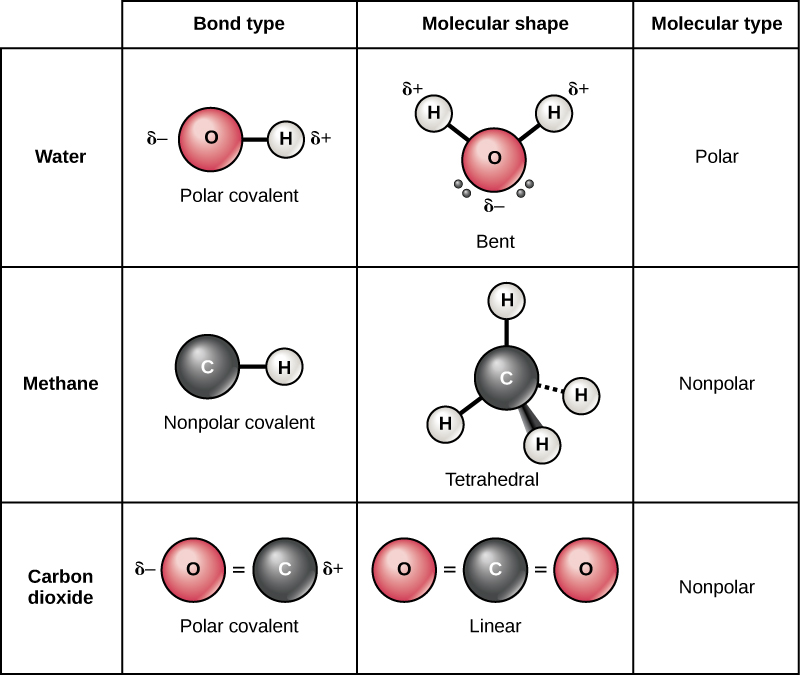

Figure 2.12図 2.12
Whether a molecule is polar or nonpolar depends both on bond type and molecular shape. Both water and carbon dioxide have polar covalent bonds, but carbon dioxide is linear, so the partial charges on the molecule cancel each other out.
分子が極性を持つかどうかは、結合の種類と分子の形の両方で決まる。水も二酸化炭素も極性共有結合を持つが、二酸化炭素は直線形であるため、分子内の部分電荷が互いに打ち消し合う。
Hydrogen Bonds and Van Der Waals Interactions水素結合とファンデルワールス相互作用
Ionic and covalent bonds between elements require energy to break. Ionic bonds are not as strong as covalent, which determines their behavior in biological systems. However, not all bonds are ionic or covalent bonds. Weaker bonds can also form between molecules. Two weak bonds that occur frequently are hydrogen bonds and van der Waals interactions. Without these two types of bonds, life as we know it would not exist. Hydrogen bonds provide many of the critical, life-sustaining properties of water and also stabilize the structures of proteins and DNA, the building block of cells.
英語のヒント
元素間のイオン結合や共有結合を切るには、エネルギーが必要である。イオン結合は共有結合ほど強くなく、このことが生体内での振る舞いを決めている。しかし、すべての結合がイオン結合か共有結合というわけではない。分子間には、より弱い結合もできる。頻繁に生じる二つの弱い結合が、水素結合とファンデルワールス相互作用である。この二種類の結合がなければ、私たちの知る生命は存在しないだろう。水素結合は、生命の維持に不可欠な水の多くの性質をもたらす。また、タンパク質や細胞の構成材料であるDNAの構造を安定させる。
When polar covalent bonds containing hydrogen form, the hydrogen in that bond has a slightly positive charge because hydrogen’s electron is pulled more strongly toward the other element and away from the hydrogen. Because the hydrogen is slightly positive, it will be attracted to neighboring negative charges. When this happens, a weak interaction occurs between the hydrogen's δ+ from one molecule and the molecule's δ– charge on another molecule with the more electronegative atoms, usually oxygen. Scientists call this interaction a hydrogen bond. This type of bond is common and occurs regularly between water molecules. Individual hydrogen bonds are weak and easily broken; however, they occur in very large numbers in water and in organic polymers, creating a major force in combination. Hydrogen bonds are also responsible for zipping together the DNA double helix.
英語のヒント
水素を含む極性共有結合が形成されると、その結合の水素はわずかに正の電荷を帯びる。水素の電子が、水素から離れてもう一方の元素へ、より強く引かれるからである。水素はわずかに正に帯電しているため、近くの負電荷に引かれる。このとき、一方の分子にある水素のδ+と、もう一方の分子にある、より電気陰性度の高い原子(通常は酸素)のδ–との間に、弱い相互作用が生じる。この相互作用を水素結合という。これはよく見られる結合であり、水分子同士の間で普通に生じる。個々の水素結合は弱く、容易に切れる。しかし、水や有機高分子には非常に多数の水素結合が生じるため、合わさると大きな力となる。水素結合は、DNA二重らせんをファスナーのようにつなぎ合わせる役割も担う。
Like hydrogen bonds, van der Waals interactions are weak attractions or interactions between molecules. Van der Waals attractions can occur between any two or more molecules and are dependent on slight fluctuations of the electron densities, which are not always symmetrical around an atom. For these attractions to happen, the molecules need to be very close to one another. These bonds—along with ionic, covalent, and hydrogen bonds—contribute to the proteins' three-dimensional structure in our cells that is necessary for their proper function.
英語のヒント
ファンデルワールス相互作用は、水素結合と同様に、分子間に働く弱い引力または相互作用である。この引力は、どのような二つ以上の分子の間にも生じる可能性があり、電子密度のわずかな揺らぎに依存する。電子密度は、原子の周囲で常に対称になっているとは限らない。こうした引力が生じるには、分子同士が非常に近くになければならない。この結合は、イオン結合、共有結合、水素結合とともに、細胞内のタンパク質が正常に働くために必要な三次元構造に寄与している。