第2章生命の化学的基盤
2.2 Water2.2 水
Learning Objectives学習目標
By the end of this section, you will be able to do the following:
この節を学び終えると、次のことができるようになる。
- Describe the properties of water that are critical to maintaining life生命の維持に不可欠な水の性質を説明する。
- Explain why water is an excellent solvent水が優れた溶媒である理由を説明する。
- Provide examples of water’s cohesive and adhesive properties水の凝集性と付着性の例を挙げる。
- Discuss the role of acids, bases, and buffers in homeostasis恒常性における酸、塩基、緩衝剤の役割を論じる。
Why do scientists spend time looking for water on other planets? Why is water so important? It is because water is essential to life as we know it. Water is one of the more abundant molecules and the one most critical to life on Earth. Water comprises approximately 60–70 percent of the human body. Without it, life as we know it simply would not exist.
英語のヒント
なぜ科学者は、ほかの惑星で水を探すことに時間をかけるのだろう。水はなぜそれほど重要なのだろう。それは、水が私たちの知る生命に不可欠だからである。水は比較的豊富に存在する分子の一つであり、地球の生命にとって最も重要な分子である。ヒトの体のおよそ60〜70%は水である。水がなければ、私たちの知る生命はそもそも存在しない。
The polarity of the water molecule and its resulting hydrogen bonding make water a unique substance with special properties that are intimately tied to the processes of life. Life originally evolved in a watery environment, and most of an organism’s cellular chemistry and metabolism occur inside the watery contents of the cell’s cytoplasm. Special properties of water are its high heat capacity and heat of vaporization, its ability to dissolve polar molecules, its cohesive and adhesive properties, and its dissociation into ions that leads to generating pH. Understanding these characteristics of water helps to elucidate its importance in maintaining life.
英語のヒント
水分子の極性と、それによって生じる水素結合のために、水は生命の過程と密接に結び付いた特別な性質を持つ、独特の物質となっている。生命はもともと水のある環境で進化し、生物の細胞内の化学反応と代謝の大部分は、水を含む細胞質の内部で起こる。水の特別な性質には、高い熱容量と気化熱、極性分子を溶かす能力、凝集性と付着性、そしてpHの発生につながるイオンへの解離がある。こうした水の特徴を理解すると、生命の維持における水の重要性を明らかにできる。
Water’s Polarity水の極性
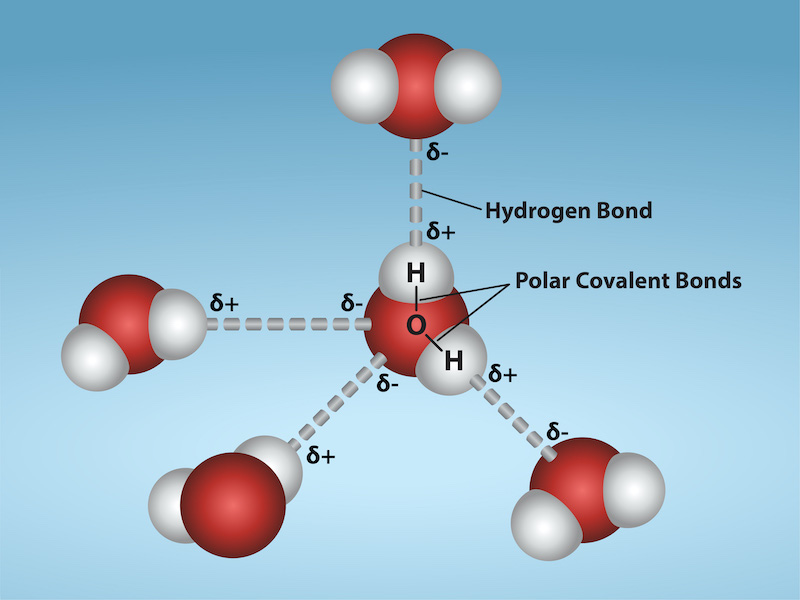
One of water’s important properties is that it is composed of polar molecules: the hydrogen and oxygen within water molecules (H2O) form polar covalent bonds. While there is no net charge to a water molecule, water's polarity creates a slightly positive charge on hydrogen and a slightly negative charge on oxygen, contributing to water’s properties of attraction. Water generates charges because oxygen is more electronegative than hydrogen, making it more likely that a shared electron would be near the oxygen nucleus than the hydrogen nucleus, thus generating the partial negative charge near the oxygen.
英語のヒント
水の重要な性質の一つは、極性分子からできていることである。水分子(H2O)内の水素と酸素は極性共有結合を形成する。水分子全体としての正味の電荷はないが、極性によって水素にはわずかな正電荷、酸素にはわずかな負電荷が生じ、水が引き合う性質につながる。水にこうした電荷が生じるのは、酸素の電気陰性度が水素より高いからである。共有電子は、水素の原子核より酸素の原子核の近くにいる可能性が高くなり、そのため酸素の近くに部分的な負電荷が生じる。
As a result of water’s polarity, each water molecule attracts other water molecules because of the opposite charges between water molecules, forming hydrogen bonds. Water also attracts or is attracted to other polar molecules and ions. We call a polar substance that interacts readily with or dissolves in water hydrophilic (hydro- = “water”; -philic = “loving”). In contrast, nonpolar molecules such as oils and fats do not interact well with water, as Figure 2.13 shows. A good example of this is vinegar and oil salad dressing (an acidic water solution). We call such nonpolar compounds hydrophobic (hydro- = “water”; -phobic = “fearing”).
英語のヒント
水の極性のため、一つ一つの水分子は、分子間にある反対符号の電荷によってほかの水分子を引き付け、水素結合を作る。水は、ほかの極性分子やイオンを引き付けたり、それらに引き付けられたりもする。水と容易に相互作用する、または水に溶ける極性物質を親水性という(hydro-は「水」、-philicは「好む」の意味)。これに対して、油や脂肪などの無極性分子は、図2.13に示すように水とはうまく相互作用しない。酢と油を使ったサラダドレッシング(酸性の水溶液)がよい例である。このような無極性化合物を疎水性という(hydro-は「水」、-phobicは「恐れる」の意味)。
OpenStax, Rice University; Biology 2e. Credit: Rao, A., Fletcher, S., Ryan, K., Tag, A. and Hawkins, A. Department of Biology, Texas A&M University · CC BY 4.0 · Source出典

Figure 2.13図 2.13
The polarity of water. The polarity of water is due to the differing electronegativities of hydrogen and oxygen. As a consequence, hydrogen bonds are formed when the slightly negative oxygen on one water molecule is attracted to the slightly positive hydrogen of another water molecule. Credit: Rao, A., Fletcher, S., Ryan, K., Tag, A. and Hawkins, A. Department of Biology, Texas A&M University
水の極性。水の極性は、水素と酸素の電気陰性度の違いによって生じる。その結果、一つの水分子のわずかに負に帯電した酸素が、別の水分子のわずかに正に帯電した水素に引き付けられると、水素結合ができる。出典:Rao, A., Fletcher, S., Ryan, K., Tag, A. and Hawkins, A.(テキサスA&M大学生物学部)
Water’s States: Gas, Liquid, and Solid水の状態:気体・液体・固体
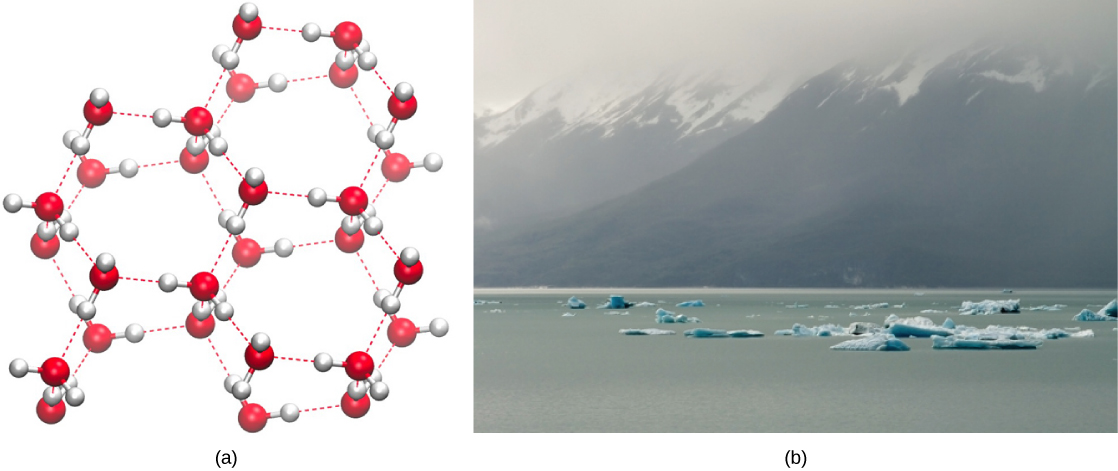
The formation of hydrogen bonds is an important quality of the liquid water that is crucial to life as we know it. As water molecules make hydrogen bonds with each other, water takes on some unique chemical characteristics compared to other liquids and, since living things have a high water content, understanding these chemical features is key to understanding life. In liquid water, hydrogen bonds constantly form and break as the water molecules slide past each other. The water molecules' motion (kinetic energy) causes the bonds to break due to the heat contained in the system. When the heat rises as water boils, the water molecules' higher kinetic energy causes the hydrogen bonds to break completely and allows water molecules to escape into the air as gas (steam or water vapor). Alternatively, when water temperature reduces and water freezes, the water molecules form a crystalline structure maintained by hydrogen bonding (there is not enough energy to break the hydrogen bonds) that makes ice less dense than liquid water, a phenomenon that we do not see when other liquids solidify.
英語のヒント
水素結合の形成は、私たちの知る生命に不可欠な液体の水が持つ、重要な性質である。水分子同士が水素結合を作ることによって、水はほかの液体と比べて独特の化学的特徴を示す。生物は多くの水を含むため、これらの化学的特徴を理解することは、生命を理解する鍵となる。液体の水では、水分子が互いのそばを滑るように移動するにつれて、水素結合が絶えずできたり切れたりしている。系に含まれる熱による水分子の運動(運動エネルギー)が、結合を切断させる。水が沸騰する際に熱が増すと、水分子の運動エネルギーが高くなって水素結合が完全に切れ、水分子が気体(水蒸気)として空気中へ出られるようになる。逆に、水温が下がって水が凍ると、水分子は水素結合に保たれた結晶構造を作る(水素結合を切るだけのエネルギーがないためである)。この構造により、氷は液体の水より密度が低くなる。これは、ほかの液体が固まるときには見られない現象である。
Water’s lower density in its solid form is due to the way hydrogen bonds orient as they freeze: the water molecules push farther apart compared to liquid water. With most other liquids, solidification when the temperature drops includes lowering kinetic energy between molecules, allowing them to pack even more tightly than in liquid form and giving the solid a greater density than the liquid.
英語のヒント
固体の水の密度が低いのは、凍るときの水素結合の向きに理由がある。液体の水と比べて、水分子同士がより離れるのである。ほかの大部分の液体では、温度が下がって固まるときに分子の運動エネルギーが低下し、分子は液体の状態よりも密に詰まることができる。そのため、固体は液体よりも密度が高くなる。
The lower density of ice, as Figure 2.14 depicts, causes it to float at the surface of liquid water, such as in an iceberg or ice cubes in a glass of water. In lakes and ponds, ice will form on the water's surface creating an insulating barrier that protects the animals and plant life in the pond from freezing. Without this insulating ice layer, plants and animals living in the pond would freeze in the solid block of ice and could not survive. The expansion of ice relative to liquid water causes the detrimental effect of freezing on living organisms. The ice crystals that form upon freezing rupture the delicate membranes essential for living cells to function, irreversibly damaging them. Cells can only survive freezing if another liquid like glycerol temporarily replaces the water in them.
英語のヒント
図2.14に示すように、氷は密度が低いため、氷山やコップの水に浮かぶ氷のように、液体の水の表面に浮く。湖や池では、水面に氷ができると断熱性のある障壁となり、水中の動植物が凍るのを防ぐ。この断熱性の氷の層がなければ、池の動植物は固い氷の塊の中で凍りつき、生き延びられない。液体の水が氷になると体積が増えることは、生物に対する凍結の有害な作用を引き起こす。凍結時にできる氷の結晶は、生きた細胞の働きに不可欠な繊細な膜を破り、元に戻せない損傷を与える。細胞が凍結に耐えて生き残れるのは、グリセロールなどの別の液体が、細胞内の水に一時的に置き換わる場合だけである。
OpenStax, Rice University; Biology 2e. (credit a: modification of work by Jane Whitney, image created using Visual Molecular Dynamics (VMD) softwareW. Humphrey W., A. Dalke, and K. Schulten, “VMD—Visual Molecular Dynamics,” Journal of Molecular Graphics 14 (1996): 33-38.; credit b: modification of work by Carlos Ponte) · CC BY 4.0 · Source出典

Figure 2.14図 2.14
Hydrogen bonding makes ice less dense than liquid water. The (a) lattice structure of ice makes it less dense than the liquid water's freely flowing molecules, enabling it to (b) float on water. (credit a: modification of work by Jane Whitney, image created using Visual Molecular Dynamics (VMD) software W. Humphrey W., A. Dalke, and K. Schulten, “VMD—Visual Molecular Dynamics,” Journal of Molecular Graphics 14 (1996): 33-38. ; credit b: modification of work by Carlos Ponte)
水素結合によって、氷は液体の水より密度が低くなる。(a)氷の格子構造は、自由に流動する液体の水分子より密度が低く、このため(b)氷は水に浮く。(出典a:Jane Whitneyの作品を改変。画像はVisual Molecular Dynamics(VMD)ソフトウェアを用いて作成。W. Humphrey W., A. Dalke, and K. Schulten, “VMD—Visual Molecular Dynamics,” Journal of Molecular Graphics 14(1996): 33–38。出典b:Carlos Ponteの作品を改変)