第2章生命の化学的基盤
Electron Orbitals電子の軌道
Although useful to explain the reactivity and chemical bonding of certain elements, the Bohr model does not accurately reflect how electrons spatially distribute themselves around the nucleus. They do not circle the nucleus like the earth orbits the sun, but we find them in electron orbitals. These relatively complex shapes result from the fact that electrons behave not just like particles, but also like waves. Mathematical equations from quantum mechanics, which scientists call wave functions, can predict within a certain level of probability where an electron might be at any given time. Scientists call the area where an electron is most likely to be found its orbital.
英語のヒント
ボーア模型は、ある種の元素の反応性や化学結合を説明するのに役立つが、電子が原子核の周りにどう空間的に分布するかを正確には表していない。電子は、地球が太陽の周りを回るように原子核を周回するのではなく、電子軌道の中で見いだされる。これらの比較的複雑な形は、電子が粒子としてだけでなく、波としても振る舞うことに由来する。科学者が波動関数と呼ぶ、量子力学の数学的な式を使えば、ある時点で電子がどこにあるかを、一定の確率の範囲で予測できる。電子が最も見いだされやすい領域を、軌道と呼ぶ。
Recall that the Bohr model depicts an atom’s electron shell configuration. Within each electron shell are subshells, and each subshell has a specified number of orbitals containing electrons. While it is impossible to calculate exactly an electron's location, scientists know that it is most probably located within its orbital path. The letter s, p, d, and f designate the subshells. The s subshell is spherical in shape and has one orbital. Principal shell 1n has only a single s orbital, which can hold two electrons. Principal shell 2n has one s and one p subshell, and can hold a total of eight electrons. The p subshell has three dumbbell-shaped orbitals, as Figure 2.8 illustrates. Subshells d and f have more complex shapes and contain five and seven orbitals, respectively. We do not show these in the illustration. Principal shell 3n has s, p, and d subshells and can hold 18 electrons. Principal shell 4n has s, p, d and f orbitals and can hold 32 electrons. Moving away from the nucleus, the number of electrons and orbitals in the energy levels increases. Progressing from one atom to the next in the periodic table, we can determine the electron structure by fitting an extra electron into the next available orbital.
英語のヒント
ボーア模型が、原子の電子殻の配置を表すことを思い出そう。各電子殻の中には副殻があり、各副殻には決まった数の電子軌道がある。電子の位置を正確に計算することはできないが、軌道の中に存在する確率が最も高いことは分かっている。副殻はs、p、d、fの文字で示す。s副殻は球形で、一つの軌道をもつ。1n主殻にはs軌道が一つだけあり、二個の電子を収容できる。2n主殻にはs副殻とp副殻が一つずつあり、合計八個の電子を収容できる。図2.8に示すように、p副殻には亜鈴形の軌道が三つある。d副殻とf副殻はより複雑な形をしており、それぞれ五つと七つの軌道を含む。これらは図には示していない。3n主殻にはs、p、d副殻があり、18個の電子を収容できる。4n主殻にはs、p、d、f軌道があり、32個の電子を収容できる。原子核から離れるにつれて、エネルギー準位内の電子と軌道の数は増える。周期表で一つの原子から次の原子へ進む際、次に入れる軌道へ電子を一個加えることで、電子の構造を決められる。
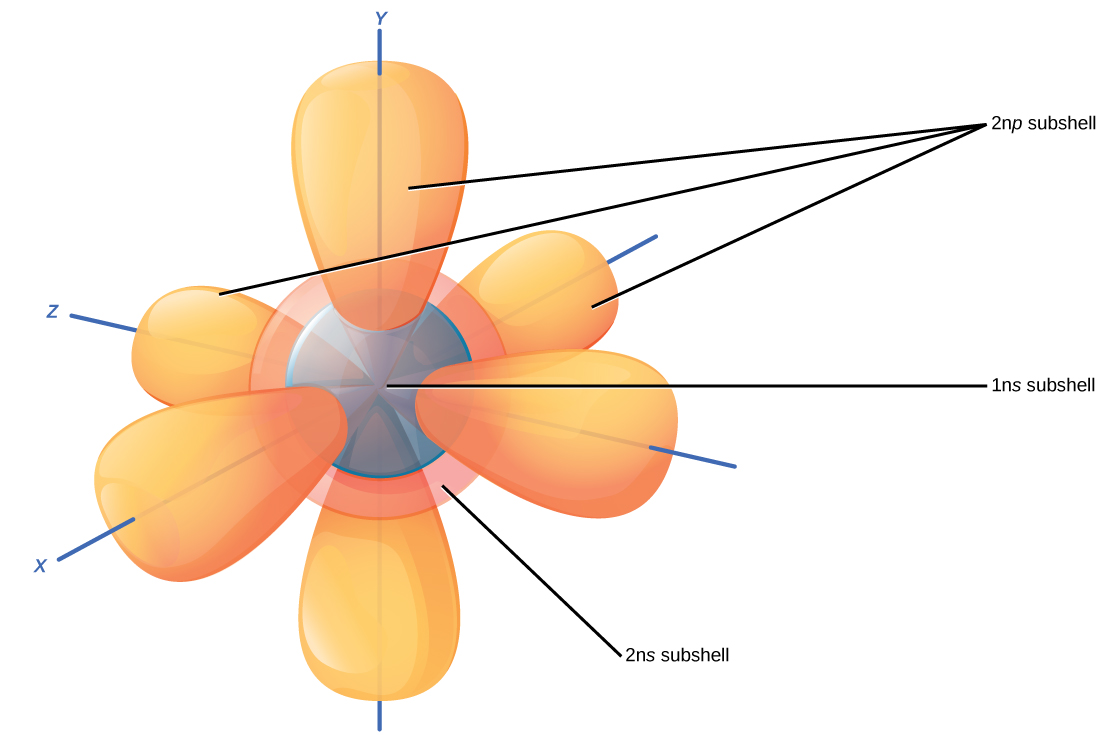

Figure 2.8図 2.8
The s subshells are shaped like spheres. Both the 1n and 2n principal shells have an s orbital, but the size of the sphere is larger in the 2n orbital. Each sphere is a single orbital. Three dumbbell-shaped orbitals comprise p subshells. Principal shell 2n has a p subshell, but shell 1 does not.
s副殻は球のような形である。1nと2nの主殻はどちらもs軌道をもつが、2n軌道の方が球が大きい。それぞれの球が一つの軌道である。p副殻は、亜鈴形の三つの軌道からなる。2n主殻にはp副殻があるが、第1殻にはない。
The closest orbital to the nucleus, the 1s orbital, can hold up to two electrons. This orbital is equivalent to the Bohr model's innermost electron shell. The 1s orbital is the closest orbital to the nucleus, and it is always filled first, before any other orbital fills. Hydrogen has one electron; therefore, it occupies only one spot within the 1s orbital. We designate this as 1s1, where the superscripted 1 refers to the one electron within the 1s orbital. Helium has two electrons; therefore, it can completely fill the 1s orbital with its two electrons. We designate this as 1s2, referring to the two electrons of helium in the 1s orbital. On the periodic table Figure 2.5, hydrogen and helium are the only two elements in the first row (period). This is because they only have electrons in their first shell, the 1s orbital. Hydrogen and helium are the only two elements that have the 1s and no other electron orbitals in the electrically neutral state.
英語のヒント
原子核に最も近い1s軌道には、最大二個の電子が入る。この軌道は、ボーア模型の最内電子殻に相当する。1s軌道は原子核に最も近く、ほかのどの軌道よりも先に、つねに最初に満たされる。水素には電子が一個あるため、1s軌道の一つの場所だけを占める。これを1s1と表し、上付きの1は1s軌道内の電子一個を意味する。ヘリウムには電子が二個あるため、この二個で1s軌道を完全に満たせる。これを1s2と表し、1s軌道内のヘリウムの電子二個を示す。図2.5の周期表では、水素とヘリウムだけが最初の行(周期)にある。電子をもつのが第一の殻、すなわち1s軌道だけだからである。電気的に中性の状態で1s軌道だけに電子をもち、ほかの電子軌道をもたない元素は、水素とヘリウムだけである。
The second electron shell may contain eight electrons. This shell contains another spherical s orbital and three “dumbbell” shaped p orbitals, each of which can hold two electrons, as Figure 2.8 shows. After the 1s orbital fills, the second electron shell fills, first filling its 2s orbital and then its three p orbitals. When filling the p orbitals, each takes a single electron. Once each p orbital has an electron, it may add a second. Lithium (Li) contains three electrons that occupy the first and second shells. Two electrons fill the 1s orbital, and the third electron then fills the 2s orbital. Its electron configuration is 1s22s1. Neon (Ne), alternatively, has a total of ten electrons: two are in its innermost 1s orbital and eight fill its second shell (two each in the 2s and three p orbitals). Thus it is an inert gas and energetically stable as a single atom that will rarely form a chemical bond with other atoms. Larger elements have additional orbitals, comprising the third electron shell. While the concepts of electron shells and orbitals are closely related, orbitals provide a more accurate depiction of an atom's electron configuration because the orbital model specifies the different shapes and special orientations of all the places that electrons may occupy.
英語のヒント
第二電子殻には八個の電子が入る。この殻には、もう一つの球形のs軌道と、三つの亜鈴形のp軌道があり、図2.8に示すように、各軌道には二個の電子が入る。1s軌道が満たされると、第二電子殻の2s軌道、次に三つのp軌道が満たされていく。p軌道を満たすときは、それぞれに一個ずつ電子が入る。すべてのp軌道に一個ずつ入った後で、二個目を加えられる。リチウム(Li)には三個の電子があり、第一と第二の殻を占める。二個が1s軌道を満たし、三個目が2s軌道に入る。電子配置は1s22s1である。一方、ネオン(Ne)には合計十個の電子があり、二個が最内の1s軌道に入り、八個が第二殻を満たす(2s軌道と三つのp軌道に、それぞれ二個ずつ)。したがって、ネオンは不活性ガスであり、一個の原子としてエネルギー的に安定しているので、ほかの原子と化学結合することはほとんどない。より大きな元素には、第三電子殻を構成する追加の軌道がある。電子殻と軌道の概念は密接に関連するが、軌道による模型は、電子が占めうるすべての場所の形と向きを示すため、原子の電子配置をより正確に表現する。