第2章生命の化学的基盤
Ions and Ionic Bondsイオンとイオン結合
Some atoms are more stable when they gain or lose an electron (or possibly two) and form ions. This fills their outermost electron shell and makes them energetically more stable. Because the number of electrons does not equal the number of protons, each ion has a net charge. Cations are positive ions that form by losing electrons. Negative ions form by gaining electrons, which we call anions. We designate anions by their elemental name and change the ending to “-ide”, thus the anion of chlorine is chloride, and the anion of sulfur is sulfide.
英語のヒント
原子の中には、電子を一つ(場合によっては二つ)受け取るか失ってイオンになると、より安定するものがある。こうすると最外電子殻が満たされ、エネルギーの面でより安定する。電子数が陽子数と一致しなくなるため、それぞれのイオンは正味の電荷を持つ。陽イオンは、電子を失ってできる正のイオンである。電子を受け取ると負のイオンができ、これを陰イオンという。英語では、陰イオンの名称は元素名の語尾を「-ide」に変えて表す。したがって、chlorine(塩素)の陰イオンはchloride(塩化物イオン)、sulfur(硫黄)の陰イオンはsulfide(硫化物イオン)となる。
Scientists refer to this movement of electrons from one element to another as electron transfer. As Figure 2.11 illustrates, sodium (Na) only has one electron in its outer electron shell. It takes less energy for sodium to donate that one electron than it does to accept seven more electrons to fill the outer shell. If sodium loses an electron, it now has 11 protons, 11 neutrons, and only 10 electrons, leaving it with an overall charge of +1. We now refer to it as a sodium ion. Chlorine (Cl) in its lowest energy state (called the ground state) has seven electrons in its outer shell. Again, it is more energy-efficient for chlorine to gain one electron than to lose seven. Therefore, it tends to gain an electron to create an ion with 17 protons, 17 neutrons, and 18 electrons, giving it a net negative (–1) charge. We now refer to it as a chloride ion. In this example, sodium will donate its one electron to empty its shell, and chlorine will accept that electron to fill its shell. Both ions now satisfy the octet rule and have complete outermost shells. Because the number of electrons is no longer equal to the number of protons, each is now an ion and has a +1 (sodium cation) or –1 (chloride anion) charge. Note that these transactions can normally only take place simultaneously: in order for a sodium atom to lose an electron, it must be in the presence of a suitable recipient like a chlorine atom.
英語のヒント
一つの元素から別の元素へ電子が移ることを、電子移動という。図2.11に示すように、ナトリウム(Na)の最外電子殻には電子が一つしかない。その殻を満たすために電子をあと七つ受け取るよりも、この一つを与える方が必要なエネルギーは少ない。ナトリウムが電子を一つ失うと、陽子は11個、中性子は11個、電子はわずか10個となり、全体として+1の電荷を持つ。これをナトリウムイオンと呼ぶ。塩素(Cl)は、エネルギーが最も低い状態(基底状態)では最外殻に七つの電子を持つ。この場合も、七つを失うより一つを受け取る方がエネルギーの面で効率がよい。そのため、電子を一つ受け取り、陽子17個、中性子17個、電子18個からなる、正味で負(−1)の電荷を持つイオンになりやすい。これを塩化物イオンと呼ぶ。この例では、ナトリウムは一つだけある電子を与えてその殻を空にし、塩素はその電子を受け取って殻を満たす。どちらのイオンもオクテット則を満たし、最外殻が完成した状態になる。電子数が陽子数と一致しなくなるので、それぞれ+1の電荷を持つナトリウム陽イオンと、−1の電荷を持つ塩化物陰イオンになる。通常、これらのやり取りは同時にしか起こらないことに注意しよう。ナトリウム原子が電子を失うには、塩素原子のような適切な受け手がそばにいなければならない。
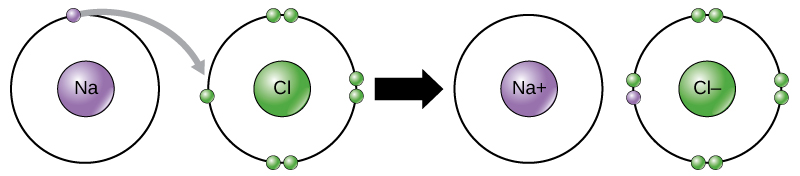

Figure 2.11図 2.11
In the formation of an ionic compound, metals lose electrons and nonmetals gain electrons to achieve an octet.
イオン化合物が形成される際には、金属は電子を失い、非金属は電子を受け取ることで、最外殻に八つの電子をそろえる。
Ionic bonds form between ions with opposite charges. For instance, positively charged sodium ions and negatively charged chloride ions bond together to make crystals of sodium chloride, or table salt, creating a crystalline molecule with zero net charge.
英語のヒント
イオン結合は、互いに逆の電荷を持つイオンの間に形成される。例えば、正に帯電したナトリウムイオンと負に帯電した塩化物イオンは結合して、塩化ナトリウム、すなわち食塩の結晶を作る。こうして、正味の電荷がゼロの結晶性分子ができる。
Physiologists refer to certain salts as electrolytes (including sodium, potassium, and calcium), ions necessary for nerve impulse conduction, muscle contractions, and water balance. Many sports drinks and dietary supplements provide these ions to replace those lost from the body via sweating during exercise.
英語のヒント
生理学では、ナトリウム、カリウム、カルシウムなどの特定の塩を電解質と呼ぶ。これらのイオンは、神経インパルスの伝導、筋収縮、水分平衡に必要である。多くのスポーツ飲料や栄養補助食品は、運動中の発汗で体外へ失われたイオンを補うために、こうしたイオンを含んでいる。
Covalent Bonds and Other Bonds and Interactions共有結合とその他の結合・相互作用
Another way to satisfy the octet rule is by sharing electrons between atoms to form covalent bonds. These bonds are much more common than ionic bonds in the molecules of living organisms. We commonly find covalent bonds in carbon-based organic molecules, such as our DNA and proteins. We also find covalent bonds in inorganic molecules like H2O, CO2, and O2. The bonds may share one, two, or three pairs of electrons, making single, double, and triple bonds, respectively. The more covalent bonds between two atoms, the stronger their connection. Thus, triple bonds are the strongest.
英語のヒント
オクテット則を満たすもう一つの方法は、原子同士で電子を共有して共有結合を形成することである。生物の分子には、イオン結合よりも共有結合の方がはるかに多い。DNAやタンパク質など、炭素を基本とする有機分子では共有結合がよく見られる。H2O、CO2、O2などの無機分子にも共有結合がある。共有する電子対は一組、二組、三組の場合があり、それぞれ単結合、二重結合、三重結合となる。二つの原子の間に共有結合が多いほど、つながりは強くなる。したがって、三重結合が最も強い。
The strength of different levels of covalent bonding is one of the main reasons living organisms have a difficult time in acquiring nitrogen for use in constructing their molecules, even though molecular nitrogen, N2, is the most abundant gas in the atmosphere. Molecular nitrogen consists of two nitrogen atoms triple bonded to each other and, as with all molecules, sharing these three pairs of electrons between the two nitrogen atoms allows for filling their outer electron shells, making the molecule more stable than the individual nitrogen atoms. This strong triple bond makes it difficult for living systems to break apart this nitrogen in order to use it as constituents of proteins and DNA.
英語のヒント
生物が自身の分子を作るための窒素を得るのに苦労する主な理由の一つは、共有結合の本数による結合の強さの違いにある。窒素分子N2は大気中で最も豊富な気体であるにもかかわらず、そうなのである。窒素分子は、互いに三重結合した二つの窒素原子からなる。すべての分子に共通することだが、この三組の電子対を二つの窒素原子で共有すると最外電子殻が満たされ、個々の窒素原子より分子の方が安定になる。この強い三重結合のために、生物は窒素分子を分解してタンパク質やDNAの構成要素として利用することが難しい。
Forming water molecules provides an example of covalent bonding. Covalent bonds bind the hydrogen and oxygen atoms that combine to form water molecules as Figure 2.9 shows. The electron from the hydrogen splits its time between the hydrogen atoms' incomplete outer shell and the oxygen atoms' incomplete outer shell. To completely fill the oxygen's outer shell, which has six electrons but which would be more stable with eight, two electrons (one from each hydrogen atom) are needed: hence, the well-known formula H2O. The two elements share the electrons to fill the outer shell of each, making both elements more stable.
英語のヒント
水分子の形成は、共有結合の一例である。図2.9に示すように、水分子を作る水素原子と酸素原子は共有結合で結ばれている。水素の電子は、水素原子の満たされていない最外殻と、酸素原子の満たされていない最外殻との間に時間を分けて存在する。酸素の最外殻には電子が六つあるが、八つあればより安定する。この殻を完全に満たすには、水素原子それぞれから一つずつ、計二つの電子が必要である。このため、よく知られた化学式H2Oとなる。二種類の元素は電子を共有してそれぞれの最外殻を満たし、どちらもより安定する。