第2章生命の化学的基盤
Functional Groups官能基
Functional groups are groups of atoms that occur within molecules and confer specific chemical properties to those molecules. We find them along the “carbon backbone” of macromolecules. Chains and/or rings of carbon atoms with the occasional substitution of an element such as nitrogen or oxygen form this carbon backbone. Molecules with other elements in their carbon backbone are substituted hydrocarbons.
英語のヒント
官能基とは、分子内に存在し、その分子に特定の化学的性質を与える原子団である。高分子の「炭素骨格」に沿って見られる。この炭素骨格は、炭素原子の鎖や環からなり、ときに炭素の一部が窒素や酸素などの元素に置き換わっている。炭素骨格にほかの元素を含む分子は、置換炭化水素である。
The functional groups in a macromolecule are usually attached to the carbon backbone at one or several different places along its chain and/or ring structure. Each of the four types of macromolecules—proteins, lipids, carbohydrates, and nucleic acids—has its own characteristic set of functional groups that contributes greatly to its differing chemical properties and its function in living organisms.
英語のヒント
高分子の官能基は、通常、その鎖状または環状の炭素骨格の一か所または数か所に結び付いている。四種類の高分子、すなわちタンパク質、脂質、炭水化物、核酸は、それぞれ特徴的な官能基の組み合わせを持つ。この組み合わせは、それぞれの化学的性質の違いと、生体内での機能に大きく寄与している。
A functional group can participate in specific chemical reactions. Figure 2.27 shows some of the important functional groups in biological molecules. They include: hydroxyl, methyl, carbonyl, carboxyl, amino, phosphate, and sulfhydryl. These groups play an important role in forming molecules like DNA, proteins, carbohydrates, and lipids. We usually classify functional groups as hydrophobic or hydrophilic depending on their charge or polarity characteristics. An example of a hydrophobic group is the nonpolar methyl molecule. Among the hydrophilic functional groups is the carboxyl group in amino acids, some amino acid side chains, and the fatty acids that form triglycerides and phospholipids. This carboxyl group ionizes to release hydrogen ions (H+) from the COOH group resulting in the negatively charged COO- group. This contributes to the hydrophilic nature of whatever molecule on which it is found. Other functional groups, such as the carbonyl group, have a partially negatively charged oxygen atom that may form hydrogen bonds with water molecules, again making the molecule more hydrophilic.
英語のヒント
官能基は特定の化学反応に参加できる。図2.27に、生体分子に含まれる重要な官能基の一部を示す。ヒドロキシ基、メチル基、カルボニル基、カルボキシ基、アミノ基、リン酸基、スルフヒドリル基などである。これらは、DNA、タンパク質、炭水化物、脂質などの分子を形成するうえで重要な役割を果たす。官能基は通常、その電荷や極性の性質に応じて、疎水性か親水性に分類する。疎水性の基の例は、無極性のメチル分子である。親水性の官能基には、アミノ酸、一部のアミノ酸側鎖、トリグリセリドやリン脂質を作る脂肪酸に含まれるカルボキシ基がある。このカルボキシ基は電離して、COOH基から水素イオン(H+)を放出し、負に帯電したCOO-基となる。どのような分子にある場合でも、この基はその分子の親水性に寄与する。カルボニル基などのほかの官能基は、部分的に負に帯電した酸素原子を持ち、水分子と水素結合を作れる。この場合も、分子はより親水性になる。
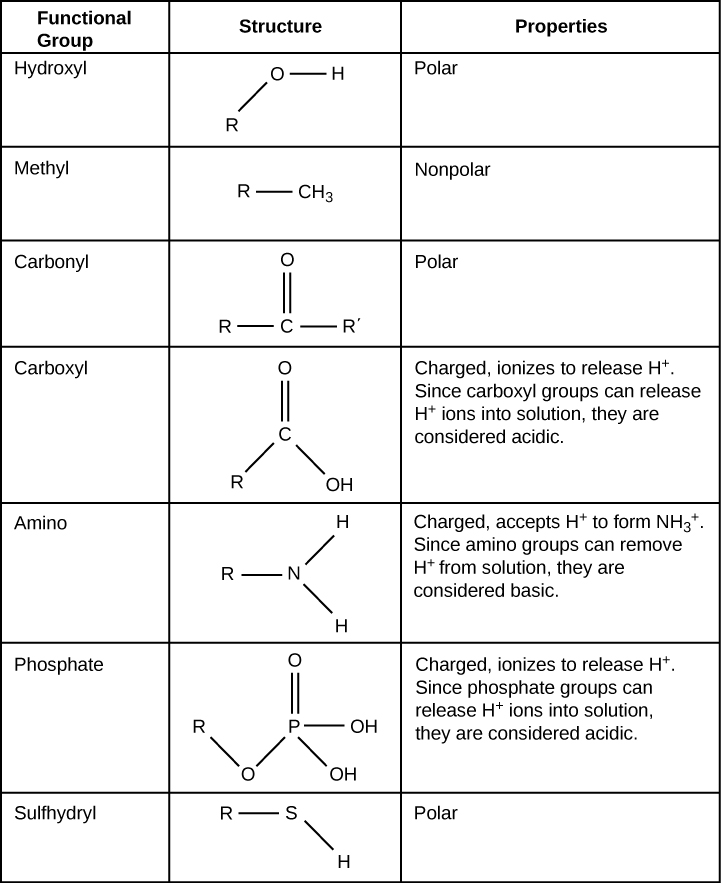
Figure 2.27図 2.27
These functional groups are in many different biological molecules. R, also known as R-group, is an abbreviation for any group in which a carbon or hydrogen atom is attached to the rest of the molecule.
これらの官能基は、多くの異なる生体分子に含まれる。RはR基とも呼ばれ、炭素原子または水素原子を介して分子の残りの部分と結び付く任意の基を表す略号である。
Hydrogen bonds between functional groups (within the same molecule or between different molecules) are important to the function of many macromolecules and help them to fold properly into and maintain the appropriate shape for functioning. Hydrogen bonds are also involved in various recognition processes, such as DNA complementary base pairing and the binding of an enzyme to its substrate, as Figure 2.28 illustrates.
英語のヒント
官能基同士の水素結合は、同じ分子内にある場合も、異なる分子間にある場合も、多くの高分子の機能に重要である。高分子が適切に折りたたまれ、働くために必要な形を保つのを助ける。また図2.28に示すように、水素結合は、DNAの相補的な塩基対形成や酵素と基質の結合など、さまざまな認識過程にも関わる。
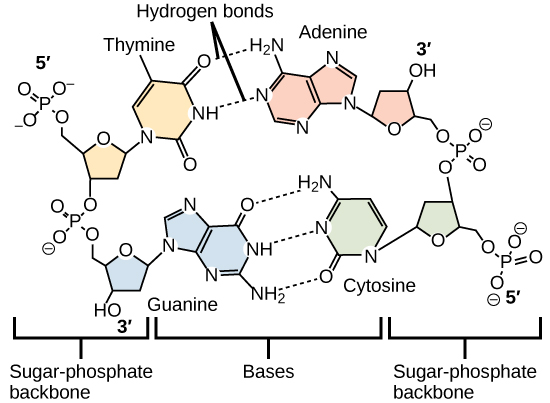


Figure 2.28図 2.28
Hydrogen bonds connect two strands of DNA together to create the double-helix structure.
水素結合が二本のDNA鎖をつなぎ、二重らせん構造を作る。
Section Summaryこの節のまとめ
The unique properties of carbon make it a central part of biological molecules. Carbon binds to oxygen, hydrogen, and nitrogen covalently to form the many molecules important for cellular function. Carbon has four electrons in its outermost shell and can form four bonds. Carbon and hydrogen can form hydrocarbon chains or rings. Functional groups are groups of atoms that confer specific properties to hydrocarbon (or substituted hydrocarbon) chains or rings that define their overall chemical characteristics and function.
英語のヒント
炭素は、その独特の性質によって生体分子の中心をなしている。炭素は酸素、水素、窒素と共有結合し、細胞の機能に重要な多くの分子を形成する。炭素は最外殻に四つの電子を持ち、四つの結合を作ることができる。炭素と水素は、炭化水素の鎖や環を形成できる。官能基は、炭化水素(または置換炭化水素)の鎖や環に特定の性質を与える原子団であり、分子全体の化学的特徴と機能を決める。
Visual Connection Questions図を使った問題
Exercises 15練習問題 15
Exercise 15問題 15
Figure 2.24 Which of the following statements is false?
図2.24 次の記述のうち、誤っているものはどれか。
- Molecules with the formulas CH3CH2COOH and C3H6O2 could be structural isomers.化学式がCH3CH2COOHとC3H6O2の分子は、構造異性体である可能性がある。
- Molecules must have a double bond to be cis-trans isomers.シス–トランス異性体であるためには、分子に二重結合が必要である。
- To be enantiomers, a molecule must have at least three different atoms or groups connected to a central carbon.鏡像異性体となるには、中心の炭素に少なくとも三種類の異なる原子または原子団が結合していなければならない。
- To be enantiomers, a molecule must have at least four different atoms or groups connected to a central carbon.鏡像異性体となるには、中心の炭素に少なくとも四種類の異なる原子または原子団が結合していなければならない。
Solution解き方
図2.24 C
Review Questions確認問題
Exercises 16–17練習問題 16–17
Exercise 16問題 16
Each carbon atom can bond with as many as________ other atom(s) or molecule(s).
各炭素原子は、ほかの原子または分子と最大________個まで結合できる。
- one一つ
- two二つ
- six六つ
- four四つ
Solution解き方
D
D
Exercise 17問題 17
Which of the following is not a functional group that can bond with carbon?
次のうち、炭素と結合できる官能基ではないものはどれか。
- sodiumナトリウム
- hydroxylヒドロキシ基
- phosphateリン酸基
- carbonylカルボニル基
Solution解き方
A
A
Critical Thinking Questions考察問題
Exercises 18–19練習問題 18–19
Exercise 18問題 18
What property of carbon makes it essential for organic life?
炭素のどの性質が、有機物を基盤とする生命にとって炭素を不可欠にしているのか。
Solution解き方
Carbon is unique and found in all living things because it can form up to four covalent bonds between atoms or molecules. These can be nonpolar or polar covalent bonds, and they allow for the formation of long chains of carbon molecules that combine to form proteins and DNA.
炭素は、原子や分子との間に最大四つの共有結合を作れるため、独特の性質を持ち、すべての生物に含まれる。その結合は無極性にも極性にもなりうる。こうした結合によって、炭素からなる分子が長い鎖を形成でき、その鎖が組み合わさってタンパク質やDNAになる。
Exercise 19問題 19
Compare and contrast saturated and unsaturated triglycerides.
飽和トリグリセリドと不飽和トリグリセリドの共通点と相違点を比較しなさい。
Solution解き方
Saturated triglycerides contain no double bonds between carbon atoms; they are usually solid at room temperature. Unsaturated triglycerides contain at least one double bond between carbon atoms and are usually liquid at room temperature.
飽和トリグリセリドは炭素原子間に二重結合を含まず、通常は室温で固体である。不飽和トリグリセリドは炭素原子間に少なくとも一つの二重結合を含み、通常は室温で液体である。
aliphatic hydrocarbon
脂肪族炭化水素
hydrocarbon consisting of a linear chain of carbon atoms
炭素原子の直鎖からなる炭化水素。
aromatic hydrocarbon
芳香族炭化水素
hydrocarbon consisting of closed rings of carbon atoms
炭素原子の閉じた環からなる炭化水素。
enantiomers
鏡像異性体
molecules that share overall structure and bonding patterns, but differ in how the atoms are three dimensionally placed such that they are mirror images of each other
全体の構造と結合のパターンは同じだが、原子の三次元的な配置が異なり、互いに鏡像となる分子。
functional group
官能基
group of atoms that provides or imparts a specific function to a carbon skeleton
炭素骨格に特定の機能を与える原子団。
geometric isomer
幾何異性体
isomer with similar bonding patterns differing in the placement of atoms alongside a double covalent bond
結合のパターンが似ており、共有二重結合の両側の原子配置が異なる異性体。
hydrocarbon
炭化水素
molecule that consists only of carbon and hydrogen
炭素と水素だけからなる分子。
isomers
異性体
molecules that differ from one another even though they share the same chemical formula
同じ化学式を持つにもかかわらず、互いに異なる分子。
organic molecule
有機分子
any molecule containing carbon (except carbon dioxide)
炭素を含むあらゆる分子(二酸化炭素を除く)。
structural isomers
構造異性体
molecules that share a chemical formula but differ in the placement of their chemical bonds
化学式は同じだが、化学結合の配置が異なる分子。
substituted hydrocarbon
置換炭化水素
hydrocarbon chain or ring containing an atom of another element in place of one of the backbone carbons
骨格をなす炭素の一つが、ほかの元素の原子に置き換わった炭化水素の鎖または環。