第2章生命の化学的基盤
Chemical Reactions and Molecules化学反応と分子
All elements are most stable when their outermost shell is filled with electrons according to the octet rule. This is because it is energetically favorable for atoms to be in that configuration and it makes them stable. However, since not all elements have enough electrons to fill their outermost shells, atoms form chemical bonds with other atoms thereby obtaining the electrons they need to attain a stable electron configuration. When two or more atoms chemically bond with each other, the resultant chemical structure is a molecule. The familiar water molecule, H2O, consists of two hydrogen atoms and one oxygen atom. These bond together to form water, as Figure 2.9 illustrates. Atoms can form molecules by donating, accepting, or sharing electrons to fill their outer shells.
英語のヒント
すべての元素は、オクテット則に従って最外殻が電子で満たされたときに最も安定する。原子にとって、その電子配置はエネルギーの面で有利であり、安定をもたらすからである。しかし、すべての元素が最外殻を満たすだけの電子を持っているわけではない。そのため、原子は別の原子と化学結合を形成し、安定した電子配置に達するために必要な電子を得る。二つ以上の原子が互いに化学結合すると、できた化学構造は分子となる。身近な水分子H2Oは、水素原子二つと酸素原子一つからなる。図2.9に示すように、これらが結合して水を形成する。原子は電子を与えたり、受け取ったり、共有したりして最外殻を満たすことで、分子を形成できる。
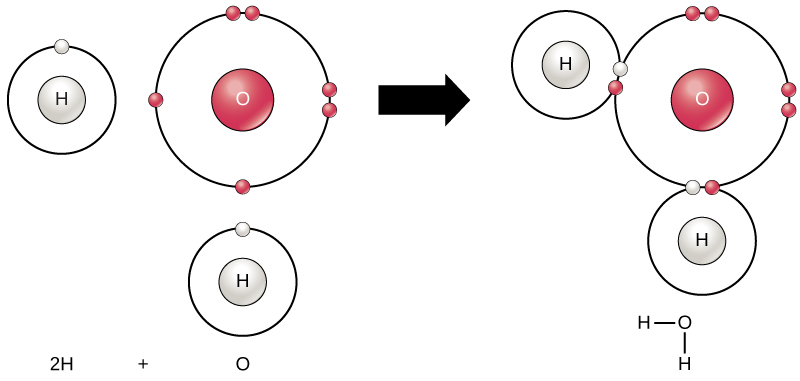
Figure 2.9図 2.9
Two or more atoms may bond with each other to form a molecule. When two hydrogens and an oxygen share electrons via covalent bonds it forms a water molecule.
二つ以上の原子が互いに結合して分子を形成することがある。水素二つと酸素一つが共有結合によって電子を共有すると、水分子ができる。
Chemical reactions occur when two or more atoms bond together to form molecules or when bonded atoms break apart. Scientists call the substances used in the beginning of a chemical reaction reactants (usually on the left side of a chemical equation), and we call the substances at the end of the reaction products (usually on the right side of a chemical equation). We typically draw an arrow between the reactants and products to indicate the chemical reaction's direction. This direction is not always a “one-way street.” To create the water molecule above, the chemical equation would be:
英語のヒント
化学反応は、二つ以上の原子が結合して分子になるとき、あるいは結合している原子が離れるときに起こる。化学反応の初めに使われる物質を反応物と呼び、通常は化学反応式の左辺に記す。反応の終わりにできる物質を生成物と呼び、通常は右辺に記す。一般に、反応物と生成物の間に矢印を描いて化学反応の向きを示す。この向きが常に「一方通行」とは限らない。上で述べた水分子を作る化学反応式は、次のようになる。
An example of a simple chemical reaction is breaking down hydrogen peroxide molecules, each of which consists of two hydrogen atoms bonded to two oxygen atoms (H2O2). The reactant hydrogen peroxide breaks down into water, containing one oxygen atom bound to two hydrogen atoms (H2O), and oxygen, which consists of two bonded oxygen atoms (O2). In the equation below, the reaction includes two hydrogen peroxide molecules and two water molecules. This is an example of a balanced chemical equation, wherein each element's number of atoms is the same on each side of the equation. According to the law of conservation of matter, the number of atoms before and after a chemical reaction should be equal, such that no atoms are, under normal circumstances, created or destroyed.
英語のヒント
簡単な化学反応の例として、過酸化水素分子の分解がある。過酸化水素分子はそれぞれ、二つの水素原子と二つの酸素原子が結合したものである(H2O2)。反応物の過酸化水素は、一つの酸素原子に二つの水素原子が結合した水(H2O)と、二つの酸素原子が結合した酸素(O2)に分解する。下の式では、二つの過酸化水素分子と二つの水分子が反応に含まれる。これは、式の両辺で各元素の原子数が同じになっている、係数を調整した化学反応式の例である。物質保存の法則によると、化学反応の前後で原子数は等しくなるはずであり、通常の状況では原子が新しく生じたり消滅したりすることはない。
Even though all of the reactants and products of this reaction are molecules (each atom remains bonded to at least one other atom), in this reaction only hydrogen peroxide and water are representatives of compounds: they contain atoms of more than one type of element. Molecular oxygen, alternatively, as Figure 2.10 shows, consists of two doubly bonded oxygen atoms and is not classified as a compound but as a homonuclear molecule.
英語のヒント
この反応の反応物と生成物はすべて分子である(各原子は、少なくとも一つの別の原子と結合している)。しかし、このうち化合物に当たるのは過酸化水素と水だけであり、これらは二種類以上の元素の原子を含む。それに対して酸素分子は、図2.10に示すように二重結合でつながれた二つの酸素原子からなり、化合物ではなく等核分子に分類される。
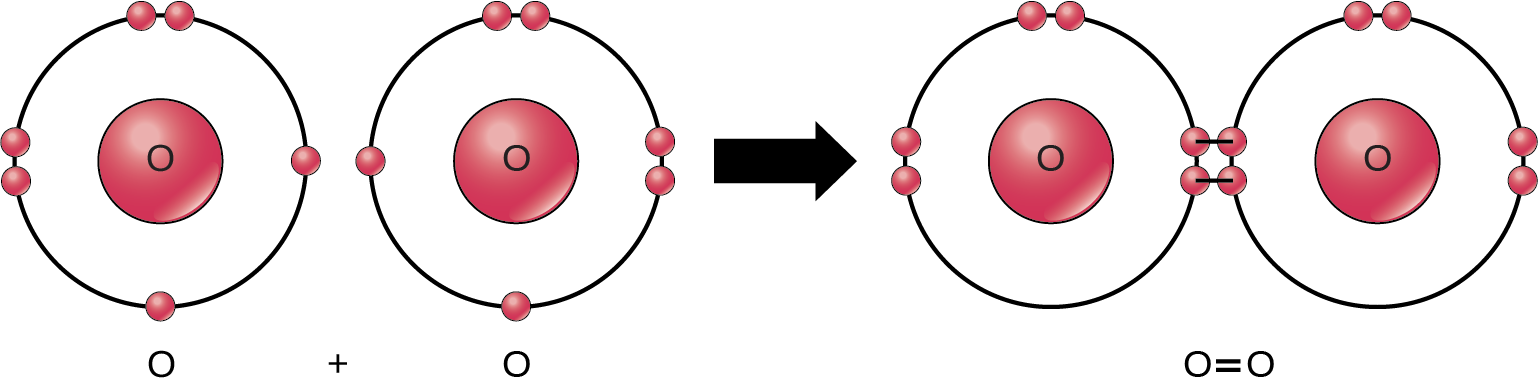


Figure 2.10図 2.10
A double bond joins the oxygen atoms in an O2 molecule.
O2分子では、酸素原子が二重結合でつながっている。
Some chemical reactions, such as the one above, can proceed in one direction until they expend all the reactants. The equations that describe these reactions contain a unidirectional arrow and are irreversible. Reversible reactions are those that can go in either direction. In reversible reactions, reactants turn into products, but when the product's concentration goes beyond a certain threshold (characteristic of the particular reaction), some of these products convert back into reactants. At this point, product and reactant designations reverse. This back and forth continues until a certain relative balance between reactants and products occurs—a state called equilibrium. A chemical equation with a double headed arrow pointing towards both the reactants and products often denote these reversible reaction situations.
英語のヒント
上の反応のように、反応物をすべて使い切るまで一方向に進む化学反応がある。これらを表す反応式には一方向の矢印が入り、反応は不可逆である。可逆反応とは、どちらの方向にも進める反応である。可逆反応では反応物が生成物になるが、生成物の濃度が一定のしきい値(その反応に固有の値)を超えると、生成物の一部が反応物に戻る。この時点では、生成物と反応物という呼び方が逆になる。この往復は、反応物と生成物が一定の相対的な釣り合いに達するまで続く。この状態を平衡という。こうした可逆反応は、反応物側と生成物側の両方を指す両向き矢印を使った化学反応式で表すことが多い。
For example, in human blood, excess hydrogen ions (H+) bind to bicarbonate ions (HCO3-) forming an equilibrium state with carbonic acid (H2CO3). If we added carbonic acid to this system, some of it would convert to bicarbonate and hydrogen ions.
英語のヒント
例えばヒトの血液では、過剰な水素イオン(H+)が炭酸水素イオン(HCO3-)と結合し、炭酸(H2CO3)との平衡状態を形成する。この系に炭酸を加えると、その一部は炭酸水素イオンと水素イオンに変わる。
However, biological reactions rarely obtain equilibrium because the concentrations of the reactants or products or both are constantly changing, often with one reaction's product a reactant for another. To return to the example of excess hydrogen ions in the blood, forming carbonic acid will be the reaction's major direction. However, the carbonic acid can also leave the body as carbon dioxide gas (via exhalation) instead of converting back to bicarbonate ion, thus driving the reaction to the right by the law of mass action. These reactions are important for maintaining homeostasis in our blood.
英語のヒント
しかし、生物の反応が平衡に達することはまれである。反応物や生成物、または両方の濃度が絶えず変化しており、ある反応の生成物が別の反応の反応物となる場合も多いからである。血液中の過剰な水素イオンの例に戻ると、反応は主に炭酸を形成する方向に進む。ただし、炭酸は炭酸水素イオンに戻る代わりに、二酸化炭素として呼気とともに体外へ出ることもある。その結果、質量作用の法則により、反応が右向きに進められる。これらの反応は、血液の恒常性を維持するために重要である。