第2章生命の化学的基盤
2.1 Atoms, Isotopes, Ions, and Molecules: The Building Blocks2.1 原子・同位体・イオン・分子:基本的な構成要素
Learning Objectives学習目標
By the end of this section, you will be able to do the following:
この節を学び終えると、次のことができるようになる。
- Define matter and elements物質と元素を定義する。
- Describe the interrelationship between protons, neutrons, and electrons陽子、中性子、電子の相互関係を説明する。
- Compare the ways in which electrons can be donated or shared between atoms原子間で電子を与える場合と共有する場合を比較する。
- Explain the ways in which naturally occurring elements combine to create molecules, cells, tissues, organ systems, and organisms自然界に存在する元素がどのように組み合わさり、分子、細胞、組織、器官系、生物を作るか説明する。
At its most fundamental level, life is made up of matter. Matter is any substance that occupies space and has mass. Elements are unique forms of matter with specific chemical and physical properties that cannot break down into smaller substances by ordinary chemical reactions. There are 118 elements, but only 98 occur naturally. The remaining elements are unstable and require scientists to synthesize them in laboratories.
英語のヒント
最も基本的な水準では、生命は物質からできている。物質とは、空間を占め、質量をもつものである。元素は、特有の化学的・物理的性質をもつ物質の固有の形態であり、通常の化学反応では、より小さな物質に分解できない。元素は118種類あるが、自然に存在するのは98種類だけである。残りの元素は不安定であり、科学者が実験室で合成する必要がある。
Each element is designated by its chemical symbol, which is a single capital letter or, when the first letter is already “taken” by another element, a combination of two letters. Some elements follow the English term for the element, such as C for carbon and Ca for calcium. Other elements’ chemical symbols derive from their Latin names. For example, the symbol for sodium is Na, referring to natrium, the Latin word for sodium.
英語のヒント
各元素は元素記号で表す。元素記号は大文字一文字、または、その最初の文字がすでに別の元素に「使われている」場合には二文字の組み合わせである。炭素のC、カルシウムのCaのように、英語の元素名に従うものもある。ほかの元素の記号はラテン語名に由来する。例えば、ナトリウムの記号Naは、ラテン語でナトリウムを意味するnatriumに由来する。
The four elements common to all living organisms are oxygen (O), carbon (C), hydrogen (H), and nitrogen (N). In the nonliving world, elements are found in different proportions, and some elements common to living organisms are relatively rare on the earth as a whole, as Table 2.1 shows. For example, the atmosphere is rich in nitrogen and oxygen but contains little carbon and hydrogen, while the earth’s crust, although it contains oxygen and a small amount of hydrogen, has little nitrogen and carbon. In spite of their differences in abundance, all elements and the chemical reactions between them obey the same chemical and physical laws regardless of whether they are a part of the living or nonliving world.
英語のヒント
すべての生物に共通する四つの元素は、酸素(O)、炭素(C)、水素(H)、窒素(N)である。非生物の世界では、元素は異なる割合で存在する。表2.1に示すように、生物では一般的な元素の中にも、地球全体では比較的少ないものがある。例えば、大気には窒素と酸素が豊富だが、炭素と水素はほとんど含まれない。一方、地殻には酸素と少量の水素が含まれるが、窒素と炭素はほとんどない。存在量にはこうした違いがあるものの、生物を構成しているか非生物を構成しているかにかかわらず、すべての元素とその間の化学反応は、同じ化学法則と物理法則に従う。
Approximate Percentage of Elements in Living Organisms (Humans) Compared to the Nonliving World 生物(人)と非生物の世界における元素の割合の概数 |
|||
|---|---|---|---|
Element 元素 |
Life (Humans) 生命(人) |
Atmosphere 大気 |
Earth’s Crust 地殻 |
Oxygen (O) 酸素(O) |
65% |
21% |
46% |
Carbon (C) 炭素(C) |
18% |
trace 微量 |
trace 微量 |
Hydrogen (H) 水素(H) |
10% |
trace 微量 |
0.1% |
Nitrogen (N) 窒素(N) |
3% |
78% |
trace 微量 |
The Structure of the Atom原子の構造
To understand how elements come together, we must first discuss the element's smallest component or building block, the atom. An atom is the smallest unit of matter that retains all of the element's chemical properties. For example, one gold atom has all of the properties of gold, like its chemical reactivity. A gold coin is simply a very large number of gold atoms molded into the shape of a coin and contains small amounts of other elements known as impurities. We cannot break down gold atoms into anything smaller while still retaining the properties of gold.
英語のヒント
元素がどう組み合わさるかを理解するには、まず元素の最小の構成要素である原子を取り上げる必要がある。原子は、その元素の化学的性質をすべて保つ、物質の最小単位である。例えば、一個の金原子は、化学反応性をはじめ、金の性質をすべてもっている。金貨は、非常に多くの金原子を硬貨の形に成形したものであり、不純物と呼ばれる少量のほかの元素も含む。金の性質を保ったまま、金原子をそれより小さなものに分解することはできない。
An atom is composed of two regions: the nucleus, which is in the atom's center and contains protons and neutrons. The atom's outermost region holds its electrons in orbit around the nucleus, as Figure 2.2 illustrates. Atoms contain protons, electrons, and neutrons, among other subatomic particles. The most common isotope of hydrogen (H) is the only exception and is made of one proton and one electron with no neutrons.
英語のヒント
原子は二つの領域からなる。原子核は原子の中心にあり、陽子と中性子を含む。図2.2が示すように、原子の最も外側の領域では、電子が原子核の周りを回っている。原子には、陽子、電子、中性子をはじめとする亜原子粒子が含まれる。最も一般的な水素(H)の同位体だけが例外であり、中性子をもたず、一個の陽子と一個の電子からできている。
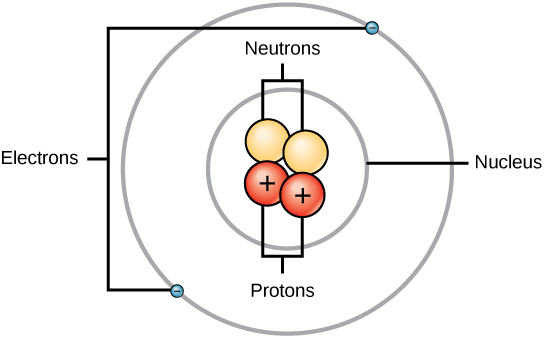

Figure 2.2図 2.2
Elements, such as helium, depicted here, are made up of atoms. Atoms are made up of protons and neutrons located within the nucleus, with electrons in orbitals surrounding the nucleus.
英語のヒント
ここに示すヘリウムなどの元素は、原子からできている。原子は、原子核の中にある陽子と中性子、および原子核を囲む軌道にある電子からできている。
Protons and neutrons have approximately the same mass, about 1.67 × 10⁻²⁴ grams. Scientists arbitrarily define this amount of mass as one atomic mass unit (amu) or one Dalton, as Table 2.2 shows. Although similar in mass, protons and neutrons differ in their electric charge. A proton is positively charged; whereas, a neutron is uncharged. Therefore, the number of neutrons in an atom contributes significantly to its mass, but not to its charge. Electrons are much smaller in mass than protons, weighing only 9.11 × 10⁻²⁸ grams, or about 1/1800 of an atomic mass unit. Hence, they do not contribute much to an element’s overall atomic mass. Therefore, when considering atomic mass, it is customary to ignore the mass of any electrons and calculate the atom’s mass based on the number of protons and neutrons alone. Although not significant contributors to mass, electrons do contribute greatly to the atom’s charge, as each electron has a negative charge equal to the proton's positive charge. In uncharged, neutral atoms, the number of electrons orbiting the nucleus is equal to the number of protons inside the nucleus. In these atoms, the positive and negative charges cancel each other out, leading to an atom with no net charge.
英語のヒント
陽子と中性子の質量はほぼ等しく、約1.67 × 10⁻²⁴グラムである。表2.2に示すように、科学者は便宜上、この質量を1原子質量単位(amu)、または1ダルトンと定義している。質量は似ているが、陽子と中性子は電荷が異なる。陽子は正の電荷をもつのに対し、中性子は電荷をもたない。そのため、原子内の中性子の数は質量には大きく寄与するが、電荷には寄与しない。電子の質量は陽子よりはるかに小さく、わずか9.11 × 10⁻²⁸グラム、すなわち約1800分の1原子質量単位である。したがって、元素の原子全体の質量にはあまり寄与しない。原子の質量を考えるときは、電子の質量を無視し、陽子と中性子の数だけに基づいて計算するのが普通である。電子は質量への寄与は小さいが、一個ずつが陽子の正電荷と大きさの等しい負電荷をもつため、原子の電荷には大きく寄与する。電荷をもたない中性の原子では、原子核の周りにある電子の数と、原子核内の陽子の数が等しい。こうした原子では正電荷と負電荷が互いに打ち消し合い、正味の電荷はなくなる。
Accounting for the sizes of protons, neutrons, and electrons, most of the atom's volume—greater than 99 percent—is empty space. With all this empty space, one might ask why so-called solid objects do not just pass through one another. The reason they do not is that the electrons that surround all atoms are negatively charged and negative charges repel each other.
英語のヒント
陽子、中性子、電子の大きさを考慮すると、原子の体積の大部分、99%以上は何もない空間である。これほど隙間があるなら、いわゆる固体の物体が、なぜ互いをそのまま通り抜けないのかと疑問に思うかもしれない。通り抜けないのは、すべての原子を取り囲む電子が負に帯電し、負電荷同士が反発し合うからである。
Protons, Neutrons, and Electrons 陽子・中性子・電子 |
|||
|---|---|---|---|
Charge 電荷 |
Mass (amu) 質量(amu) |
Location 位置 |
|
Proton 陽子 |
+1 |
1 |
nucleus 原子核 |
Neutron 中性子 |
0 |
1 |
nucleus 原子核 |
Electron 電子 |
–1 |
0 |
orbitals 軌道 |