第2章生命の化学的基盤
Water’s High Heat Capacity水の高い熱容量
Water’s high heat capacity is a property that hydrogen bonding among water molecules causes. Water has the highest specific heat capacity of any common liquid. We define specific heat as the amount of heat one gram of a substance must absorb or lose to change its temperature by one degree Celsius. For water, this amount is one calorie. It therefore takes water a long time to heat and a long time to cool. In fact, water's specific heat capacity is about five times more than that of sand. This explains why the land cools faster than the sea. Due to its high heat capacity, warm blooded animals use water to more evenly disperse heat in their bodies: it acts in a similar manner to a car’s cooling system, transporting heat from warm places to cool places, causing the body to maintain a more even temperature.
英語のヒント
水の高い熱容量は、水分子間の水素結合による性質である。水は、一般的な液体の中で最も高い比熱容量を持つ。比熱とは、物質1グラムの温度を摂氏1度変えるために、その物質が吸収または放出しなければならない熱量である。水の場合、この量は1カロリーである。そのため、水は温まるのにも冷めるのにも長い時間がかかる。実際、水の比熱容量は砂のおよそ5倍であり、このことは陸地が海よりも速く冷える理由を説明する。温血動物は、水の高い熱容量を利用して、体内の熱をより均等に分散させる。水は車の冷却装置と同じように、温かい場所から冷たい場所へ熱を運び、体の温度をより均一に保つ。
Water’s Heat of Vaporization水の気化熱
Water also has a high heat of vaporization, the amount of energy required to change one gram of a liquid substance to a gas. A considerable amount of heat energy (586 cal) is required to accomplish this change in water. This process occurs on the water's surface. As liquid water heats up, hydrogen bonding makes it difficult to separate the liquid water molecules from each other, which is required for it to enter its gaseous phase (steam). As a result, water acts as a heat sink or heat reservoir and requires much more heat to boil than does a liquid such as ethanol (grain alcohol), whose hydrogen bonding with other ethanol molecules is weaker than water’s hydrogen bonding. Eventually, as water reaches its boiling point of 100° Celsius (212° Fahrenheit), the heat is able to break the hydrogen bonds between the water molecules, and the kinetic energy (motion) between the water molecules allows them to escape from the liquid as a gas. Even when below its boiling point, water’s individual molecules acquire enough energy from other water molecules such that some surface water molecules can escape and vaporize: we call this process evaporation.
英語のヒント
水は気化熱も大きい。気化熱とは、液体の物質1グラムを気体に変えるために必要なエネルギー量である。水でこの変化を起こすには、かなりの量の熱エネルギー(586 cal)が必要となる。この過程は水面で起こる。液体の水が温まっても、水素結合があるため、水分子同士を引き離すのは難しい。水が気相(水蒸気)になるには、この引き離しが必要である。そのため、水は熱の吸収源または熱の貯蔵庫として働き、エタノール(穀物アルコール)のような液体よりも、沸騰に多くの熱を必要とする。エタノール分子同士の水素結合は、水分子同士の水素結合より弱いのである。やがて水が沸点の摂氏100度(華氏212度)に達すると、熱によって水分子間の水素結合が切れ、水分子の運動エネルギー(運動)によって、分子が液体から気体として出ていけるようになる。沸点より低い温度でも、個々の水分子がほかの水分子から十分なエネルギーを受け取ると、水面の一部の分子は外へ出て気化できる。この過程を蒸発という。
The fact that hydrogen bonds need to be broken for water to evaporate means that bonds use a substantial amount of energy in the process. As the water evaporates, energy is taken up by the process, cooling the environment where the evaporation is taking place. In many living organisms, including in humans, the evaporation of sweat, which is 90 percent water, allows the organism to cool so that it can maintain homeostasis of body temperature.
英語のヒント
水が蒸発するには水素結合を切る必要があるということは、その過程で結合がかなりの量のエネルギーを使うことを意味する。水が蒸発するときにはエネルギーが吸収され、蒸発が起こっている場所の周囲が冷える。ヒトを含む多くの生物では、90%が水である汗が蒸発することで体を冷やし、体温の恒常性を維持できる。
Water’s Solvent Properties水の溶媒としての性質
Since water is a polar molecule with slightly positive and slightly negative charges, ions and polar molecules can readily dissolve in it. Therefore, we refer to water as a solvent, a substance capable of dissolving other polar molecules and ionic compounds. The charges associated with these molecules will form hydrogen bonds with water, surrounding the particle with water molecules. We refer to this as a sphere of hydration, or a hydration shell, as Figure 2.15 illustrates and serves to keep the particles separated or dispersed in the water.
英語のヒント
水は、わずかな正電荷と負電荷を持つ極性分子であるため、イオンや極性分子は容易に水に溶ける。そのため、水は溶媒、すなわちほかの極性分子やイオン化合物を溶かすことのできる物質と呼ばれる。これらの分子に伴う電荷は水と水素結合を作り、粒子は水分子に囲まれる。図2.15に示すように、これを水和圏、または水和殻という。これによって粒子は水中で離れた状態、すなわち分散した状態に保たれる。
When we add ionic compounds to water, the individual ions react with the water molecules' polar regions and their ionic bonds are disrupted in the process of dissociation. Dissociation occurs when atoms or groups of atoms break off from molecules and form ions. Consider table salt (NaCl, or sodium chloride): when we add NaCl crystals to water, the NaCl molecules dissociate into Na+ and Cl– ions, and spheres of hydration form around the ions, as Figure 2.15 illustrates. The partially negative charge of the water molecule’s oxygen surrounds the positively charged sodium ion. The hydrogen's partially positive charge on the water molecule surrounds the negatively charged chloride ion.
英語のヒント
イオン化合物を水に加えると、個々のイオンが水分子の極性を持つ領域と反応し、解離の過程でイオン結合が切れる。解離とは、原子や原子団が分子から離れてイオンになることである。食塩(NaCl、塩化ナトリウム)を考えよう。NaClの結晶を水に加えると、NaClの分子はNa+イオンとCl–イオンに解離し、図2.15に示すように、イオンの周囲に水和圏が形成される。水分子の酸素が持つ部分的な負電荷は、正に帯電したナトリウムイオンを取り囲む。水分子の水素が持つ部分的な正電荷は、負に帯電した塩化物イオンを取り囲む。
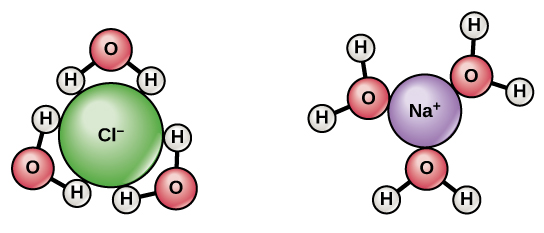
Figure 2.15図 2.15
When we mix table salt (NaCl) in water, it forms spheres of hydration around the ions.
食塩(NaCl)を水に混ぜると、イオンの周囲に水和圏が形成される。
Water’s Cohesive and Adhesive Properties水の凝集性と付着性
Have you ever filled a glass of water to the very top and then slowly added a few more drops? Before it overflows, the water forms a dome-like shape above the rim of the glass. This water can stay above the glass because of the property of cohesion. In cohesion, water molecules are attracted to each other (because of hydrogen bonding), keeping the molecules together at the liquid-gas (water-air) interface, although there is no more room in the glass.
英語のヒント
コップの縁いっぱいまで水を入れ、さらに数滴をゆっくり足したことはあるだろうか。あふれ出す前に、水はコップの縁より上に、ドームのような盛り上がりを作る。水がコップより上にとどまれるのは、凝集という性質のためである。凝集では、水分子同士が水素結合によって引き合う。そのため、コップにそれ以上の余地がなくても、液体と気体、つまり水と空気の境界面で、分子がまとまっていられる。
Cohesion allows for surface tension, the capacity of a substance to withstand rupturing when placed under tension or stress. This is also why water forms droplets when on a dry surface rather than flattening by gravity. When we place a small scrap of paper onto a water droplet, the paper floats on top even though paper is denser (heavier) than the water. Cohesion and surface tension keep the water molecules' hydrogen bonds intact and support the item floating on the top. It’s even possible to “float” a needle on top of a glass of water if you place it gently without breaking the surface tension, as Figure 2.16 shows.
英語のヒント
凝集によって表面張力が生じる。表面張力とは、物質が張力や応力を受けたときに、表面の破れに抵抗する能力である。乾いた面の上で、水が重力によって平たく広がるのではなく水滴になるのも、このためである。小さな紙片を水滴の上に置くと、紙の方が水より密度が高い(重い)にもかかわらず、紙は上に浮く。凝集と表面張力が水分子の水素結合を保ち、水面に浮く物体を支えている。図2.16に示すように、表面張力を壊さないようにそっと置けば、コップの水面に針さえ「浮かべる」ことができる。
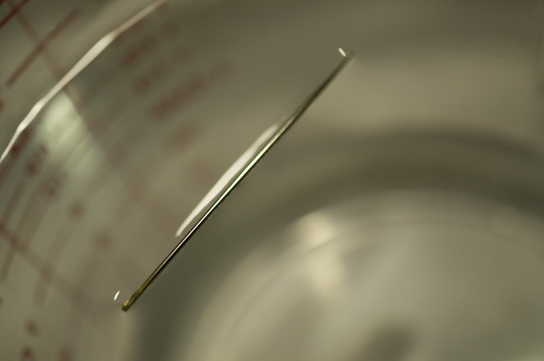
Figure 2.16図 2.16
A needle's weight pulls the surface downward. At the same time, the surface tension pulls it up, suspending it on the water's surface preventing it from sinking. Notice the indentation in the water around the needle. (credit: Cory Zanker)
針の重さが水面を下へ引く。それと同時に表面張力が針を上へ引き、水面に支えて沈むのを防ぐ。針の周囲で水面がへこんでいることに注目しよう。(出典:Cory Zanker)
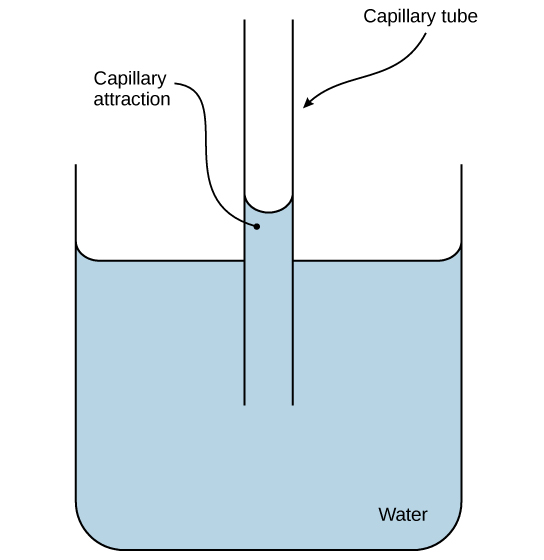
These cohesive forces are related to water’s property of adhesion, or the attraction between water molecules and other molecules. This attraction is sometimes stronger than water’s cohesive forces, especially when the water is exposed to charged surfaces such as those on the inside of thin glass tubes known as capillary tubes. We observe adhesion when water “climbs” up the tube placed in a glass of water: notice that the water appears to be higher on the tube's sides than in the middle. This is because the water molecules are attracted to the capillary's charged glass walls more than they are to each other and therefore adhere to it. We call this type of adhesion capillary action, as Figure 2.17 illustrates.
英語のヒント
これらの凝集力は、水の付着という性質、すなわち水分子とほかの分子の間に働く引力と関係している。この引力は、水分子同士の凝集力より強いことがある。特に、毛細管と呼ばれる細いガラス管の内面のような、帯電した表面に水が触れる場合にそうなる。水を入れたコップに管を立てると、水が管を「登る」様子として付着を観察できる。管の中央よりも、壁面近くの方が水面が高くなっていることに注目しよう。これは、水分子同士が引き合う力よりも、毛細管の帯電したガラス壁へ水分子が引かれる力の方が強く、水が壁に付着するためである。図2.17に示すこの種の付着を、毛細管現象という。
OpenStax, Rice University; Biology 2e. (credit: modification of work by Pearson-Scott Foresman, donated to the Wikimedia Foundation) · CC BY 4.0 · Source出典
Figure 2.17図 2.17
The adhesive forces exerted by the glass' internal surface exceeding the cohesive forces between the water molecules themselves causes capillary action in a glass tube. (credit: modification of work by Pearson-Scott Foresman, donated to the Wikimedia Foundation)
ガラスの内面から働く付着力が、水分子同士の凝集力を上回ることによって、ガラス管内で毛細管現象が起こる。(出典:Pearson-Scott Foresmanの作品を改変。原作品はウィキメディア財団に寄贈)
Why are cohesive and adhesive forces important for life? Cohesive and adhesive forces are important for transporting water from the roots to the leaves in plants. These forces create a “pull” on the water column. This pull results from the tendency of water molecules evaporating on the plant's surface to stay connected to water molecules below them, and so they are pulled along. Plants use this natural phenomenon to help transport water from their roots to their leaves. Without these properties of water, plants would be unable to receive the water and the dissolved minerals they require. In another example, insects such as the water strider, as Figure 2.18 shows, use the water's surface tension to stay afloat on the water's surface layer and even mate there.
英語のヒント
凝集力と付着力は、生命にとってなぜ重要なのだろう。これらの力は、植物の根から葉へ水を運ぶうえで重要である。水の柱に「引く力」を生むからである。植物の表面で蒸発する水分子が、その下の水分子とつながったままでいようとするため、この力が生じ、下の水分子も一緒に引かれる。植物はこの自然現象を利用して、根から葉へ水を運んでいる。水にこうした性質がなければ、植物は必要な水や、水に溶けた無機塩類を受け取れない。別の例では、図2.18のアメンボのような昆虫が水の表面張力を利用して水面に浮かび、そこで交尾することさえある。
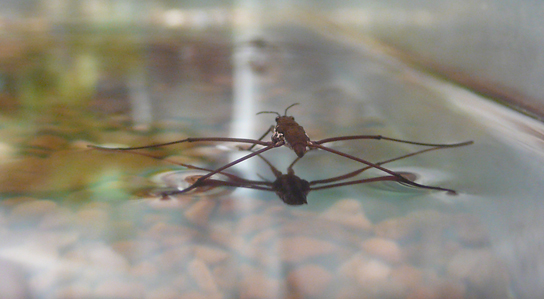


Figure 2.18図 2.18
Water’s cohesive and adhesive properties allow this water strider (Gerris sp.) to stay afloat. (credit: Tim Vickers)
水の凝集性と付着性によって、このアメンボ(Gerris属の一種)は水面に浮かんでいられる。(出典:Tim Vickers)