第2章生命の化学的基盤
pH, Buffers, Acids, and BasespH・緩衝剤・酸・塩基
The pH of a solution indicates its acidity or basicity.
溶液のpHは、その酸性度または塩基性度を示す。
You may have used litmus or pH paper, filter paper treated with a natural water-soluble dye for use as a pH indicator. It tests how much acid (acidity) or base (basicity) exists in a solution. You might have even used some to test whether the water in a swimming pool is properly treated. In both cases, the pH test measures hydrogen ions' concentration in a given solution.
英語のヒント
リトマス紙やpH試験紙を使ったことがあるかもしれない。これらは、pHの指示薬として使うために、天然の水溶性色素で処理したろ紙である。溶液に酸がどれほどあるか(酸性度)、または塩基がどれほどあるか(塩基性度)を調べる。プールの水が適切に処理されているか確認するために使った人もいるだろう。どちらの場合も、pH試験は対象の溶液中の水素イオン濃度を測定する。
Hydrogen ions spontaneously generate in pure water by the dissociation (ionization) of a small percentage of water molecules into equal numbers of hydrogen (H+) ions and hydroxide (OH-) ions. While the hydroxide ions are kept in solution by their hydrogen bonding with other water molecules, the hydrogen ions, consisting of naked protons, immediately attract to un-ionized water molecules, forming hydronium ions (H3O+). Still, by convention, scientists refer to hydrogen ions and their concentration as if they were free in this state in liquid water.
英語のヒント
純水では、水分子のごく一部が解離(電離)して、同数の水素イオン(H+)と水酸化物イオン(OH-)になることで、水素イオンが自然に生じる。水酸化物イオンは、ほかの水分子との水素結合によって溶液中に保たれる。一方、水素イオンは裸の陽子からなり、すぐに電離していない水分子へ引き付けられて、ヒドロニウムイオン(H3O+)を形成する。それでも慣例として、水素イオンとその濃度について述べるときは、液体の水の中に、この状態のまま遊離して存在するかのように扱う。
The concentration of hydrogen ions dissociating from pure water is 1 × 10⁻⁷ moles H+ ions per liter of water. Moles (mol) are a way to express the amount of a substance (which can be atoms, molecules, ions, etc.). One mole represents the atomic weight of a substance, expressed in grams, which equals the amount of the substance containing as many units as there are atoms in 12 grams of 12C. Mathematically, one mole is equal to 6.02 × 10²³ particles of the substance. Therefore, 1 mole of water is equal to 6.02 × 10²³ water molecules. We calculate the pH as the negative of the base 10 logarithm of this concentration. The log10 of 1 × 10⁻⁷ is -7.0, and the negative of this number (indicated by the “p” of “pH”) yields a pH of 7.0, which is also a neutral pH. The pH inside of human cells and blood are examples of two body areas where near-neutral pH is maintained.
英語のヒント
純水から解離する水素イオンの濃度は、水1リットル当たり1 × 10⁻⁷モルのH+イオンである。モル(mol)は、物質(原子、分子、イオンなど)の量を表す方法である。1モルは物質の原子量をグラムで表した量に相当し、12グラムの12Cに含まれる原子数と同じ数の単位を含む物質量に等しい。数値で表すと、1モルはその物質の粒子6.02 × 10²³個に等しい。したがって、水1モルは水分子6.02 × 10²³個に等しい。pHは、この濃度の常用対数、つまり底が10の対数の符号を反転して求める。1 × 10⁻⁷の常用対数は−7.0であり、この数の符号を反転すると(pHの「p」がこれを示す)、pHは7.0となる。これは中性のpHでもある。ヒトの細胞内と血液は、体内で中性に近いpHが維持されている場所の例である。
Non-neutral pH readings result from dissolving acids or bases in water. Using the negative logarithm to generate positive integers, high concentrations of hydrogen ions yield a low pH number; whereas, low levels of hydrogen ions result in a high pH. An acid is a substance that increases hydrogen ions' (H+) concentration in a solution, usually by having one of its hydrogen atoms dissociate. A base provides either hydroxide ions (OH–) or other negatively charged ions that combine with hydrogen ions, reducing their concentration in the solution and thereby raising the pH. In cases where the base releases hydroxide ions, these ions bind to free hydrogen ions, generating new water molecules.
英語のヒント
酸や塩基を水に溶かすと、pHは中性からずれる。対数の符号を反転して正の整数を得るので、水素イオン濃度が高いとpHの数値は低くなり、水素イオン濃度が低いとpHは高くなる。酸とは、通常は自身の水素原子の一つを解離させることで、溶液中の水素イオン(H+)濃度を高める物質である。塩基は、水酸化物イオン(OH–)、または水素イオンと結合する別の負イオンを供給し、溶液中の水素イオン濃度を下げ、それによってpHを高める。塩基が水酸化物イオンを放出する場合、このイオンは遊離した水素イオンと結合して、新しい水分子を作る。
The stronger the acid, the more readily it donates H+. For example, hydrochloric acid (HCl) completely dissociates into hydrogen and chloride ions and is highly acidic; whereas the acids in tomato juice or vinegar do not completely dissociate and are weak acids. Conversely, strong bases are those substances that readily donate OH– or take up hydrogen ions. Sodium hydroxide (NaOH) and many household cleaners are highly alkaline and give up OH– rapidly when we place them in water, thereby raising the pH. An example of a weak basic solution is seawater, which has a pH near 8.0 This is close enough to a neutral pH that marine organisms have adapted in order to live and thrive in a saline environment.
英語のヒント
酸が強いほど、H+を容易に放出する。例えば塩酸(HCl)は、水素イオンと塩化物イオンに完全に解離し、強い酸性を示す。一方、トマトジュースや酢に含まれる酸は完全には解離せず、弱酸である。逆に、強塩基はOH– を容易に放出するか、水素イオンを取り込む物質である。水酸化ナトリウム(NaOH)や多くの家庭用洗剤は強いアルカリ性を示し、水に入れると速やかにOH–を放出してpHを高める。弱い塩基性を示す溶液の例に海水があり、そのpHは8.0に近い。この値は中性に十分近いため、海洋生物は塩分を含む環境で生存し繁栄できるように適応してきた。
The pH scale is, as we previously mentioned, an inverse logarithm and ranges from 0 to 14 (Figure 2.19). Anything below 7.0 (ranging from 0.0 to 6.9) is acidic, and anything above 7.0 (from 7.1 to 14.0) is alkaline. Extremes in pH in either direction from 7.0 are usually inhospitable to life. The pH inside cells (6.8) and the pH in the blood (7.4) are both very close to neutral. However, the environment in the stomach is highly acidic, with a pH of 1 to 2. As a result, how do stomach cells survive in such an acidic environment? How do they homeostatically maintain the near neutral pH inside them? The answer is that they cannot do it and are constantly dying. The stomach constantly produces new cells to replace dead ones, which stomach acids digest. Scientists estimate that the human body completely replaces the stomach lining every seven to ten days.
英語のヒント
先に述べたように、pH尺度は対数の符号を反転したもので、0から14の範囲を取る(図2.19)。7.0より低い値(0.0〜6.9)は酸性、7.0より高い値(7.1〜14.0)はアルカリ性である。7.0からどちらの方向に大きく離れても、通常は生命に適さなくなる。細胞内のpH(6.8)と血液のpH(7.4)は、どちらも中性に非常に近い。しかし、胃の中はpHが1〜2という強い酸性である。それでは、胃の細胞はどうやってこのような酸性環境で生き延びるのだろう。細胞内のpHを中性近くに保つ恒常性を、どう維持するのだろう。答えは、それができず、絶えず死んでいるということである。胃は、死んで胃酸に消化された細胞を置き換えるために、新しい細胞を絶えず作っている。科学者の推定では、ヒトの胃の内壁は7〜10日ごとに完全に入れ替わる。
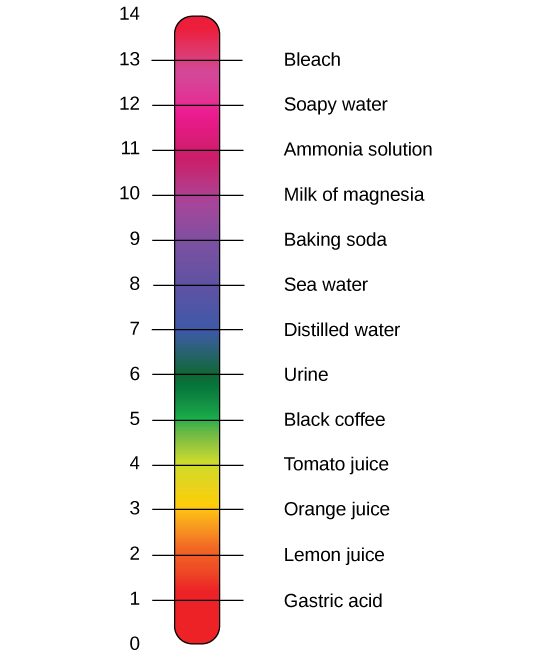
OpenStax, Rice University; Biology 2e. (credit: modification of work by Edward Stevens) · CC BY 4.0 · Source出典
Figure 2.19図 2.19
The pH scale measures hydrogen ions' (H+) concentration in a solution. (credit: modification of work by Edward Stevens)
pH尺度は、溶液中の水素イオン(H+)濃度を測るものである。(出典:Edward Stevensの作品を改変)
How can organisms whose bodies require a near-neutral pH ingest acidic and basic substances (a human drinking orange juice, for example) and survive? Buffers are the key. Buffers readily absorb excess H+ or OH–, keeping the body's pH carefully maintained in the narrow range required for survival. Maintaining a constant blood pH is critical to a person’s well-being. The buffer maintaining the pH of human blood involves carbonic acid (H2CO3), bicarbonate ion (HCO3–), and carbon dioxide (CO2). When bicarbonate ions combine with free hydrogen ions and become carbonic acid, it removes hydrogen ions and moderates pH changes. Similarly, as Figure 2.20 shows, excess carbonic acid can convert to carbon dioxide gas which we exhale through the lungs. This prevents too many free hydrogen ions from building up in the blood and dangerously reducing the blood’s pH. Likewise, if too much OH– enters into the system, carbonic acid will combine with it to create bicarbonate, lowering the pH. Without this buffer system, the body’s pH would fluctuate enough to put survival in jeopardy.
英語のヒント
体内で中性に近いpHを必要とする生物が、酸性や塩基性の物質を摂取しても生きていられるのはなぜだろう。ヒトがオレンジジュースを飲む場合などがその例である。鍵となるのは緩衝剤である。緩衝剤は過剰なH+やOH–を容易に吸収し、生存に必要な狭い範囲に体内のpHを厳密に保つ。血液のpHを一定に維持することは、人の健康に不可欠である。ヒトの血液のpHを保つ緩衝作用には、炭酸(H2CO3)、炭酸水素イオン(HCO3–)、二酸化炭素(CO2)が関わる。炭酸水素イオンが遊離した水素イオンと結合して炭酸になると、水素イオンが除かれてpHの変化が和らぐ。同様に、図2.20に示すように、過剰な炭酸は二酸化炭素になり、肺から呼気として排出される。これにより、遊離した水素イオンが血液中に過度に蓄積して、血液のpHが危険なほど低下するのを防ぐ。また、OH–が過剰に入ってきた場合には、炭酸がそれと結合して炭酸水素イオンを作り、pHを下げる。この緩衝系がなければ、体内のpHは生存を危うくするほど変動してしまう。



Figure 2.20図 2.20
This diagram shows the body’s buffering of blood pH levels. The blue arrows show the process of raising pH as more CO2 is made. The purple arrows indicate the reverse process: the lowering of pH as more bicarbonate is created.
この図は、体が血液のpHを緩衝する仕組みを示している。青い矢印は、CO2がより多く作られるにつれてpHが上がる過程を示す。紫の矢印は、その逆の過程、つまり炭酸水素イオンがより多く作られるにつれてpHが下がる過程を示す。
Other examples of buffers are antacids that some people use to combat excess stomach acid. Many of these over-the-counter medications work in the same way as blood buffers, usually with at least one ion capable of absorbing hydrogen and moderating pH, bringing relief to those who suffer “heartburn” after eating. Water's unique properties that contribute to this capacity to balance pH—as well as water’s other characteristics—are essential to sustaining life on Earth.
英語のヒント
緩衝剤の別の例は、過剰な胃酸を抑えるために使われる制酸薬である。こうした市販薬の多くは血液の緩衝剤と同じように働く。通常は、水素を吸収してpHを和らげる能力を持つイオンを少なくとも一種類含み、食後の「胸焼け」に苦しむ人の症状を軽くする。pHの釣り合いを保つこの能力に寄与する水の独特な性質は、水のほかの特徴とともに、地球上の生命の維持に不可欠である。